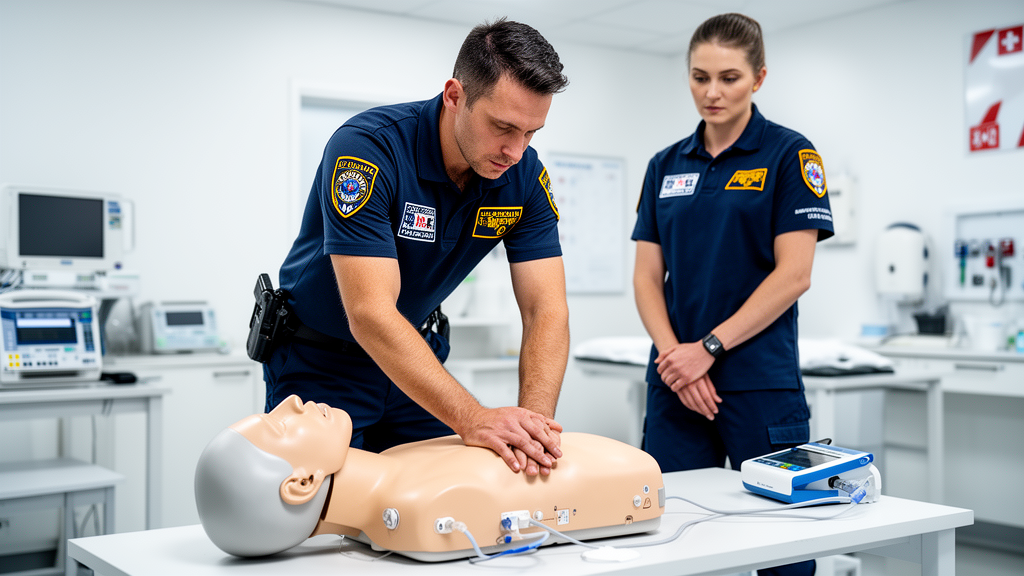
A structured cardiac arrest intervention protocol training program was associated with significant improvements in paramedic students’ cardiopulmonary resuscitation knowledge, psychomotor performance, self-perceived competence, and clinical practice attitudes, according to a single-group quasi-experimental study published in BMC Medical Education. The educational evaluation examined how dedicated protocol-based instruction influenced student capabilities across multiple assessment intervals, documenting measurable gains immediately following the coursework as well as at a two-month short-term follow-up.
The investigation was conducted with forty-four first-year paramedic students during the spring semester of the 2024–2025 academic year. Researchers designed the program specifically to develop and evaluate a standardized curriculum intended to support cardiopulmonary resuscitation knowledge, practical execution, personal competence perceptions, and professional outlooks. The underlying educational framework was aligned directly with resuscitation guidance applicable at the time of the intervention to ensure that instructional content reflected current clinical standards for emergency cardiac arrest management.
The instructional intervention comprised thirty-six total hours of structured education divided into distinct didactic and practical components. Students completed twenty-four hours of theoretical instruction alongside twelve hours of simulation-based practical training.
To assess participant development, data were collected at three separate chronological intervals: baseline prior to the intervention (T1), immediately after the training was completed (T2), and at a two-month short-term follow-up session (T3). The research team utilized researcher-developed, content-reviewed measures to evaluate basic life support and advanced life support knowledge, psychomotor skills, and self-perceived cardiopulmonary resuscitation competence. In addition, an established measurement scale was administered across these intervals to monitor changes in clinical practice attitudes.
Analytical testing utilizing Friedman tests and Bonferroni-adjusted Wilcoxon signed-rank tests revealed that student scores in both knowledge and psychomotor skills were significantly higher at both T2 and T3 compared to baseline T1 measurements, with all comparisons yielding statistical significance at p < 0.001. Self-perceived cardiopulmonary resuscitation competence also increased significantly following the program, whereas clinical practice attitudes registered modest improvements. Statistical evaluation of effect sizes using Kendall’s W indicated that advanced life support knowledge achieved the greatest magnitude of change, demonstrating an effect size of 0.823.
Exploratory multiple linear regression analyses carried out at the two-month follow-up assessment identified notable statistical relationships among the evaluated domains. Specifically, self-perceived cardiopulmonary resuscitation competence was positively associated with advanced life support skills and clinical practice attitudes at T3.
While the protocol training was associated with positive learning outcomes across multiple metrics, the authors highlighted critical design boundaries that constrain the findings. Because the investigation relied on a single-group quasi-experimental design without an independent control group and evaluated participants over a brief two-month window, the observed developments should be interpreted strictly as intervention-associated changes rather than definitive causal effects. The authors concluded that future controlled studies incorporating larger student cohorts and extended longitudinal observation periods will be necessary to clarify broader applicability and assess long-term skill retention.
Subject of Research: Paramedic cardiac arrest intervention protocol training and resuscitation competencies
Article Title: Cardiac arrest intervention protocol training and observed changes in knowledge, skills, self-perceived competence, and clinical practice attitudes of paramedic students: a single-group quasi-experimental study
Article References: Turan, D., Bulut, E., Güleryüz, A., & Gündüz, A. (2026). Cardiac arrest intervention protocol training and observed changes in knowledge, skills, self-perceived competence, and clinical practice attitudes of paramedic students: a single-group quasi-experimental study. BMC Medical Education. https://doi.org/10.1186/s12909-026-10862-y
Image Credits: AI Generated
DOI: 10.1186/s12909-026-10862-y
Keywords: cardiac arrest, resuscitation training, paramedic students, cardiopulmonary resuscitation, basic life support, advanced life support, simulation-based training, psychomotor skills, clinical practice attitudes, self-perceived competence, quasi-experimental study, medical education, retention assessment, Friedman test, Kendall's W, Wilcoxon signed-rank test, emergency care education
News Source: Courtney Benton. (November 19, 2026). Cardiac Arrest Protocol Training Associated with Paramedic Resuscitation Skill Gains. Scienmag.