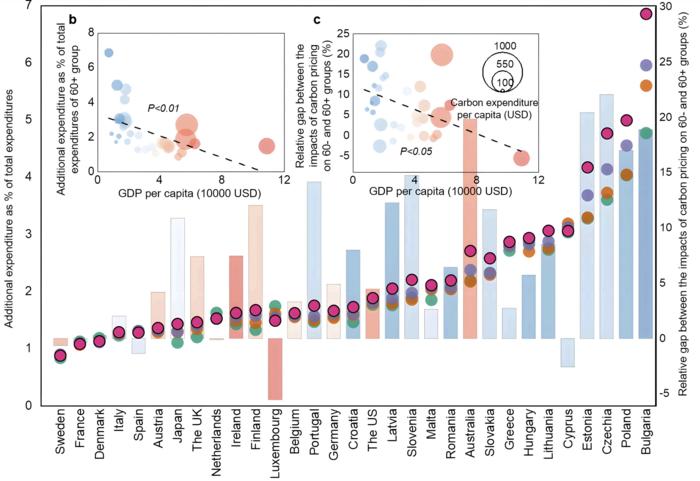
As the human population ages, carbon pricing policies may disproportionately harm low-income seniors, according to a study. Carbon pricing policies are designed to reduce carbon emissions by improving the competitiveness of renewable energy and other low carbon technologies as well as by collecting revenue to finance climate change mitigation efforts. Laixiang Sun and colleagues modeled the consequences of proposed carbon pricing policies on different age-income groups in the US, the UK and Japan—and on different age classes for 28 other countries, using a global multi-regional input-output model combined with household expenditure survey data. The authors find that because carbon pricing will increase the cost of heating and cooling, these policies would harm the low-income elderly and elderly in less wealthy countries more than other groups. There are two main drivers of the finding. Firstly, elderly people stay at home for more of the day, on average, and are more sensitive to temperature, and therefore require more heating and cooling and more stable heating and cooling than younger individuals. Secondly, the low-income elderly and the elderly in less wealthy countries are often on fixed incomes that cannot increase to compensate for a higher cost of living. The global population is aging, with over 1 billion people already over age 60, a demographic group projected to number 2.1 billion by 2050. According to the authors, a targeted social protection is called for to buffer the impacts on the elderly as the world works to mitigate climate change.
Credit: Tiana et al.
As the human population ages, carbon pricing policies may disproportionately harm low-income seniors, according to a study. Carbon pricing policies are designed to reduce carbon emissions by improving the competitiveness of renewable energy and other low carbon technologies as well as by collecting revenue to finance climate change mitigation efforts. Laixiang Sun and colleagues modeled the consequences of proposed carbon pricing policies on different age-income groups in the US, the UK and Japan—and on different age classes for 28 other countries, using a global multi-regional input-output model combined with household expenditure survey data. The authors find that because carbon pricing will increase the cost of heating and cooling, these policies would harm the low-income elderly and elderly in less wealthy countries more than other groups. There are two main drivers of the finding. Firstly, elderly people stay at home for more of the day, on average, and are more sensitive to temperature, and therefore require more heating and cooling and more stable heating and cooling than younger individuals. Secondly, the low-income elderly and the elderly in less wealthy countries are often on fixed incomes that cannot increase to compensate for a higher cost of living. The global population is aging, with over 1 billion people already over age 60, a demographic group projected to number 2.1 billion by 2050. According to the authors, a targeted social protection is called for to buffer the impacts on the elderly as the world works to mitigate climate change.
Journal
PNAS Nexus
DOI
10.1093/pnasnexus/pgad209
Article Title
Implementation of carbon pricing in an aging world calls for targeted protection schemes
Article Publication Date
18-Jul-2023