• HOME
  • NEWS
  • EXPLORE
    • CAREER
      • Companies
      • Jobs
    • EVENTS
    • iGEM
      • News
      • Team
    • PHOTOS
    • VIDEO
    • WIKI
  • BLOG
  • COMMUNITY
    • FACEBOOK
    • INSTAGRAM
    • TWITTER
Wednesday, April 8, 2026
BIOENGINEER.ORG
No Result
View All Result
  • Login
  • HOME
  • NEWS
  • EXPLORE
    • CAREER
      • Companies
      • Jobs
        • Lecturer
        • PhD Studentship
        • Postdoc
        • Research Assistant
    • EVENTS
    • iGEM
      • News
      • Team
    • PHOTOS
    • VIDEO
    • WIKI
  • BLOG
  • COMMUNITY
    • FACEBOOK
    • INSTAGRAM
    • TWITTER
  • HOME
  • NEWS
  • EXPLORE
    • CAREER
      • Companies
      • Jobs
        • Lecturer
        • PhD Studentship
        • Postdoc
        • Research Assistant
    • EVENTS
    • iGEM
      • News
      • Team
    • PHOTOS
    • VIDEO
    • WIKI
  • BLOG
  • COMMUNITY
    • FACEBOOK
    • INSTAGRAM
    • TWITTER
No Result
View All Result
Bioengineer.org
No Result
View All Result
Home NEWS Science News Chemistry

Capillary shrinkage triggers high-density porous structure

Bioengineer by Bioengineer
February 13, 2020
in Chemistry
Reading Time: 2 mins read
0
IMAGE
Share on FacebookShare on TwitterShare on LinkedinShare on RedditShare on Telegram

IMAGE

Credit: ©Science China Press


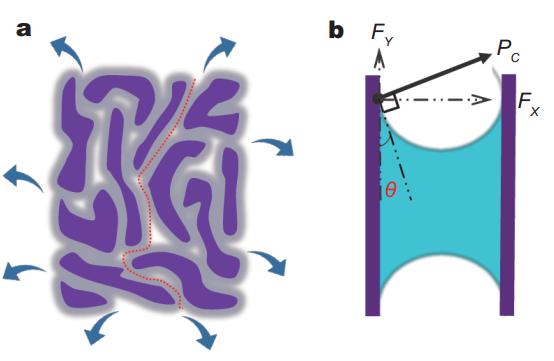
Materials with both a high density and a large surface area are required in many applications, typically for energy storage under a limited space. However, they are hard to obtain by using conventional strategies. In the previous study, Quan-Hong Yang et al. reported that graphene oxide (GO) can be used to produce a porous carbon material with a high density of 1.58 g cm-3 from hydrogel by evaporation-induced drying. However, the shrinkage of hydrogels is not yet clearly illustrated and there is still no full understanding of how the capillary forces work.

Recently, the same group from Tianjin University, China explored the capillary shrinkage of graphene oxide hydrogels in Science China Materials (DOI: 10.1007/s40843-019-1227-7) based on the different surface tension of the trapped solvent.

They chose water and 1,4-dioxane which have a sole difference in surface tension to investigate the mechanism of such a network shrinkage in r-GO hydrogel, and found the surface tension of the evaporating solvent and the associated capillary force regulated by the interfacial interaction between the r-GO sheets and the solvent determined the capillary forces in the nanochannels. Solvents with higher surface tensions generate stronger capillary forces during evaporation, which can compact the r-GO framework into a dense yet porous material. More promisingly, by using solvents with different surface tensions, the microstructure of the resulting materials can be precisely manipulated and densified, realizing an excellent balance of the density and porosity in materials not limited to carbon materials. This work provides a reliable methodology of controlled shrinkage of flexible graphene network and has great potential for high volumetric performance in practical devices.

###

See the article: Changsheng Qi, Chong Luo, Ying Tao, Wei Lv, Chen Zhang, Yaqian Deng, Huan Li, Junwei Han, Guowei Ling and Quan-Hong Yang, “Capillary shrinkage of graphene oxide hydrogels”, Science China Materials. doi: 10.1007/s40843-019-1227-7

http://engine.scichina.com/publisher/scp/journal/SCMs/doi/10.1007/s40843-019-1227-7?slug=fulltext

Media Contact
Quan-Hong Yang
[email protected]

Related Journal Article

http://dx.doi.org/10.1007/s40843-019-1227-7

Tags: Chemistry/Physics/Materials Sciences
Share12Tweet8Share2ShareShareShare2

Related Posts

UH Engineer Uncovers Structural Flaw Behind Lithium-Ion Battery Failures

UH Engineer Uncovers Structural Flaw Behind Lithium-Ion Battery Failures

April 8, 2026
Harnessing Light to Manipulate Nuclear Spins in Molecules Opens New Avenues for Quantum Technology

Harnessing Light to Manipulate Nuclear Spins in Molecules Opens New Avenues for Quantum Technology

April 8, 2026

Innovative Method for Creating Branched Molecules Promises to Speed Up Future Drug Development

April 8, 2026

Cr³⁺-Doped InP Quantum Dots Achieve Breakthrough in Pure Blue Emission and Room-Temperature Ferromagnetism

April 8, 2026
Please login to join discussion

POPULAR NEWS

  • blank

    Revolutionary AI Model Enhances Precision in Detecting Food Contamination

    98 shares
    Share 39 Tweet 25
  • Imagine a Social Media Feed That Challenges Your Views Instead of Reinforcing Them

    1011 shares
    Share 399 Tweet 250
  • Popular Anti-Aging Compound Linked to Damage in Corpus Callosum, Study Finds

    44 shares
    Share 18 Tweet 11
  • Promising Outcomes from First Clinical Trials of Gene Regulation in Epilepsy

    51 shares
    Share 20 Tweet 13

About

We bring you the latest biotechnology news from best research centers and universities around the world. Check our website.

Follow us

Recent News

Social Support, Sleep Quality, and Pain Management: Key Factors Influencing Mental Health in Older Adults

Study Finds Long-Term Opioid Prescriptions Decline, Yet Millions Continue Extended Therapy

UH Engineer Uncovers Structural Flaw Behind Lithium-Ion Battery Failures

Subscribe to Blog via Email

Enter your email address to subscribe to this blog and receive notifications of new posts by email.

Join 78 other subscribers
  • Contact Us

Bioengineer.org © Copyright 2023 All Rights Reserved.

Welcome Back!

Login to your account below

Forgotten Password?

Retrieve your password

Please enter your username or email address to reset your password.

Log In
No Result
View All Result
  • Homepages
    • Home Page 1
    • Home Page 2
  • News
  • National
  • Business
  • Health
  • Lifestyle
  • Science

Bioengineer.org © Copyright 2023 All Rights Reserved.