• HOME
  • NEWS
  • EXPLORE
    • CAREER
      • Companies
      • Jobs
    • EVENTS
    • iGEM
      • News
      • Team
    • PHOTOS
    • VIDEO
    • WIKI
  • BLOG
  • COMMUNITY
    • FACEBOOK
    • INSTAGRAM
    • TWITTER
Wednesday, November 11, 2026
BIOENGINEER.ORG
No Result
View All Result
  • Login
  • HOME
  • NEWS
  • EXPLORE
    • CAREER
      • Companies
      • Jobs
        • Lecturer
        • PhD Studentship
        • Postdoc
        • Research Assistant
    • EVENTS
    • iGEM
      • News
      • Team
    • PHOTOS
    • VIDEO
    • WIKI
  • BLOG
  • COMMUNITY
    • FACEBOOK
    • INSTAGRAM
    • TWITTER
No Result
View All Result
Bioengineer.org
No Result
View All Result
Home NEWS Science News Chemistry

Capacity-Loading Model Predicts Breakthrough Behavior in Fixed-Bed Adsorption Columns

by
November 11, 2026
in Chemistry
Reading Time: 2 mins read
0
Capacity-Loading Model Predicts Breakthrough Behavior in Fixed-Bed Adsorption Columns

Capacity-Loading Model Predicts Breakthrough Behavior in Fixed-Bed Adsorption Columns

Share on FacebookShare on TwitterShare on LinkedinShare on RedditShare on Telegram

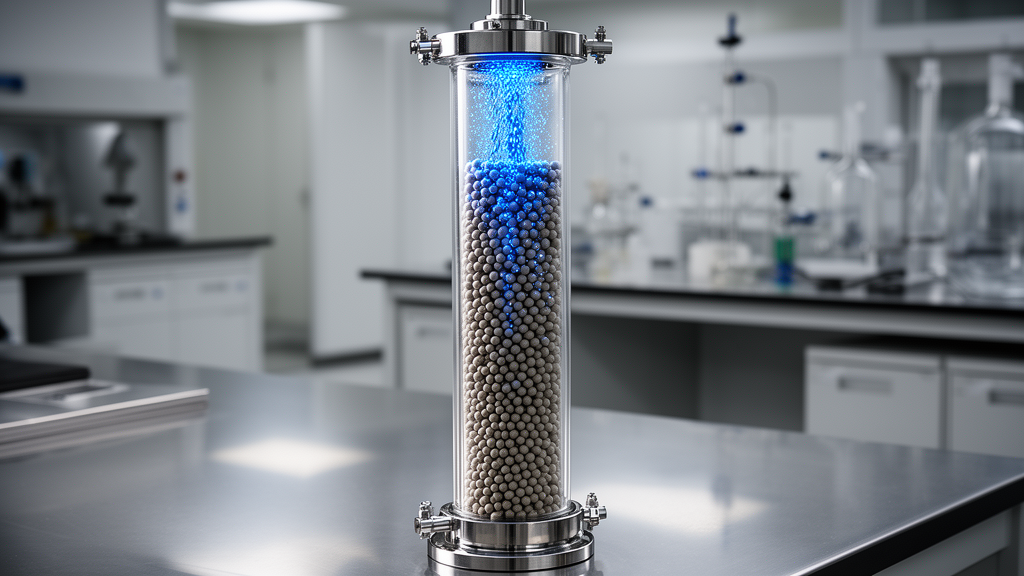
A computational modeling study published in the journal Environmental Surfaces and Interfaces introduces a new semi-mechanistic column breakthrough model for fixed-bed adsorption systems based on a capacity-loading framework. Developed by Clint Sutherland of the University of Trinidad and Tobago, the formulation tracks the progressive loading of adsorption capacity along the length of an adsorbent bed to predict breakthrough behavior from the internal consumption of capacity rather than through post-hoc curve fitting.

Fixed-bed adsorption columns are widely deployed across water purification, air treatment, and resource recovery operations to capture fluid-phase contaminants within packed beds of solid adsorbent material. A central engineering objective in these systems is accurately forecasting the breakthrough point, defined as the operational threshold when treated effluent first exceeds allowable contaminant concentrations, which establishes when an adsorbent bed requires regeneration or complete replacement.

Standard engineering workflows have historically depended on empirical equations fitted to observed breakthrough curves, an approach that can restrict physical insight and reduce predictive transferability across differing operating conditions. The newly proposed model addresses these constraints by linking measurable breakthrough dynamics directly to the physical progression of capacity exhaustion as fluid traverses the solid medium.

A sensitivity analysis of the semi-mechanistic capacity-loading model demonstrated how primary governing parameters alter breakthrough curve profiles, characterized by the ratio of effluent to influent concentration over time relative to a baseline sigmoidal profile. The evaluated parameters include the characteristic time, a lumped resistance parameter, a capacity depletion parameter, a saturation dynamics parameter, and a loading exponent.

Grounding prediction in the physical accumulation of adsorbed mass along the column provides practitioners with an operational and sizing tool that does not rely strictly on empirical curve fitting, according to Sutherland.

The research was conducted within the Unit for Project Management and Civil Infrastructure Systems at The University of Trinidad and Tobago and released through the open-access publisher KeAi. Sutherland reported no competing financial interests or personal relationships that influenced the published findings.

Subject of Research: Semi-mechanistic modeling of fixed-bed adsorption column breakthrough

Article Title: A novel column breakthrough model for fixed-bed adsorption based on a capacity-loading framework: A semi-mechanistic framework

Article References: A novel column breakthrough model for fixed-bed adsorption based on a capacity-loading framework: A semi-mechanistic framework. Original publication (Bibliographic details unavailable.)

Image Credits: AI Generated

DOI: Not provided

Keywords: fixed-bed adsorption, column breakthrough, capacity-loading framework, semi-mechanistic modeling, breakthrough curve, adsorption capacity, water purification, air treatment, resource recovery, computational simulation, packed-bed adsorbers, lumped resistance parameter, capacity depletion parameter, saturation dynamics parameter, loading exponent, characteristic time, sigmoidal SCLM profile, Environmental Surfaces and Interfaces

News Source: Bethany Barker. (November 11, 2026). Capacity-Loading Model Predicts Breakthrough Behavior in Fixed-Bed Adsorption Columns. Scienmag.


Tags: adsorption capacityair treatmentbreakthrough curvecapacity depletion parametercapacity-loading frameworkcharacteristic timecolumn breakthroughcomputational simulationEnvironmental Surfaces and Interfacesfixed-bed adsorptionloading exponentlumped resistance parameterpacked-bed adsorbersresource recoverysaturation dynamics parametersemi-mechanistic modelingsigmoidal SCLM profilewater purification
Share12Tweet7Share2ShareShareShare1

Related Posts

Green Voltammetry Uses Ethanol to Detect Albendazole at Unmodified Carbon Electrodes

Green Voltammetry Uses Ethanol to Detect Albendazole at Unmodified Carbon Electrodes

November 11, 2026
RDKit Descriptors Capture Most Predictive Performance Across Twenty-Two Drug Endpoints

RDKit Descriptors Capture Most Predictive Performance Across Twenty-Two Drug Endpoints

November 11, 2026

Computational Screening Identifies Novel Dihydroorotate Dehydrogenase Inhibitors for Malaria Treatment

November 11, 2026

Nanocomposite Photocatalyst Degrades 98.8 Percent of Rifampicin Under Ultraviolet Irradiation

November 11, 2026

POPULAR NEWS

  • Splicing Changes Drive Kidney Disease in Zebrafish Model

    Splicing Changes Drive Kidney Disease in Zebrafish Model

    29 shares
    Share 12 Tweet 7
  • New Compound Targets TMED3 to Trigger ER Stress in Pancreatic Cancer

    29 shares
    Share 12 Tweet 7
  • Review Evaluates Sensory Ion Channels and Targeted Therapies in Dry Eye Disease

    29 shares
    Share 12 Tweet 7
  • Adolescent With Proteus Syndrome Develops Multiple Coexisting Ovarian Tumors and Amenorrhea

    29 shares
    Share 12 Tweet 7

About

We bring you the latest biotechnology news from best research centers and universities around the world. Check our website.

Follow us

Recent News

Researchers Validate Persian Version of the Self-Directed Online Learning Scale

Rwanda Study Links AI Tool Gender Gap to Access, Not Skill

Exome Sequencing Reveals Gene Candidates in Brazilian Consanguineous Cohort

Subscribe to Blog via Email

Enter your email address to subscribe to this blog and receive notifications of new posts by email.

Join 86 other subscribers
  • Contact Us

Bioengineer.org © Copyright 2023 All Rights Reserved.

Welcome Back!

Login to your account below

Forgotten Password?

Retrieve your password

Please enter your username or email address to reset your password.

Log In
No Result
View All Result
  • Homepages
    • Home Page 1
    • Home Page 2
  • News
  • National
  • Business
  • Health
  • Lifestyle
  • Science

Bioengineer.org © Copyright 2023 All Rights Reserved.