


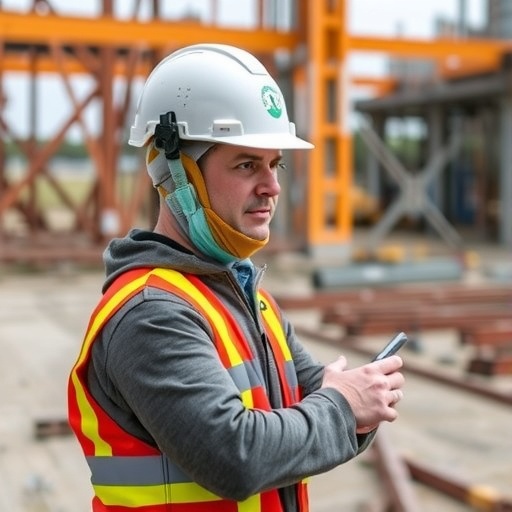
In the dynamic and often hazardous environment of construction sites, head injuries remain a paramount concern, driving intense research efforts into protective gear efficacy. A groundbreaking study published in the International Journal of Legal Medicine challenges and refines our understanding of how construction helmets function under real-world trauma conditions. Titled “Can construction helmets save lives? Evidence from a biomechanical reconstruction of a work-related head trauma,” the research delves deep into the biomechanical realities of head injuries sustained on-site and evaluates how protective helmets mitigate fatal outcomes.
The study goes beyond mere impact absorption metrics, employing advanced biomechanical reconstruction technologies. These reconstructions simulate the forces generated during a specific work-related trauma incident, providing detailed insights into the kinematics and dynamics of head impacts. By recreating the exact conditions under which an accident occurred, researchers have opened a novel window into the complex interaction between impact forces, helmet materials, and the human skull.
One crucial revelation from this research is the nuanced understanding of helmet performance. The protective gear’s effectiveness is not solely dictated by its capacity to diffuse initial impact force; instead, it also depends significantly on how it influences intracranial pressure distribution and angular acceleration of the brain. The researchers employed state-of-the-art finite element modeling to analyze these internal biomechanical factors, which historically have been challenging to quantify during field accidents.
The team’s methodology integrated empirical accident data with computational biomechanics—melding physical engineering principles with biological responses. This blend has enabled an unprecedented resolution into injury mechanisms, particularly in differentiating between linear and rotational forces imparted during a fall or collision on a construction site. Rotational forces, often underestimated, have been correlated with more severe brain injuries such as diffuse axonal injury, which helmets may inadequately protect against.
Moreover, the paper critically assesses current helmet design standards, suggesting that industry norms might require revisiting. The data demonstrates that although helmets excel in mitigating high-energy, direct impacts, their design philosophy may not optimally address multidirectional forces that frequently occur in real accidents. This insight has enormous implications for product development, regulatory frameworks, and workplace safety protocols.
The investigation also underscores the role of helmet fit and material properties. Variability in padding thickness, shell rigidity, and strap tension can influence the transmission of forces to the skull. The study utilized high-speed cameras and sensor arrays in combination with biomechanical models to quantify these subtle differences, advocating for personalized helmet fitting routines and possibly new adaptive materials that better preserve structural integrity while maintaining wearer comfort.
Importantly, the research bridges a critical gap between laboratory testing and on-site efficacy. Traditional helmet testing protocols, often based on simplified drop tests, might not sufficiently reflect the complexity of real-world accidents. This study’s biomechanical reconstruction method simulates multi-axis impacts and remembers the multifaceted nature of construction site hazards, offering a more accurate and predictive framework for evaluating helmet performance.
Beyond the scientific findings, this work carries significant implications for occupational safety policies. Construction companies, safety regulators, and insurance bodies could harness these insights to enforce stricter helmet certification criteria or incentivize innovations in helmet technology. Furthermore, educational programs designed for workers could stress the importance of correct helmet use and maintenance, amplifying practical safety measures.
The research team’s use of detailed motion capture and computational simulations represents cutting-edge interdisciplinary collaboration—combining expertise in forensic engineering, neurology, material science, and occupational health. Such synergy allows the study not only to analyze injury causation but also visualizes potential improvements capable of saving lives and reducing long-term disability among construction workers.
On a societal scale, reducing the prevalence and severity of traumatic head injuries in construction could translate to profound economic benefits. Lessening medical costs, rehabilitation time, and productivity loss can shift the heavy financial burden often borne by workers and employers alike. This underscores the critical nature of informed protective strategies that align with biomechanical realities presented in this study.
The authors, led by Lindgren, Kleiven, and Li, pave the way for future explorations into protective gear efficacy across diverse industries where head trauma risk is substantial. The methodology showcased offers a blueprint to investigate other types of head injuries—from sports to automotive crashes—potentially revolutionizing helmet standards worldwide.
In conclusion, this compelling biomechanical reconstruction study advances our understanding of construction helmet performance in a manner that is both scientifically profound and practically applicable. It calls for renewed attention to helmet design, testing, and usage, advocating a shift towards evidence-based, sophisticated safety solutions tailored for the high-risk environments workers face every day. With these insights, the question transforms from “Can construction helmets save lives?” to “How can construction helmets save more lives?”
Subject of Research: Construction helmets and their effectiveness in preventing work-related traumatic head injuries through biomechanical reconstruction.
Article Title: Can construction helmets save lives? Evidence from a biomechanical reconstruction of a work-related head trauma.
Article References:
Lindgren, N., Kleiven, S. & Li, X. Can construction helmets save lives? Evidence from a biomechanical reconstruction of a work-related head trauma. Int J Legal Med (2026). https://doi.org/10.1007/s00414-025-03695-9
Image Credits: AI Generated
DOI: https://doi.org/10.1007/s00414-025-03695-9
Tags: advanced helmet technologybiomechanical analysis of head traumaconstruction helmet effectivenessconstruction site safety measuresdynamic head injury researchhead injury prevention in constructionhelmet material performance analysisimpact forces on construction sitesintracranial pressure and helmetsprotective gear for construction workerstrauma simulation in researchworkplace safety and head injuries



