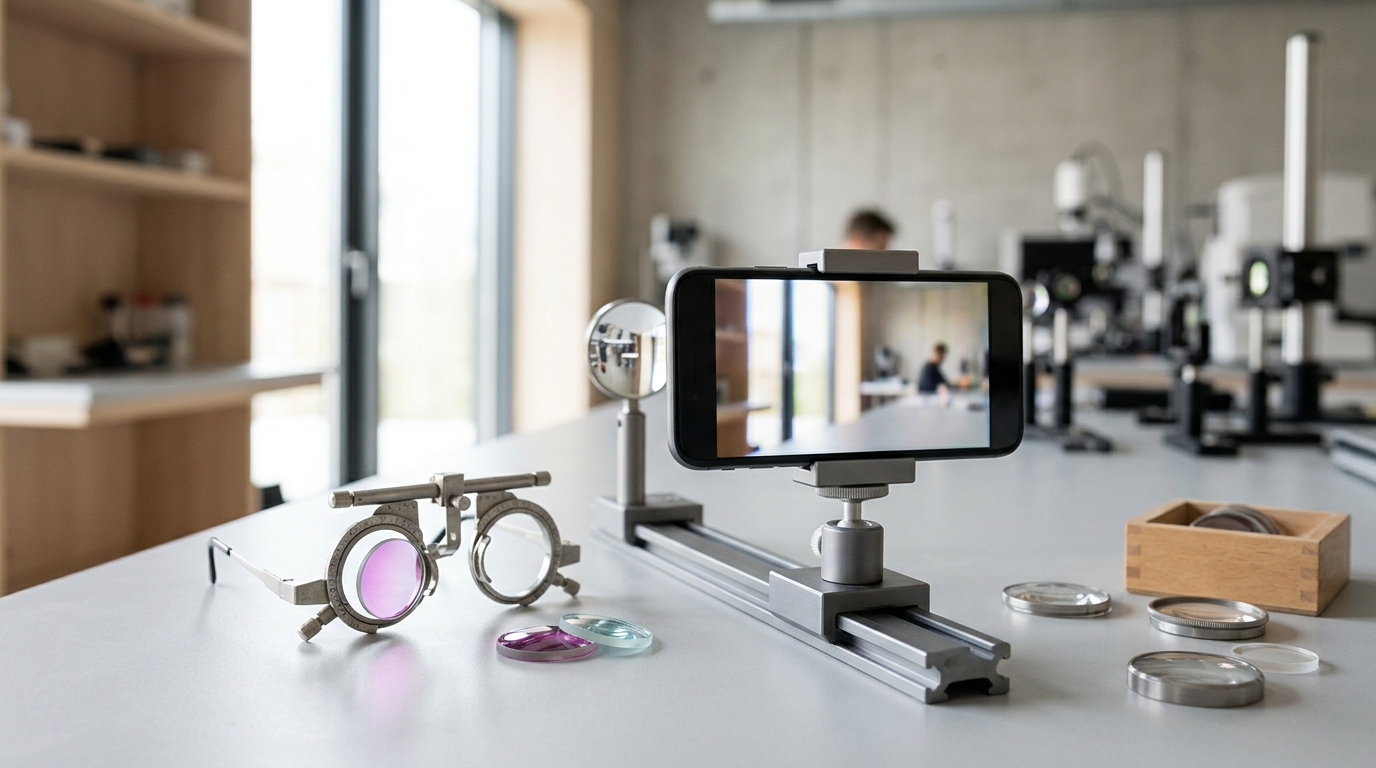
Researchers have developed a new camera-based image dataset and a corresponding mobile application designed to visually illustrate how lower-order refractive errors influence the appearance of scenes. By utilizing a physical camera setup rather than relying on abstract diagrams, the authors aimed to create a more relatable and illustrative way to visualize refractive-blur, helping to bridge the gap between technical descriptions of optical defocus and real-world image perception.
To create the dataset, the study team captured 2,008 individual images in May 2024 using a high-resolution Canon EOS R10 camera equipped with an RF-S18-45 mm lens. The experimental design incorporated a variety of supplementary spherical and cylindrical trial lenses to simulate a broad spectrum of refractive conditions. The conditions included 40 different spherical powers ranging from ± 0.25 to ± 5.00 D in 0.25-D increments, along with 48 distinct cylinder conditions ranging from − 0.25 to − 3.00 D, applied at four specific axes: 0°, 45°, 90°, and 135°. These conditions were captured both individually and in various combinations to ensure a comprehensive representation of lower-order refractive errors.
The final dataset is structured to facilitate organized, offline retrieval and comprises 1,920 combined spherocylindrical images, 40 sphere-only images, and 48 cylinder-only images. To make this data accessible and interactive, the research team integrated the images into a mobile application named iVision Refractive Demo. The application allows users to select specific refractive settings and instantly view the corresponding stored image, providing a direct visual representation of how those particular optical powers modify the sharpness and clarity of a scene.
It is critical to note that the study and its resulting software are strictly illustrative. The authors emphasized that the project was a proof-of-concept initiative and did not include any psychophysical, diagnostic-accuracy, usability, or patient-outcome validation. Because the simulation is based on camera optics rather than human biological perception, it does not function as a reliable prediction of a specific patient’s vision or as a tool to simulate the performance of complex intraocular lenses, such as multifocal or extended-depth-of-focus implants.
The researchers underscored that significant additional work is required before this approach can be considered for any clinical application or effectiveness claim. Future development would necessitate rigorous optical bench testing, reproducibility assessments, observer studies, and formal clinical usability evaluations. As currently presented, the dataset and application serve as a starting point for visualizing optical defocus but remain unvalidated for medical or diagnostic use, highlighting the complexities involved in creating accurate, patient-specific visual simulations.
Subject of Research: Development and illustrative application of a refractive error image simulation dataset.
Article Title: Development of a camera-based refractive error image simulation dataset and mobile application: a proof-of-concept study
Article References: Ueathaweephol, S., Wiriyabanditkul, T., Dejgambhir, V., & Somkijrungroj, T. (2026). Development of a camera-based refractive error image simulation dataset and mobile application: a proof-of-concept study. BMC Ophthalmology. https://doi.org/10.1186/s12886-026-05506-0
Image Credits: AI Generated
DOI: 10.1186/s12886-026-05506-0
Keywords: Refractive Error, Medical Imaging, Ophthalmology, Visual Simulation, Mobile Application, Optics, Defocus, Myopia, Hyperopia, Astigmatism, Image Dataset, Proof-of-Concept, Clinical Optics, Vision Science, Optical Fidelity
News Source: Ophelia Keating. (November 17, 2026). Camera-Based Dataset and App Developed to Illustrate Refractive Errors. Scienmag.