Transportation researchers have developed an end-to-end optimization framework that calibrates the adaptive smoothing method for freeway traffic state reconstruction, using empirical ground truth collected from dense roadside instrumentation. By reformulating the classic spatial-temporal filtering algorithm into a parameterized kernel optimization problem within PyTorch, the investigation demonstrates that systematically tuning smoothing parameters against full-state observations substantially sharpens highway velocity field estimates. The calibrated pipeline processes sparse input streams from radar detector networks and aligns them against empirical baseline measurements, achieving measurable gains in capturing traveling shockwaves and congested slowdowns. Rather than relying on static algorithmic rules established decades ago, the experimental framework directly optimizes anisotropic smoothing kernels against ground-truth mean speed data.
The adaptive smoothing method represents a foundational approach in transportation engineering for reconstructing continuous traffic flow fields from sparse roadway sensors. First introduced by Treiber and Helbing in 2002 and subsequently refined by Treiber and Kesting, the formulation emerged from empirical insights into traffic wave dynamics and spatial filtering principles. In 2010, researchers improved the computational execution of the algorithm by introducing Fast Fourier Transform and cross-correlation techniques, allowing the method to handle dynamic freeway management tasks such as data imputation, missing value refinement, velocity profiling, and vehicle emission estimation. Transportation research groups routinely re-implemented the algorithm in isolation, frequently defaulting to historical reference parameters without performing rigorous local calibration due to a lack of continuous, full-state baseline observations.
At its mathematical core, the adaptive smoothing method models traffic speed as a non-linear blending of two anisotropic spatio-temporal convolution operations. The governing parameter set contains six distinct variables: the characteristic propagation velocity in congested regimes, the wave propagation velocity under free-flowing conditions, spatial and temporal smoothing filter widths, a threshold velocity marking the phase boundary between congested and unimpeded traffic, and a transition scale parameter governing the softness of the regime switch. Two distinct kernel functions process sparse observations projected onto high-resolution coordinate grids: one oriented along upstream-propagating congestion waves and another oriented along downstream-propagating free-flow trajectories. Because traffic disturbances propagate differently in upstream and downstream directions, these anisotropic formulations assign weights exponentially based on spatial and temporal offsets. The resulting intermediate velocity fields are dynamically combined through an adaptive, hyperbolic tangent weighting function that evaluates local speeds to determine whether congestion or free-flow physical mechanisms dominate each roadway cell.
To overcome historical computational bottlenecks and make calibration tractable for large-scale freeway networks, the research team rebuilt the mathematical architecture within a modern deep learning framework. Standard spatial-temporal convolution operations were converted into differentiable Fast Fourier Transform implementations, reducing algorithmic time complexity from quadratic scaling down to quasi-linear performance. Every functional step across the pipeline—including Fourier domain transformations, matrix slicing, tensor division, and the hyperbolic tangent activation—was designed to maintain mathematical differentiability. Optimization was driven by the Adam algorithm using a learning rate of 0.01 over 1000 training epochs, with parameter updates systematically rounded to two decimal places at each iteration for practical deployment. The free-flow propagation velocity parameter was constrained via clamping in PyTorch to not exceed 96.56 kilometers per hour, corresponding to 60 miles per hour.
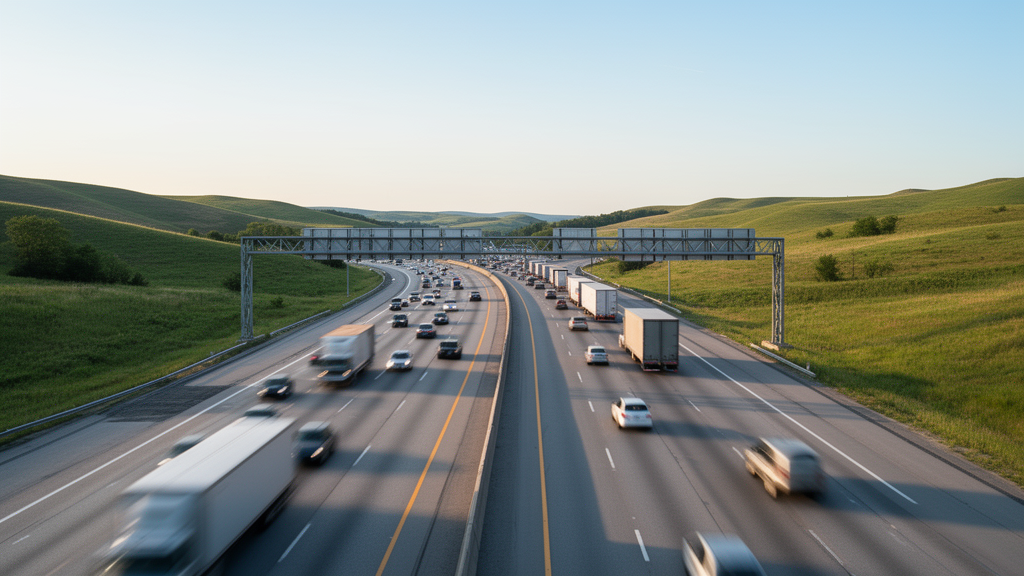
Empirical calibration was executed using continuous field measurements gathered from the I-24 MOTION observation testbed situated along a 6.76-kilometer segment of Interstate 24 near Nashville, Tennessee. Ground-truth speed data from the facility was processed following Edie's definition at a spatial resolution of 32 meters and temporal resolution of 4 seconds using the parallelogram method. Concurrent sparse measurements were acquired from the I-24 Radar Detector System, an operational array of Wavetronix SmartSensor HD radar units providing 30-second aggregated traffic counts, speeds, and occupancies at average intervals of 483 meters. The experimental dataset examined westbound corridor operations on July 9, 2024, between 6:00 AM and 10:00 AM, spanning mile markers 58.7 to 62.7. Raw radar detections were spatially aligned to the high-resolution grid using nearest-neighbor indexing, establishing an overlapping experimental testbed for direct loss minimization.
The training objective was structured as a weighted root-mean-square deviation between reconstructed velocity fields and empirical ground truth, explicitly emphasizing congested flow regimes where operational accuracy is paramount. Cells exhibiting velocities at or below a critical threshold of 24.14 kilometers per hour were assigned an error weight multiplier of ten, whereas free-flowing cells received a unit weight of one. Computational execution was conducted on an enterprise workstation equipped with two NVIDIA RTX A6000 graphics processors, an AMD Ryzen Threadripper 3960X 24-core processor, and 256 gigabytes of system memory. Hardware-independent profiling demonstrated a computational workload of 6.77 times ten to the tenth power floating-point operations and 3.38 times ten to the tenth power multiply-accumulate operations. The optimized model achieved an average inference latency of 14.59 milliseconds, delivering an operational throughput of 68.54 inferences per second while drawing a peak graphics memory footprint of 1432.41 megabytes.
Tracking parameter evolution across training iterations revealed rapid numerical convergence, with loss functions stabilizing within 50 epochs and individual physical parameters settling after approximately 600 epochs. Lane-by-lane execution required approximately 50 seconds on graphics hardware, totaling roughly four minutes across all four freeway lanes. The resulting calibrated parameters revealed notable differences across highway lanes: congested wave speeds consistently converged between 19 and 21 kilometers per hour, aligning closely with empirical traffic wave literature. Furthermore, the optimal temporal and spatial smoothing filter widths shrank to approximately one-third of the sensor sampling intervals, departing substantially from the historical rule of thumb that set them to half the sensor spacing. Lane 1, operating as a high-occupancy vehicle corridor characterized by sedan traffic, exhibited higher transition threshold speeds and wider transition zones than Lane 4, where mixed truck volumes and proximity to merging ramps dampened free-flow wave structure.
Comprehensive evaluation demonstrated that parameter calibration dramatically enhances reconstruction fidelity beyond conventional bulk error measurements. While the root-mean-square error showed an incremental reduction from 11.70 kilometers per hour under default parameters to 11.41 kilometers per hour under calibrated values, the Wasserstein distance dropped from 5.09 to 3.46 kilometers per hour, representing an improvement of 31.96 percent in matching true velocity distributions. Analyzing traffic wave detection through intersection-over-union metrics at a 24 kilometer per hour threshold revealed an accuracy increase from 0.4167 to 0.5279, reflecting a 26.6 percent enhancement. However, residual spatial maps highlighted a subtle algorithmic trade-off: the calibrated model introduced a marginal rise in false-positive congested regions where dissipating shockwaves faded. Spatial error distributions confirmed that estimation variance remained lowest in close proximity to radar sensors and expanded across unmonitored highway gaps, while pinpointing localized hardware anomalies at specific radar locations such as sensor index 176.
To evaluate temporal stability, the calibrated parameters derived from July 9, 2024, were cross-validated across four independent operating days: July 8, 10, 11, and 12. Across these uncalibrated validation days, root-mean-square errors consistently ranged between 8.23 and 12.53 kilometers per hour, while Wasserstein distances remained bounded between 1.28 and 4.20 kilometers per hour, demonstrating that parameters optimized on a representative weekday generalise effectively without requiring day-to-day retuning. Independent daily calibrations confirmed that routine operational days exhibited remarkably similar parameters, whereas an incident-induced disruption on Thursday triggered distinct parameter shifts reflecting atypical congestion patterns. Spatial tracking affirmed that lane-specific calibration remains critical for operational deployments, as physical differences in lane usage, vehicle composition, and driving behavior fundamentally alter wave propagation dynamics across adjacent travel lanes.
The calibrated framework was further deployed across extended operational corridors lacking dense trajectory instrumentation to verify broader scalability. Applying the calibrated parameters to the full 27.36-kilometer I-24 SMART Corridor across a four-hour window required just 1.07 seconds of central processing unit time, successfully resolving intricate shockwave progressions that simple interpolation methods obscured. An additional evaluation on the Virginia Department of Transportation’s Interstate 95 variable speed limit corridor near Fredericksburg covered 24.14 kilometers across four and a half hours, completing reconstruction in 1.30 seconds despite severe radar data gaps. The authors noted structural limitations inherent to the mathematical architecture, particularly the non-convex optimization landscape induced by hyperbolic tangent and minimum operations, which demands sensible initial parameter seeds to avoid local minima. Looking ahead, relaxing the stationary kernel assumption through locally adaptive kernels and incorporating more than two anisotropic kernels could yield more accurate representations of real-world traffic.
Subject of Research: Freeway traffic state reconstruction and adaptive smoothing calibration
Article Title: Calibrating adaptive smoothing methods for freeway traffic reconstruction
Article References: Ji, J., Gloudemans, D., Zachár, G., Nice, M. W., Barbour, W., & Work, D. B. (2026). Calibrating adaptive smoothing methods for freeway traffic reconstruction. European Transport Research Review, 18(1), Article 56. https://doi.org/10.1186/s12544-026-00818-0
Image Credits: AI Generated
DOI: 10.1186/s12544-026-00818-0
Keywords: adaptive smoothing method, traffic state reconstruction, spatio-temporal traffic patterns, I-24 MOTION, freeway operations, PyTorch implementation, traffic wave estimation, Fast Fourier Transform convolution, parameter calibration, Wavetronix radar sensors, Wasserstein distance, weighted root mean square deviation, smart corridors, variable speed limit, anisotropic kernels, traffic congestion dynamics, sensor network imputation
News Source: Denise Maddox. (November 11, 2026). Calibrated Adaptive Smoothing Reduces Freeway Traffic Reconstruction Error on Interstate Testbed. Scienmag.