KIT and Helmholtz Institute Ulm (HIU) Develop First Electrolytes for Calcium Batteries with Acceptable Properties at Room Temperature
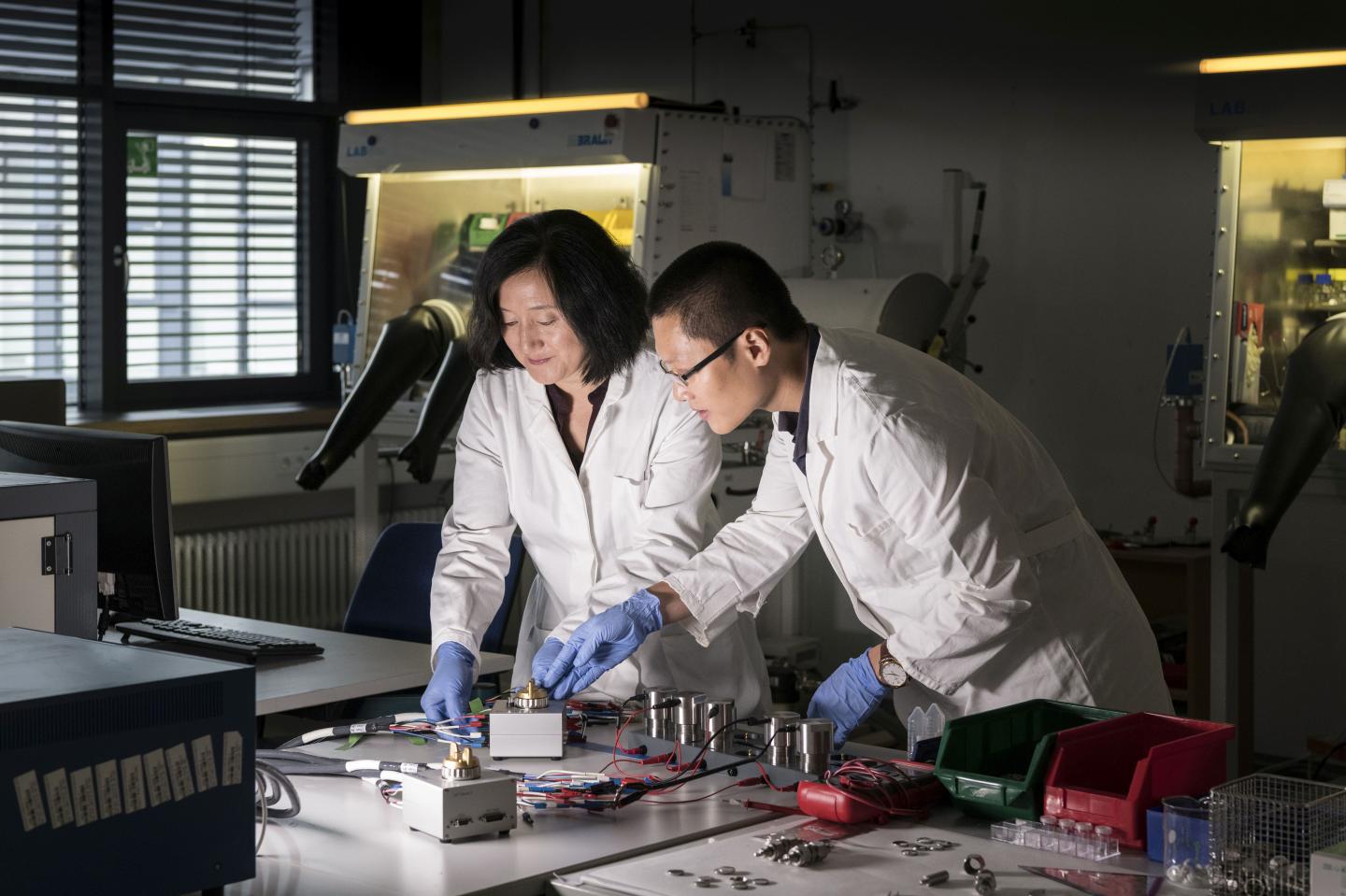
Credit: (Photo: Markus Breig/KIT)
Calcium-based batteries promise to reach a high energy density at low manufacturing costs. This lab-scale technology has the potential for replacing lithium-ion technology in future energy storage systems. Using the electrolytes available, however, it has been impossible so far to charge calcium batteries at room temperature. In the Energy & Environmental Science journal, researchers of Karlsruhe Institute of Technology (KIT) now present a promising electrolyte class, with which this will be possible. (DOI: 10.1039/c9ee01699f)
Efficient, large, and low-cost energy storage systems will facilitate nationwide transition to zero-emission mobility and power supply. Today’s predominant lithium-ion technology, however, cannot fulfill this task on a global scale, says Professor Maximilian Fichtner of KIT, Director of the research platform CELEST (Center for Electrochemical Energy Storage Ulm & Karlsruhe). Here, calcium batteries and other storage technologies are studied. “In the medium term, lithium-ion batteries will reach their limits in terms of performance and some of the resources used for their manufacture. This will prevent their future use wherever that would be reasonable for the energy transition. Availability of resources needed for manufacture, such as cobalt, nickel, and lithium, is limited.” At the Helmholtz Institute Ulm (HIU) established by KIT in cooperation with Ulm University, Fichtner and his team focus on alternative battery technologies instead. These technologies are based on more abundant resources. Calcium is a promising candidate, because it can release and accept two electrons per atom contrary to lithium and because it supplies a voltage similar to that of lithium: “Calcium is the fifth most abundant element in the Earth’s crust. It is distributed homogeneously on Earth and it is safe, non-toxic, and inexpensive.”
Search for a Suitable Electrolyte
Still, there has been a big obstacle in calcium battery development so far: In contrast to the established lithium-ion technology or more recent sodium or magnesium technologies, practicable electrolytes to produce rechargeable calcium batteries have been lacking so far. “For a few years now, experimental electrolytes and, hence, prototypes of the calcium battery have been available,” say Dr. Zhenyou Li, first author of the study, and Dr. Zhirong Zhao-Karger, who heads the project. Both are working in the POLiS (Post Lithium Storage) Cluster of Excellence of KIT that is embedded in CELEST. “But these electrolytes enable charging at temperatures beyond 75 degrees Celsius only and additionally they are susceptible to undesired side reactions.”
The researchers have now succeeded in synthesizing a class of new electrolytes based on special organic calcium salts. These electrolytes enable charging at room temperature. Using the new electrolyte calcium tetrakis[hexafluoroisopropyloxy]borate, the researchers demonstrated feasibility of calcium batteries of high energy density, storage capacity, and quick-charging capability. Their results are reported in the journal Energy & Environmental Science.
Calcium Batteries as Sustainable Energy Storage Systems
The new class of electrolytes is an important basis for transferring calcium batteries from the laboratory to application. In electric vehicles, mobile electronic devices, and stationary storage systems, they might replace the presently predominating lithium-ion battery one day. But this may take a while: “The new electrolytes are a first important step,” Fichtner emphasizes. “There still is a far way to go to the mature calcium battery.”
###
Original publication:
Zhenyou Li, Olaf Fuhr, Maximilian Fichtner, Zhiron Zhao-Karger: Towards stable and efficient electrolytes for room-temperature rechargeable calcium batteries. Energy & Environmental Science, 2019. DOI: 10.1039/c9ee01699f.
https:/
About the CELEST Research Platform with the POLiS Cluster of Excellence
The CELEST (Center for Electrochemical Energy Storage Ulm & Karlsruhe) research platform for strategic collaboration was established in 2018 by KIT, Ulm University, and the Center for Solar Energy and Hydrogen Research Baden-Württemberg (ZSW). It is one of the biggest battery research activities in international comparison. 45 working groups from 29 institutes of KIT, Ulm University, and ZSW contribute their complementary expertise to CELEST- from fundamental research to close-to-practice development to technology transfer. CELEST focuses on three research fields: Lithium-ion technology, energy storage beyond lithium, and alternative technologies for electrochemical energy storage and conversion.
The POLiS (Post Lithium Storage) Cluster of Excellence also is embedded in CELEST. Within POLiS, researchers from Karlsruhe and Ulm conduct research relating to the future battery. In late 2018, the Cluster was acquired within the highly competitive Excellence Strategy competition of the federation and the federal states. It has a budget of about EUR 7 million per year and is scheduled for a duration of initially seven years. POLiS partners are KIT and Ulm University, associated partners are ZSW and Gießen University. Half of the about 100 researchers are working in Karlsruhe, half in Ulm.
More information on the Cluster of Excellence: https:/
About the Helmholtz Institute Ulm
The Helmholtz Institute Ulm (HIU) was established in January 2011 by Karlsruhe Institute of Technology (KIT), member of the Helmholtz Association, in cooperation with Ulm University. With the German Aerospace Center (DLR) and the Center for Solar Energy and Hydrogen Research Baden-Württemberg (ZSW), two other renowned institutions are involved in the HIU as associated partners. The international team of about 120 scientists at HIU works on the development of future energy storage systems for stationary and mobile use.
Find more about HIU at: http://www.
More about the KIT Energy Center: http://www.
Press contact: Margarete Lehné, Stellvertretende Pressesprecherin, Phone: +49 721 608-21157, Fax: +49 721 608-4568, margaret. [email protected]
Being „The Research University in the Helmholtz Association”, KIT creates and imparts knowledge for the society and the environment. It is the objective to make significant contributions to the global challenges in the fields of energy, mobility and information. For this, about 9,300 employees cooperate in a broad range of disciplines in natural sciences, engineering sciences, economics, and the humanities and social sciences. KIT prepares its 25,100 students for responsible tasks in society, industry, and science by offering research-based study programs. Innovation efforts at KIT build a bridge between important scientific findings and their application for the benefit of society, economic prosperity, and the preservation of our natural basis of life.
Media Contact
Monika Landgraf
[email protected]
49-721-608-21105
Original Source
https:/
Related Journal Article
http://dx.