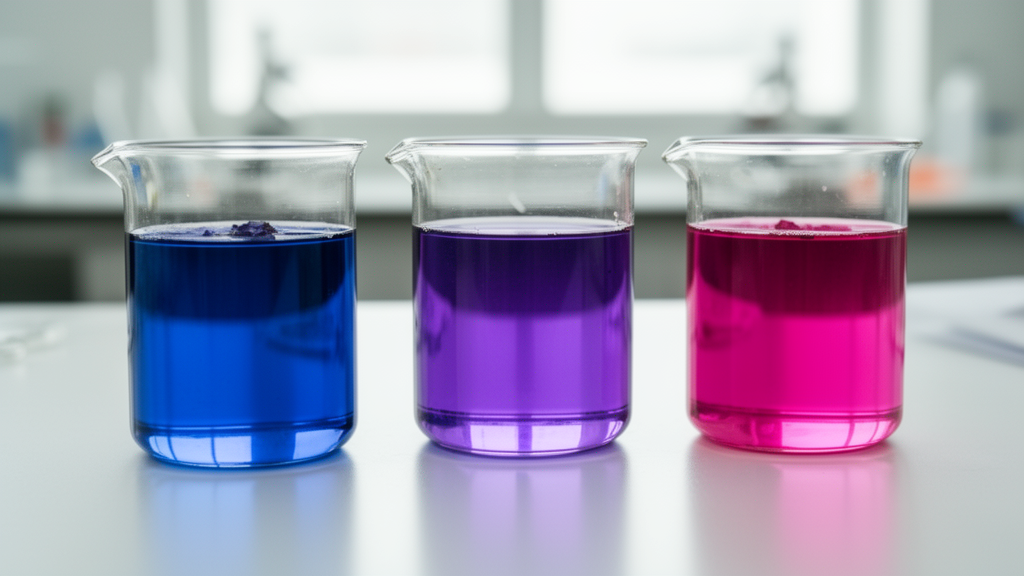
Researchers published a study in the journal Fashion and Textiles demonstrating that an aqueous extract of Clitoria ternatea, commonly known as butterfly pea, functions as a stable natural dye with distinct halochromic properties. The study, led by Henadeera Arachchige Ayomi Perera and colleagues, systematically evaluated the extract’s spectral transitions, chemical stability, and textile dyeing performance. The primary finding is that the extract exhibits well-defined, continuous color changes across a broad pH range of 1 to 12, retaining measurable signal without the typical colorless intermediate regions observed in many other anthocyanin-based dyes.
The research team focused on the practical applicability of this natural colorant for potential smart textile applications. Unlike previous studies that primarily concentrated on extraction efficiency or food applications, this work addressed the critical gap in understanding how the dye behaves under realistic processing and environmental conditions. The authors emphasized that for a halochromic dye to be useful in textiles, it must maintain its color-responsive behavior not just in solution, but also when exposed to heat, light, and chemical reagents commonly found in textile processing.
The dye was produced using an ultrasonic-assisted aqueous extraction method. Dried butterfly pea flower petals were ground to a particle size between 0.17 and 0.25 mm and combined with distilled water. The mixture was subjected to ultrasound at 40 degrees Celsius for 45 minutes, a process that enhances mass transfer and allows for faster recovery of colorants without the need for toxic organic solvents. The resulting extract yielded a total anthocyanin content of 6.74 milligrams of delphinidin-3-glucoside equivalents per gram of dry flowers, a value that is lower than some ethanolic extractions but higher than certain conventional aqueous methods.
Spectroscopic analysis revealed that the extract’s color is governed by the structural transformations of anthocyanin molecules in response to pH changes. At strongly acidic pH levels of 1 to 2, the dye appears magenta or red, with absorption maxima shifting to approximately 549 to 553 nanometers. As the pH increases to a neutral or moderately alkaline range, the color transitions through purple and blue to greenish-yellow, with absorption maxima shifting to approximately 619 to 626 nanometers. This continuous spectral response is attributed to the presence of polyacylated delphinidin-derived anthocyanins, known as ternatins, which stabilize the chromophore through intramolecular co-pigmentation.
Stability testing indicated that the extract is highly sensitive to temperature. At 4 degrees Celsius, the dye exhibited excellent stability with a half-life ranging from 31 to 36 days. However, at elevated temperatures, the degradation rate increased significantly. At 60 degrees Celsius, the half-life dropped to approximately 7 days, and at 80 degrees Celsius, the dye underwent rapid decay within three hours. These findings suggest that while the dye is stable under cold storage, it requires careful thermal management during textile processing to prevent premature degradation.
The study also evaluated the extract’s compatibility with various chemical reagents used in dyeing. Sodium sulfate, a common electrolyte, largely preserved the chromophoric structure and even enhanced absorbance intensity through ionic-strength effects. In contrast, transition metal ions such as iron and copper induced spectral changes associated with complexation and oxidative degradation. Sodium sulfite proved to be the most destructive reagent, causing rapid bleaching by attacking the anthocyanin flavylium cation to form colorless sulfonate adducts. These results highlight the importance of reagent selection in maintaining the long-term durability of the dye.
Dyeing trials were conducted on multifiber fabrics containing acetate, cotton, nylon, polyester, acrylic, and wool. The results demonstrated a strong preference for cellulose-based fibers, with cotton exhibiting the highest color difference values. When dyed with a 50 mg/mL concentration of the extract, cotton showed a color difference (ΔE) of 33.55 after dyeing and 23.84 following exposure to an acidic pH 2 buffer. This pronounced response indicates that the anthocyanin chromophores retained their reversible pH-responsive behavior even after being immobilized on the cotton substrate.
The fiber-dependent dyeability followed a specific order: Cotton > Nylon > Wool > Acetate > Acrylic > Polyester. This trend reflects the availability of polar functional groups and the hydrophilicity of the fibers. Cotton’s abundant hydroxyl groups facilitate hydrogen bonding with the hydroxyl-rich anthocyanins, leading to superior dye uptake. Synthetic fibers like polyester, which are highly crystalline and hydrophobic, showed the lowest dyeability under the mild dyeing conditions of 60 degrees Celsius and atmospheric pressure used in the study.
Despite the promising halochromic performance, the study identified significant limitations regarding the durability of the dyed fabrics. Wash fastness testing revealed that both dye concentrations experienced measurable color changes after laundering, with the 50 mg/mL sample showing a ΔE of 25.56. Light fastness testing also indicated poor resistance to photodegradation, with grey scale ratings of 1 and 2 for the lower and higher concentrations, respectively. These results suggest that while the dye is effective as a proof-of-concept for pH sensing, it currently lacks the long-term stability required for commercial smart textiles.
The authors conclude that Clitoria ternatea extract shows strong potential as a natural halochromic dye for textile-based sensing applications. The combination of broad pH responsiveness, quantified stability under cold conditions, and preferential uptake on cotton provides a solid foundation for further development. However, the study emphasizes that the current fabric system is a preliminary model. Future research must focus on improving dye fixation through strategies such as mordanting, encapsulation, or fiber-surface modification to enhance wash and light fastness.
This research contributes to the growing field of sustainable textile coloration by providing a comprehensive evaluation of a natural dye’s behavior under realistic conditions. By moving beyond simple extraction yields to a detailed analysis of environmental and chemical stability, the study offers a more application-relevant understanding of how natural anthocyanins can be integrated into functional materials. The findings underscore the need for a balanced approach that considers both the initial color expression and the long-term durability of natural dyes in practical textile applications.
The use of aqueous extraction methods in this study aligns with the broader goal of reducing the environmental impact of textile processing. Water-based systems are less toxic and simplify post-processing compared to solvent-intensive methods. As the industry seeks alternatives to synthetic colorants, the detailed characterization of natural dyes like butterfly pea provides valuable data for developing more sustainable and functional textile products. The study’s focus on the specific chemical interactions between the dye and various reagents offers insights that can guide the optimization of future dyeing protocols.
Ultimately, the work highlights the complexity of translating natural pigments into functional smart materials. While the halochromic behavior of Clitoria ternatea is robust in solution, its performance on fabrics is influenced by a multitude of factors including fiber chemistry, dye concentration, and environmental exposure. The study provides a detailed roadmap for addressing these challenges, suggesting that with further refinement in fixation and stabilization techniques, butterfly pea dye could become a viable option for next-generation pH-sensitive textiles.
The structural basis for the extract’s stability lies in the specific chemistry of its pigments. LC-DAD-MS analysis identified a multicomponent profile dominated by polyacylated delphinidin-derived anthocyanins, tentatively assigned as ternatin-related compounds. Unlike simpler anthocyanins that often lose color in intermediate pH ranges due to hydration into colorless hemiketal forms, the Clitoria ternatea extract maintained a continuous spectral response. This resilience is attributed to intramolecular co-pigmentation, where acyl groups and extended conjugated systems stabilize the chromophore through stacking interactions. The presence of these highly substituted molecules explains why the dye retains visible absorbance bands at approximately 574 and 619 nm even under chemical stress, a feature that distinguishes it from less stabilized natural colorants.
Light exposure introduced a complex variable in the stability assessment. While anthocyanins are typically accelerated in degradation by light, the extract showed a longer apparent half-life at 16 degrees Celsius under light exposure compared to dark storage. The authors noted that this counterintuitive result could not be fully explained by the presented data, suggesting that the specific acylated structure may offer unique photochemical protection. However, the mechanism remains uncertain and requires further investigation. This wavelength-dependent behavior highlights the need for careful interpretation of environmental stability, as the dye’s response to light varies depending on the specific spectral band monitored.
The study also clarified the distinct roles of different chemical reagents in textile processing. Sodium sulfate acted primarily through ionic-strength effects, enhancing absorbance without destroying the chromophore, making it the most compatible reagent for maintaining color intensity. In contrast, iron and copper salts induced different degradation pathways. Iron caused an initial spectral reorganization consistent with metal complexation, followed by oxidative decay, while copper promoted a more regular oxidative fading. Sodium sulfite was the most destructive, causing rapid bleaching through nucleophilic attack on the flavylium cation. These findings indicate that reagent selection is critical for preserving the functional halochromic behavior of the dye in practical applications.
Despite the promising spectral properties, the current fabric system remains a proof-of-concept rather than a finished product. The lack of cyclic reversibility testing means that the long-term reusability of the pH-responsive signal is not yet established. Furthermore, the mild dyeing conditions used, specifically 60 degrees Celsius at atmospheric pressure without mordants, limited the uptake on synthetic fibers. The authors suggest that future improvements in fixation, such as encapsulation or crosslinking, are necessary to address the limited wash and light fastness observed. This work provides a detailed baseline for understanding how natural anthocyanins interact with textile substrates, offering a roadmap for developing more durable and functional smart materials.
Subject of Research: Halochromic behavior and stability of Clitoria ternatea anthocyanin extract in textile dyeing
Article Title: Natural dye from Clitoria ternatea and its halochromic behavior
Article References: Perera, H. A. A., Van Amber, R., Wang, L., Houshyar, S., & Wang, X. (2026). Natural dye from Clitoria ternatea and its halochromic behavior. Fashion and Textiles, 13(1), Article 48. https://doi.org/10.1186/s40691-026-00501-x
Image Credits: AI Generated
DOI: 10.1186/s40691-026-00501-x
Keywords: Clitoria ternatea, natural dye, halochromic, textile, anthocyanin, pH-sensitive, stability, sustainable fashion, Natural, Clitoria, ternatea, behavior
News Source: Denise Maddox. (November 9, 2026). Butterfly Pea Dye Shows Stable pH-Responsive Color Changes. Scienmag.