• HOME
  • NEWS
  • EXPLORE
    • CAREER
      • Companies
      • Jobs
    • EVENTS
    • iGEM
      • News
      • Team
    • PHOTOS
    • VIDEO
    • WIKI
  • BLOG
  • COMMUNITY
    • FACEBOOK
    • INSTAGRAM
    • TWITTER
Wednesday, April 8, 2026
BIOENGINEER.ORG
No Result
View All Result
  • Login
  • HOME
  • NEWS
  • EXPLORE
    • CAREER
      • Companies
      • Jobs
        • Lecturer
        • PhD Studentship
        • Postdoc
        • Research Assistant
    • EVENTS
    • iGEM
      • News
      • Team
    • PHOTOS
    • VIDEO
    • WIKI
  • BLOG
  • COMMUNITY
    • FACEBOOK
    • INSTAGRAM
    • TWITTER
  • HOME
  • NEWS
  • EXPLORE
    • CAREER
      • Companies
      • Jobs
        • Lecturer
        • PhD Studentship
        • Postdoc
        • Research Assistant
    • EVENTS
    • iGEM
      • News
      • Team
    • PHOTOS
    • VIDEO
    • WIKI
  • BLOG
  • COMMUNITY
    • FACEBOOK
    • INSTAGRAM
    • TWITTER
No Result
View All Result
Bioengineer.org
No Result
View All Result
Home NEWS Science News Chemistry

Building walls that will make summer heat waves more bearable

Bioengineer by Bioengineer
September 28, 2020
in Chemistry
Reading Time: 3 mins read
0
IMAGE
Share on FacebookShare on TwitterShare on LinkedinShare on RedditShare on Telegram

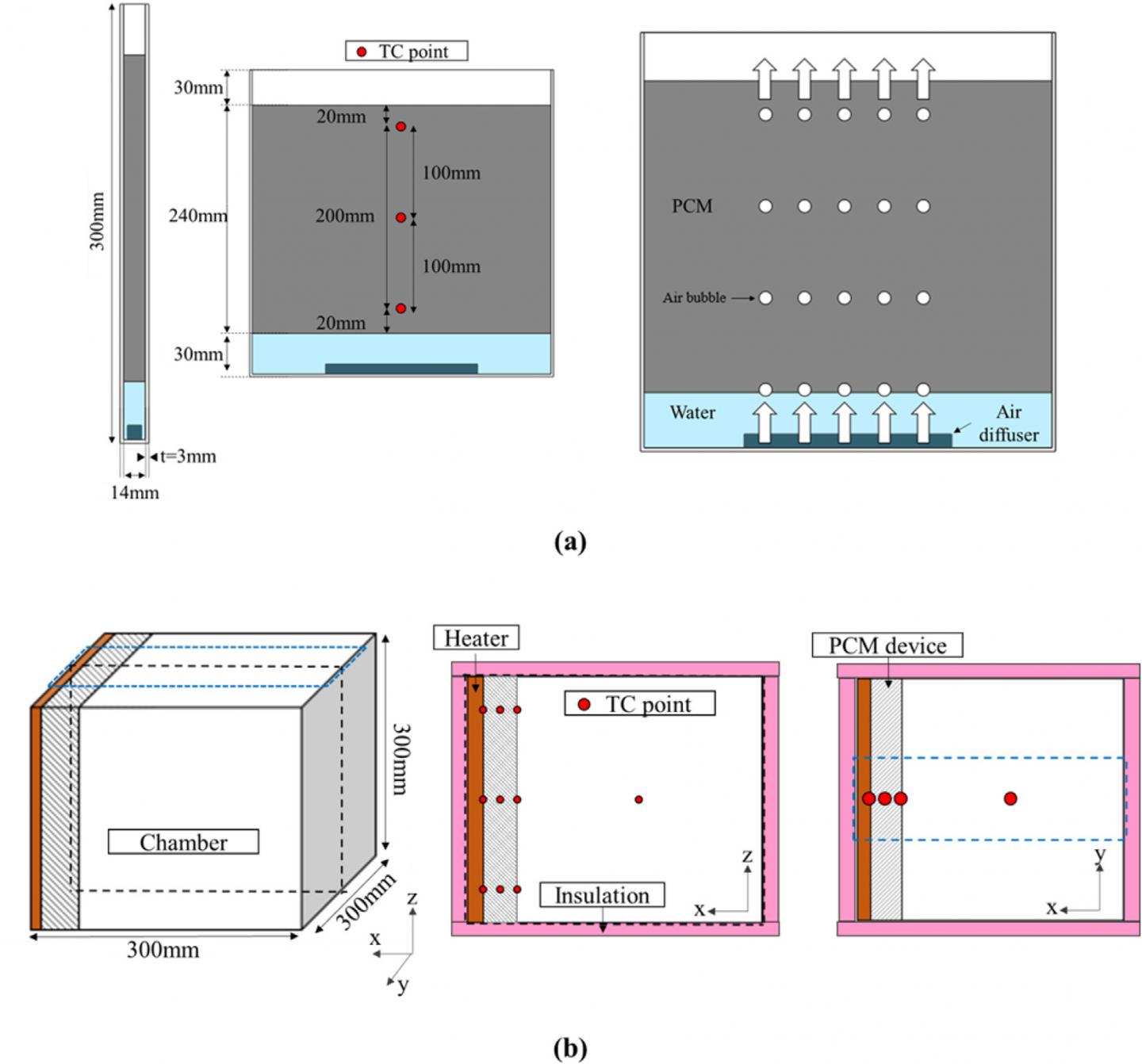
A new way to reduce heat penetration through building walls. Application of a phase change material and bubble injections to building walls.
IMAGE

Credit: Korea Institue of Science and Technology(KIST)

With the summer heat becoming increasingly unbearable and prolonged over the years due to climate change, the cooling load in the summertime has also been on the rise. Insulation is currently the primary solution for blocking heat from entering a building, but by applying an additional material that can delay heat penetration, it can suppress the indoor temperature from rising and in turn lower the cooling load of the building.

A research team in Korea has developed a new material for buildings walls that can help reduce the penetration of heat from the outside. The team directed by Dr. Sarng Woo Karng from the National Research Agenda Division of the Korea Institute of Science and Technology (KIST) revealed that they have successfully lowered heat penetration through building walls by applying a phase change material (PCM).

PCMs refer to materials that absorbs or releases heat from/to the surrounding area but does not change temperature during phase change. One of the most common types is paraffin oil, which is used to make candles. A solid PCM absorbs heat as it transitions into liquid phase, so by using a case to hold it when it is in liquid phase without causing any leakage, it is possible to apply them to a building wall to block heat from entering inside.

The problem is, however, PCMs do not melt evenly from the outside toward the inside during phase transition from solid to liquid. To be more specific, PCMs turn into liquid starting from the outermost layer, and the parts that are hot move upward, while the parts that are still relatively cool move downward. Thus, while the upper part may have completely melted, the lower part will have not, and as a result, heat will penetrate into the building through the area where the PCM is in liquid phase. Ultimately, the PCM becomes ineffective in controlling the indoor temperature and is rendered useless.

Dr. Karng’s team addressed the non-uniform phase change with bubble injections. By injecting bubbles into bottom part of the PCM during phase transition enabled uniform circulation of the PCM in liquid phase. As a result, the PCM melted from the area closest to the envelope in a uniform manner, and heat penetration was inhibited across the building wall until the entire PCM melted.

Dr. Karng said, “We expect that the insulating wall using the PCM bubble generator used in this study will contribute to reducing the amount of energy used to heat or cool a building. Insulation techniques using PCMs helps reduce heat penetration, in combination with the building insulating material, and it can also be used as the outer walls of zero-energy buildings.”

###

This study was carried out with a grant from the Ministry of Science and ICT (MSIT), as part of the Institutional R&D Program of KIST. It was published in the latest edition of Energy Conversion and Management (Top 1.87% in the field of JCR), a leading international journal in the energy sector.

Media Contact
Do-Hyun Kim
[email protected]

Related Journal Article

http://dx.doi.org/10.1016/j.enconman.2020.113187

Tags: Chemistry/Physics/Materials SciencesTechnology/Engineering/Computer Science
Share12Tweet8Share2ShareShareShare2

Related Posts

Breakthrough in Precise Synthesis of Chiral Cyclic Imine Esters via Transient Binary Copper Co-Catalysis

Breakthrough in Precise Synthesis of Chiral Cyclic Imine Esters via Transient Binary Copper Co-Catalysis

April 8, 2026
blank

Herrmann Ostrowski Secures NSF Grant to Advance Interdisciplinary Optimization Research

April 7, 2026

AI Cracks the “1+1>2” Formula for Advancing Green Hydrogen Production

April 7, 2026

Single-Atom-Enhanced SnS2/CdS S-Scheme Photocatalyst Boosts Hydrogen Production and Lactic Acid Oxidation Synergistically

April 7, 2026
Please login to join discussion

POPULAR NEWS

  • blank

    Revolutionary AI Model Enhances Precision in Detecting Food Contamination

    98 shares
    Share 39 Tweet 25
  • Imagine a Social Media Feed That Challenges Your Views Instead of Reinforcing Them

    1010 shares
    Share 399 Tweet 250
  • Popular Anti-Aging Compound Linked to Damage in Corpus Callosum, Study Finds

    44 shares
    Share 18 Tweet 11
  • Promising Outcomes from First Clinical Trials of Gene Regulation in Epilepsy

    51 shares
    Share 20 Tweet 13

About

We bring you the latest biotechnology news from best research centers and universities around the world. Check our website.

Follow us

Recent News

XPANCEO Advances High-Precision Passive Eye-Tracking Technology for Smart Contact Lenses

Young Forest Owners in Finland Face Challenges Balancing Their Values

KRICT Innovates Easy and Scalable Method to Enhance Ag2Se Thermoelectric Performance

Subscribe to Blog via Email

Enter your email address to subscribe to this blog and receive notifications of new posts by email.

Join 78 other subscribers
  • Contact Us

Bioengineer.org © Copyright 2023 All Rights Reserved.

Welcome Back!

Login to your account below

Forgotten Password?

Retrieve your password

Please enter your username or email address to reset your password.

Log In
No Result
View All Result
  • Homepages
    • Home Page 1
    • Home Page 2
  • News
  • National
  • Business
  • Health
  • Lifestyle
  • Science

Bioengineer.org © Copyright 2023 All Rights Reserved.