Osaka, Japan – For many of us, when we think of microbiomes, our first thoughts are probably about the beneficial microorganisms that live in our guts. But now, researchers from Japan and US have discovered how the microbes living in fruit flies can enhance their reproduction.
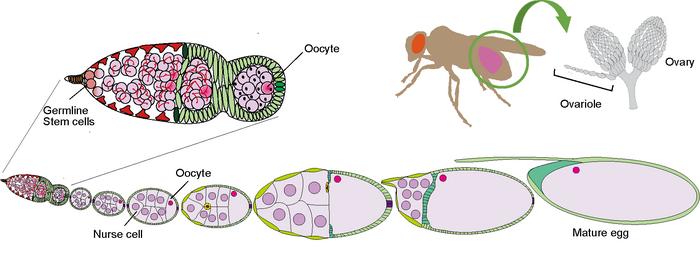
Credit: Osaka university
Osaka, Japan – For many of us, when we think of microbiomes, our first thoughts are probably about the beneficial microorganisms that live in our guts. But now, researchers from Japan and US have discovered how the microbes living in fruit flies can enhance their reproduction.
In a recently published study in Communications Biology, the research group has revealed that microbes in the fruit fly microbiome are involved in controlling the germline stem cells that form eggs, as well as subsequent egg maturation, in female fruit flies.
The microbiome—the community of microorganisms that live together in and on a host—has a huge role in facilitating functions that are necessary for survival. This includes metabolic regulation, intake of nutrients, and reproduction, including improving fertility in conditions of inadequate nutrition. However, the specific molecular mechanisms enabling microbes to control the maturation of the germline (the lineage of cells within an organism that gives rise to eggs and sperms) are still a mystery.
“We propose that microbes control various stages of oogenesis, which leads the production of eggs in the ovary,” says lead author of the study Ritsuko Suyama. “They may do this by modifying hormone levels and their successive pathways and can therefore promote host fertility in conditions of poor nutrition.”
The researchers investigated the effects of microbes on oogenesis in fruit flies, Drosophila melanogaster. Using genetic analysis, the team revealed that microbes boost oogenesis by both accelerating the division of ovarian cells and suppressing programmed cell death, as well as increasing the production of germline stem cells (GSC) by enhanced cell division and eventually increasing the number of mature eggs in females.
“We discovered that the microbes’ enhancement of reproductive function was controlled by the activation of the hormonal pathways for ecdysone and juvenile hormones in the germline stem cells—the cells that develop into eggs,” explains Toshie Kai, senior author.
Ecdysone is a steroid hormone that regulates moulting in insects. The researchers found that the ecdysone pathway may be an important mediator for a microbe-induced increase of GSCs and egg maturation. Meanwhile, the juvenile hormone pathway is involved only in GSC proliferation, which indicates that the hormonal pathways are activated during different stages of oogenesis.
“Our results show that environmental microbes can improve host reproduction by controlling hormone release and increasing oogenesis in their hosts,” says Suyama.
These new discoveries about host-microbe interactions could present new avenues for improvements in reproductive health, for example via new treatments involving probiotics. Specifically, the findings from this study will contribute to the understanding of how microbes boost their host’s reproductive processes, which will open the door for new methods to improve fertility and infertility treatment.
###
The article, “Microbes control Drosophila germline stem cell increase and egg maturation through hormonal pathways,” was published in Communications Biology at DOI: 10.1038/s42003-023-05660-x
About Osaka University
Osaka University was founded in 1931 as one of the seven imperial universities of Japan and is now one of Japan’s leading comprehensive universities with a broad disciplinary spectrum. This strength is coupled with a singular drive for innovation that extends throughout the scientific process, from fundamental research to the creation of applied technology with positive economic impacts. Its commitment to innovation has been recognized in Japan and around the world, being named Japan’s most innovative university in 2015 (Reuters 2015 Top 100) and one of the most innovative institutions in the world in 2017 (Innovative Universities and the Nature Index Innovation 2017). Now, Osaka University is leveraging its role as a Designated National University Corporation selected by the Ministry of Education, Culture, Sports, Science and Technology to contribute to innovation for human welfare, sustainable development of society, and social transformation.
Website: https://resou.osaka-u.ac.jp/en
Journal
Communications Biology
DOI
10.1038/s42003-023-05660-x
Method of Research
Experimental study
Subject of Research
Animals
Article Title
Microbes control Drosophila germline stem cell increase and egg maturation through hormonal pathways
Article Publication Date
21-Dec-2023