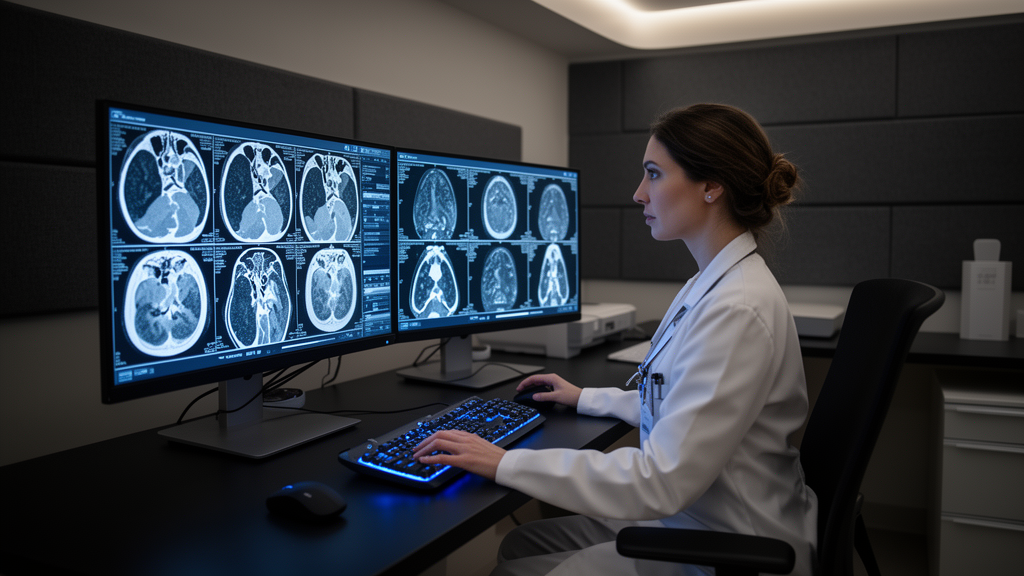
A sixteen-contribution research collection published in Frontiers in Radiology highlights how advanced imaging modalities—spanning quantitative ultrasound, multiparametric MRI, radiomics, and artificial intelligence—address diagnostic refinement and treatment guidance in breast cancer care. The editorial by Lulu Wang of Reykjavik University emphasizes that while early detection frames the broader ambition of breast imaging, the included studies focus primarily on patients with identified lesions or established disease. Across the care pathway, imaging informs consequential choices: determining whether an abnormality warrants biopsy, characterizing tumour biology, anticipating treatment response, and guiding clinical procedures. Each clinical decision involves distinct uncertainties, prompting researchers to examine when supplemental imaging information genuinely resolves a consequential diagnostic or therapeutic question.
A core focus of several contributions is balancing cancer detection against the avoidance of unnecessary invasive procedures. In evaluating lesions classified as BI-RADS 4, an investigation by Zhou and colleagues determined that the Kaiser score outperformed apparent diffusion coefficient measurements alone. Crucially, combining the Kaiser score with apparent diffusion coefficient measurements did not improve overall diagnostic discrimination beyond the Kaiser score alone. Their detailed assessment of lesion morphology and pathology-specific misclassifications illustrates that diagnostic usefulness cannot be adequately summarized by a single overarching performance metric.
Other studies within the collection extend diagnostic refinement to risk stratification within established diagnostic categories. Sun and colleagues investigated quantitative ultrasound scoring specifically for BI-RADS 4A nodules among patients in the Tibetan Plateau region. In parallel, Xia and colleagues integrated automated breast volume scanning with conventional ultrasound using habitat radiomics. Both studies analyzed variations among lesions that carry the same baseline diagnostic classification, aiming to assess whether refined scoring can reduce benign biopsies while preserving acceptable cancer detection rates.
Diagnostic discrimination was also evaluated in conditions where benign and malignant diseases share overlapping appearances. Wu and colleagues assessed non-mass breast carcinoma and mastitis, observing that the training advantage of biplanar radiomics diminished upon internal validation; however, combining clinical variables with radiomics achieved superior validation discrimination compared to either modality alone. In a separate single-centre study with internal validation, Chen and colleagues documented promising radiomics discrimination of phyllodes tumours from breast cancer and fibroadenoma, demonstrating that additional analytical measurements are most informative when tested against clearly defined diagnostic alternatives.
A complementary subset of investigations analyzed atypical presentations and diagnostic mimics that complicate clinical interpretation. Wei and colleagues detailed subtype-specific sonographic features of metaplastic breast cancer, identifying benign-appearing characteristics within spindle cell tumours. To assist in distinguishing markedly hypoechoic triple-negative breast cancers from benign cysts and fibroadenomas, Xiang and colleagues explored colour mapping techniques. These findings emphasize that malignant lesions may closely mimic benign disease on standard imaging.
Conversely, other reports illustrated benign conditions that present with suspicious imaging features. An investigation of diabetic mastopathy by Chen and colleagues documented reassuring mammographic findings alongside suspicious sonographic features. Additionally, a case report by He and Lu detailed the diagnostic interpretation of a pleomorphic adenoma, an uncommon benign breast lesion, in a patient with a documented history of malignancy. Collectively, these investigations demonstrate that clinical errors can stem from both misleadingly benign and deceptively suspicious appearances, reinforcing the necessity of correlating imaging with clinical history and pathological findings.
The collection also explores imaging beyond lesion classification by assessing underlying tumour biology and therapeutic outcomes. Chen and colleagues evaluated multiparametric MRI measurements alongside clinicopathological variables to examine HER2 expression categories. Zhang and colleagues integrated intratumoral and peritumoral MRI radiomics, deep transfer learning, and clinical indicators, validating their model across two external test cohorts. The external validation revealed lower discrimination compared to development data, underscoring the critical necessity of testing predictive models outside initial training sets.
Further expanding the biological scope, Liu and colleagues applied ultrasound radiomics and machine learning to discriminate stromal tumour-infiltrating lymphocyte levels in resectable, non-metastatic triple-negative breast cancer, achieving moderate internal-validation performance. In the neoadjuvant therapeutic setting, Wu and colleagues formulated an MRI–clinicopathological nomogram designed to predict pathological complete response in patients with HER2-positive breast cancer. The editorial notes that while these models show potential, statistical associations with pathology do not establish biological mechanisms, and predicting response does not automatically identify which alternative treatment would benefit a patient.
Addressing computational methodologies, a review by Wang contextualized the collection within broader developments in self-supervised learning and transformer-based architectures for breast image analysis. These computational frameworks aim to mitigate annotation scarcity and capture complex contextual relationships across detection, segmentation, and classification tasks. Because expert annotation is labor-intensive and disease presentations are heterogeneous, self-supervised learning enables the utilization of unlabelled data, while transformer architectures capture wider spatial patterns. Nonetheless, the editorial cautions that complex representations can capture acquisition artifacts alongside genuine pathology, requiring validation that learned features persist across institutions and imaging conditions.
Transitioning from diagnostic interpretation to clinical action, procedural contributions examined image guidance during interventions. Kósa and colleagues conducted a prospective study comparing indocyanine green fluorescence with technetium-99m for sentinel lymph-node localization, finding that a combined approach yielded complementary detection. Addressing operative challenges, Zheng and colleagues analyzed ductoscopy-related difficulties and proposed a procedural classification system tied to management strategies. These studies show that procedural utility depends on localization reliability, operator proficiency, resource requirements, and established management protocols for handling procedural failure.
Synthesizing the findings, the editorial outlines distinct evidential standards across clinical applications: diagnostic tools must reduce interventions without missing malignancies, biological models must provide actionable data beyond tissue pathology, and procedural guidance must perform reliably under routine practice. Progress in breast imaging relies on distinguishing when advanced analytics genuinely resolve clinical uncertainty from when ambiguity persists. Future advances will require determining whether additional diagnostic precision translates into safer decisions, more informative tumour characterization, and dependable patient care.
The Research Topic underscores that breast imaging is not a monolithic discipline but a series of distinct decision-making junctures. Throughout the care pathway, clinicians must navigate unique uncertainties that require evidence specifically tailored to the consequences of each choice. Whether determining if an abnormality demands a biopsy, characterizing the biological potential of a lesion, predicting a patient’s treatment response, or guiding a surgical intervention, the informational requirement shifts with the clinical context. Recognizing these distinct challenges is essential, as the utility of an imaging finding depends heavily on the disease under evaluation, the preexisting data available, and the management action that the finding is intended to support.
Diagnostic errors often emerge from the inherent limitations of standard imaging, where malignancy can assume reassuring appearances or, conversely, benign pathology can mimic suspicious lesions. The significance of investigations into these mimics extends far beyond the recognition of specific entities; they demonstrate the critical need to investigate discordance among clinical, radiological, and pathological findings. In this regard, clinical history serves as an indispensable anchor. Quantitative tools developed to identify typical disease presentations often require rigorous evaluation in less common or misleading cases, where diagnostic support is arguably most valuable but also most susceptible to interpretation error.
A recurring theme across the technical contributions is the balance between analytical complexity and practical utility. While radiomics and machine learning offer powerful means of extracting information from heterogeneous disease presentations, increased complexity does not inherently guarantee improved clinical performance. Researchers must remain cautious of the distinction between retrospective discrimination and evidence that truly supports a change in clinical management. For combined diagnostic models, establishing that every input is available and reliable at the time of clinical use is paramount. Moreover, as computational architectures like transformers and self-supervised learning methods are integrated to overcome resource-intensive annotation requirements, a central challenge remains whether the learned representations provide an incremental contribution proportionate to their implementation demands.
When extending imaging into the biological and treatment-response domains, the scope of interpretation requires similar scrutiny. Predicting a response to therapy does not, in itself, identify which alternative treatment would benefit a specific patient. The opportunity lies in determining how these predictive outputs add actionable information to standard tissue-based assessments, particularly in circumstances where imaging findings and pathological reports may disagree. This requires a shift in focus toward determining where imaging can best complement established care pathways.
The collection also highlights the evolution of procedural imaging, where the objective moves beyond mere interpretation toward the successful execution of an intervention. Evaluation should account for localization reliability, operator proficiency, the resource demands of the technique, and the availability of management strategies for procedural failure. By grounding these innovations in the conditions required for reliable clinical execution, researchers can better clarify how a technique contributes to the overall care pathway. Establishing these procedural conditions is a necessary step before broader implementation can be supported, ensuring that visualization truly supports reliable patient care under routine conditions.
Subject of Research: Innovations in breast cancer imaging across diagnostic assessment, biological characterization, and procedural guidance
Article Title: Editorial: Innovations in breast cancer imaging: from early detection to precision care
Article References: Wang, L. (2026). Editorial: Innovations in breast cancer imaging: from early detection to precision care. Frontiers in Radiology, 6, 2036678. https://doi.org/10.3389/fradi.2026.2036678
Image Credits: AI Generated
DOI: 10.3389/fradi.2026.2036678
Keywords: breast cancer imaging, quantitative ultrasound, radiomics, multiparametric MRI, artificial intelligence, BI-RADS 4 lesions, Kaiser score, apparent diffusion coefficient, habitat radiomics, mastitis, phyllodes tumours, metaplastic breast cancer, HER2 expression, tumour-infiltrating lymphocytes, pathological complete response, sentinel lymph-node localization, ductoscopy, self-supervised learning
News Source: Ophelia Keating. (November 19, 2026). Breast Imaging Studies Evaluate Diagnostic Refinement and Treatment Response Across Care Pathways. Scienmag.