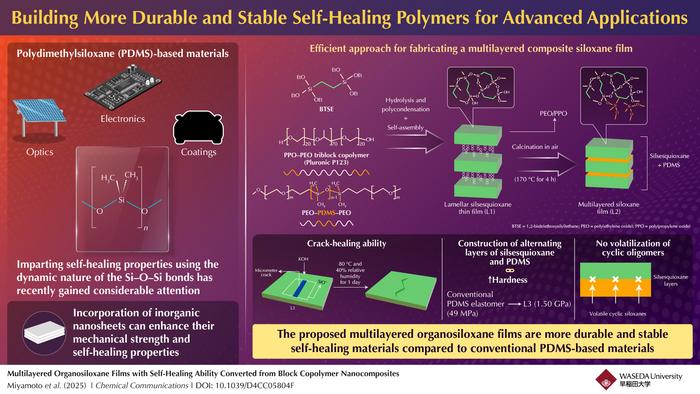

Researchers at Waseda University have made a groundbreaking advancement in the realm of material science by developing an innovative self-healing film through a sophisticated multilayered approach using organosiloxane and polydimethylsiloxane (PDMS). This recent development could revolutionize the applications of self-healing materials, especially in industries that require durable, maintenance-free coatings, such as electronics, aerospace, and optics. The research team, led by Professor Atsushi Shimojima alongside Research Associate Yoshiaki Miyamoto and Assistant Professor Takamichi Matsuno, has published their findings in the prestigious journal, Chemical Communications.
Self-healing materials are designed with the extraordinary ability to autonomously mend themselves after sustaining damage. The underlying mechanism often relies on dynamic chemical bonds that can break and reform. With organosiloxane, the focus is placed on silanolate (Si-O⁻) groups that significantly enhance these materials’ capability to repair themselves. The introduction of these silanolate groups facilitates the rearrangement and reconnection of the siloxane (Si-O-Si) networks, thereby enabling the films to recover from micro-scale damage.
In the study, the researchers employed a self-assembly technique to fabricate layered films that showcase significant improvements over traditional PDMS elastomers. Conventional PDMS materials have their limitations in terms of hardness and susceptibility to deterioration. The innovative multilayered films developed at Waseda University integrate highly cross-linked organosiloxane layers with grafted PDMS layers to enhance rigidity and stability.
The self-assembly process began by depositing a solution comprising 1,2-bis(triethoxysilyl)ethane along with various block copolymers onto a silicon or glass substrate. Spin-coating and drop-casting were employed to create a thin film with a lamellar structure. Following the deposition, the films underwent calcination at a controlled temperature, removing the copolymer components and leaving behind a robust structure composed of silsesquioxane and PDMS layers.
A key aspect of this development is the introduction of self-healing properties through the introduction of Si-O⁻ groups. The films were treated with a specialized solution containing tetrahydrofuran, water, and potassium hydroxide (KOH). This unique treatment encouraged the conversion of silanol (Si-OH) groups into Si-O⁻ ions, greatly facilitating the self-healing mechanisms. Remarkably, the final film exhibited the ability to recover from micrometer-scale cracks after being exposed to elevated temperatures and humidity.
Notably, the enhanced properties of these multilayered films stand in stark contrast to conventional self-healing PDMS elastomers, which typically possess a hardness rating of 49 MPa. The new self-healing film surpassed expectations with an astounding hardness of 1.50 GPa, demonstrating that it is not only tougher but also potentially more versatile for various applications. This significant increase in hardness could pave the way for more reliable protective coatings in harsh environments.
The implications of these advancements extend far beyond mere hardness measurements; they touch on sustainability and durability in material applications. The multilayered design proposed by the researchers leads to materials that are less susceptible to wear and tear, thereby reducing the frequency of maintenance and replacements for various industrial applications. For manufacturers and users alike, this translates to lower long-term costs and environmental benefits through reduced material waste.
Additionally, the combination of the organosiloxane and PDMS layers offers improved thermal resistance, enhancing the films’ overall performance in high-temperature environments. Areas of application encompass flexible electronics, where the resilience of the material can significantly impact longevity and functionality. The incorporation of self-healing capabilities makes it even more attractive for use in consumer electronics that require durability against everyday wear.
In a world that is incessantly pursuing greener and more sustainable materials, the development of these self-healing siloxane films represents a promising stride towards achieving those goals. The research does not only highlight the scientific ingenuity of the team at Waseda University but also presents a viable solution to some pressing challenges faced by modern industries. As industries continue to expand and innovate, the demand for advanced materials that can self-repair will likely become a key pursuit.
Miyamoto, the lead author of the study, states the transformative potential of this innovation by saying, “Replacing traditional materials with our self-healing material, which is less susceptible to deterioration and has high hardness, would be in high demand for maintenance-free and durable applications.” This statement encapsulates the core of their research agenda: enabling sustained performance in practical applications across various sectors.
With ongoing research and further validation, Waseda University’s advances in self-healing film technology could shift the landscape of materials science. The study, published on January 6, 2025, is a call to industries to reconsider how materials are selected and implemented in production lines. The focus on innovative, adaptive materials that can withstand environmental challenges is a progressive step in aligning with global sustainability targets.
Researchers anticipate that these films will inspire additional studies aimed at refining self-healing technologies and exploring their potential in even broader applications. The development of these multilayered organosiloxane films not only showcases the capabilities of contemporary research but also illustrates the emerging intersections within various scientific disciplines, including chemistry, engineering, and material science. As these developments continue to unfold, the impact on industry standards will likely resonate globally.
In conclusion, the work coming out of Waseda University stands as a promising beacon in the field of material science. The multilayered self-healing siloxane films are presented as a solution poised to address current limitations in material properties while also driving the conversation forward about sustainable engineering practices. The scientific community eagerly awaits further breakthroughs that might extend the applicability and performance of self-healing materials.
Subject of Research: Self-healing siloxane films
Article Title: Multilayered organosiloxane films with self-healing ability converted from block copolymer nanocomposites
News Publication Date: 6-Jan-2025
Web References: https://doi.org/10.1039/D4CC05804F
References: Chemical Communications
Image Credits: Dr. Yoshiaki Miyamoto from Waseda University
Keywords
Self-healing materials, organosiloxane, polydimethylsiloxane, multilayered films, material science, durability, sustainability, protective coatings, flexible electronics, thermally resistant materials, advanced materials, self-assembly technology.
Tags: aerospace material innovationschemical communications journal publicationsdurable coatings for electronicsdynamic chemical bonds in materialsinnovative self-assembly techniquesmultilayered film developmentoptics industry breakthroughsorganosiloxane applicationspolydimethylsiloxane advancementsself-healing materialsself-repairing technology in engineeringWaseda University research