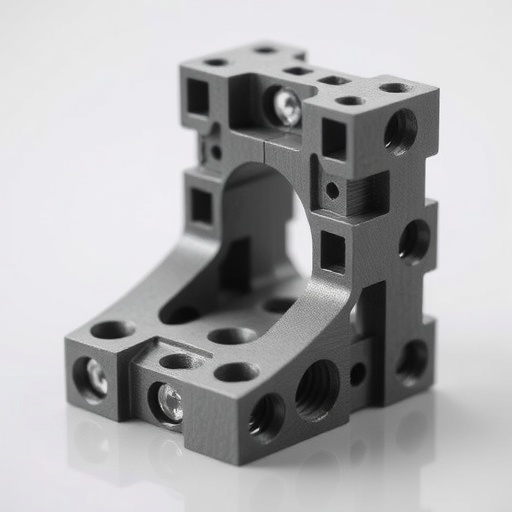
Revolutionizing Cemented Carbides: A Breakthrough in Additive Manufacturing
In the realm of materials science, few compounds have garnered as much attention for their unique combination of hardness and wear resistance as tungsten carbide–cobalt (WC–Co) composites. These materials are widely utilized in various high-demand applications, from cutting tools to construction equipment. However, their remarkable hardness also poses challenging obstacles during manufacturing processes, particularly in shaping the materials into usable forms. Traditional fabrication techniques have relied heavily on powder metallurgy, a method that tends to be both inefficient and excessively costly. Now, a pioneering approach using additive manufacturing and laser technology promises not only to mitigate these challenges but to enhance the overall production quality and reduce waste.
The conventional production of WC–Co cemented carbides involves complicated processes that utilize high-pressure sintering combined with expensive machinery. These methods not only consume significant amounts of raw materials but also yield suboptimal results, often compromising the material’s integrity. As the demand for such advanced materials continues to grow, researchers have been pressed to explore new and more efficient production techniques. The explorers of this new frontier are now leveraging innovative methods such as additive manufacturing (AM) along with hot-wire laser irradiation, a combination that holds the potential to redefine the landscape of cemented carbide manufacturing.
Additive manufacturing, often referred to as 3D printing, involves layering materials to build structures incrementally. By utilizing hot-wire laser irradiation, an amalgamation of a high-energy laser beam together with preheated filler wire can be employed to optimize deposition rates and improve process efficiency. This advanced method allows researchers to deposit WC–Co exactly where needed, which significantly reduces unnecessary material consumption and optimizes production efficiency. Importantly, it also preserves the hardness and durability that are crucial to the utility of these composite materials.
The findings of this groundbreaking study appear in the prestigious International Journal of Refractory Metals and Hard Materials. Researchers explored two distinct fabrication methods during their experiments. The first method utilizes direct laser irradiation on the upper surface of the cemented carbide rod, while the second, more innovative method directs the laser beam beneath the rod, radiating through to the base material. Remarkably, this dual approach enables the softening of the metals without experiencing complete melting, which is particularly advantageous for maintaining the desired mechanical properties of the final product.
Indeed, the results from this investigation highlight that the newly developed techniques yield highly durable cemented carbides while maintaining a remarkable hardness level exceeding 1400 HV—a measure reflecting resistance to penetration. Such hardness levels position these materials among the toughest utilized in industrial applications, just shy of superhard materials such as diamonds and sapphires. Perhaps most notably, the team’s efforts have succeeded in fabricating defect-free cemented carbide molds, a primary objective of their research.
However, the endeavor has not been without its challenges. For instance, the rod-leading method experienced some degree of decomposition of tungsten carbide in the upper sections of the product, resulting in defects that undermined the structural integrity of the final composite. Similarly, issues arose with the laser-leading method concerning retention of hardness. To address these obstacles, researchers implemented a nickel-based alloy middle layer and consistently monitored temperatures, ensuring they remained at levels above cobalt’s melting point but below the threshold for grain growth. This careful calibration has led to successful production of AM-based cemented carbides without compromising on hardness or durability.
This auspicious development presents a springboard for further advancements in the fabrication of cemented carbide materials. Researchers are keen to continue exploring this technique, aiming to overcome challenges such as cracking during the manufacturing process, as well as expanding the capacity for crafting more complex geometric forms. This innovative approach, which revolves around softening metal rather than full melting, could find applications extending beyond cemented carbides, potentially influencing other material types within various industrial sectors.
As a passionate advocate for advancing manufacturing technologies, Keita Marumoto, assistant professor at Hiroshima University’s Graduate School of Advanced Science and Engineering, articulates the importance of this research. “Cemented carbides are crucial for cutting tool applications, but the raw materials are costly. By adopting additive manufacturing, we can precisely deposit cemented carbide materials where necessary, thus significantly reducing material expenditures.” This emphasis on cost efficiency and resource management could prove transformative for industries reliant on these materials.
Research integrity is maintained, with the authors declaring no conflicts of interest influencing their work. The potential implications of this research extend beyond immediate applications, hinting at future developments in manufacturing processes that could reshape not only the production of WC–Co cemented carbides but also the wider adoption of additive manufacturing technologies across other high-performance materials.
In conclusion, the fusion of additive manufacturing and laser technology signifies a strong advance in the production of tungsten carbide cemented materials. As researchers from Hiroshima University continue their ambitious efforts, the future of cemented carbides looks increasingly bright, promising to pave the path for more sustainable and efficient production methods. By steadily overcoming production hurdles, they could set the stage for innovations that resonate throughout the materials science community and integrated industrial applications.
Subject of Research: Utilization of additive manufacturing and hot-wire laser irradiation in the production of cemented carbides.
Article Title: Effect of the hot-wire laser irradiation method and a Ni-based alloy middle layer on mechanical properties and microstructure in additive manufacturing of WC–Co cemented carbide.
News Publication Date: 13-Dec-2025
Web References: International Journal of Refractory Metals and Hard Materials
References: 10.1016/j.ijrmhm.2025.107624
Image Credits: Credit: Courtesy of Keita Marumoto/Hiroshima University
Keywords
Additive manufacturing, cemented carbides, tungsten carbide, cobalt, laser technology, material science, fabrication techniques, mechanical properties, industrial applications.
Tags: 3D printing advancementsadditive manufacturing breakthroughscemented carbides fabricationefficient production techniqueshigh-demand applications of WC-Coinnovative methods in materials engineeringlaser technology in manufacturingmanufacturing tough engineering materialsovercoming manufacturing challenges in ceramicsreducing waste in materials sciencerevolutionizing industrial manufacturing processestungsten carbide-cobalt composites