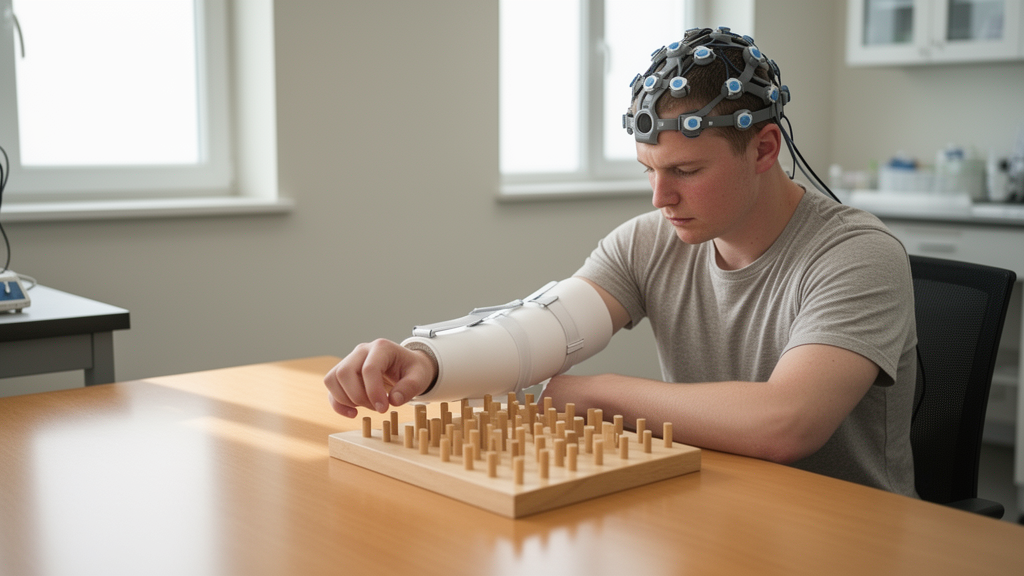
Applying anodal transcranial direct current stimulation over the left primary motor cortex limits declines in hand dexterity and enhances motor learning during temporary limb disuse, according to a randomized controlled trial published in the Journal of NeuroEngineering and Rehabilitation. The scientific investigation evaluated whether targeted non-invasive electrical stimulation of the motor cortex could successfully alleviate the detrimental functional deficits typically induced by short-term limb immobilization in healthy adult participants.
Periods of short-term limb immobilization are known to alter cortical excitability within the brain and impair overall motor performance. However, prior to this investigation, the precise impact of acute disuse on motor learning and hand dexterity had remained uncertain. While transcranial direct current stimulation had previously demonstrated promise for enhancing motor learning and manual dexterity in healthy settings, whether the technique could actively mitigate the adverse functional consequences of physical immobilization remained unresolved.
To investigate these questions, researchers conducted a randomized trial registered under Clinical Trial Registration No NCT07089056, which was originally registered on 08 July 2025. The research team recruited sixty healthy adult participants and randomly assigned them to one of three experimental groups: a control group that received neither immobilization nor stimulation, a second group that underwent short-term immobilization combined with active anodal transcranial direct current stimulation, and a third group that experienced immobilization paired with sham stimulation.
For participants allocated to the two immobilization cohorts, the right hand was fully immobilized for a continuous period of sixteen hours. Toward the end of this immobilization period, participants in the active intervention group received a single twenty-minute session of anodal transcranial direct current stimulation applied over the left primary motor cortex, designated as M1.
Motor outcomes were systematically evaluated across two primary testing intervals: baseline assessments conducted at T0 prior to the intervention, and follow-up assessments conducted at T1 immediately following the completion of the intervention. The study distinguished general motor performance, defined as the overall capacity to execute movement tasks across both speed and accuracy dimensions of motor output, from selective motor learning and manual hand dexterity.
To quantify these distinct dimensions of motor function, the researchers utilized two established behavioral assessments. The Sequence Reaction Time Task was employed to evaluate general motor performance as well as motor learning. In parallel, the Purdue Pegboard task was used to assess hand dexterity, incorporating both a dedicated right-hand test isolating the immobilized limb and a bimanual assemble test requiring active coordination between both hands.
The experimental results demonstrated that short-term immobilization diminished hand dexterity without significantly impairing general motor performance or selective motor sequence learning. Immediately following the intervention at T1, the immobilization plus sham stimulation group exhibited significantly lower right-hand dexterity scores (p = 0.011) and lower assemble task scores (p = 0.034) on the Purdue Pegboard task in comparison to the non-immobilized control group.
Crucially, the application of anodal transcranial direct current stimulation mitigated the detrimental effects of immobilization on manual dexterity while simultaneously improving motor learning and general motor performance. At the T1 post-intervention assessment, participants in the immobilization plus active stimulation group achieved significantly higher motor learning scores (p = 0.014), right-hand dexterity scores (p = 0.039), and assemble task scores (p = 0.032) on the Purdue Pegboard task compared to the immobilization plus sham stimulation group.
In their conclusion, the study authors affirmed that short-term limb immobilization impairs hand dexterity while leaving general motor execution and motor learning largely unaffected. Applying anodal transcranial direct current stimulation over the primary motor cortex during the immobilization period successfully limited this functional decline and even enhanced motor learning, suggesting that transcranial direct current stimulation may serve as an effective early intervention to preserve motor function and manual dexterity during temporary limb immobilization.
Subject of Research: Effects of anodal transcranial direct current stimulation on hand dexterity and motor learning during limb immobilization
Article Title: Effects of transcranial direct current stimulation during short–term immobilization on motor learning and hand dexterity in healthy adults
Article References: Yang, Z., Nitsche, M. A., Zhang, X., Yue, T., Zhao, R., & Qi, F. (2026). Effects of transcranial direct current stimulation during short–term immobilization on motor learning and hand dexterity in healthy adults. Journal of NeuroEngineering and Rehabilitation. https://doi.org/10.1186/s12984-026-02181-6
Image Credits: AI Generated
DOI: 10.1186/s12984-026-02181-6
Keywords: transcranial direct current stimulation, tDCS, anodal stimulation, short-term immobilization, limb immobilization, motor learning, hand dexterity, primary motor cortex, M1, Sequence Reaction Time Task, SRTT, Purdue Pegboard task, cortical excitability, general motor performance, assemble test, right-hand test, sham stimulation, healthy adults
News Source: Cassandra Pierce. (November 20, 2026). Brain Stimulation During Limb Immobilization Preserves Hand Dexterity and Boosts Motor Learning. Scienmag.