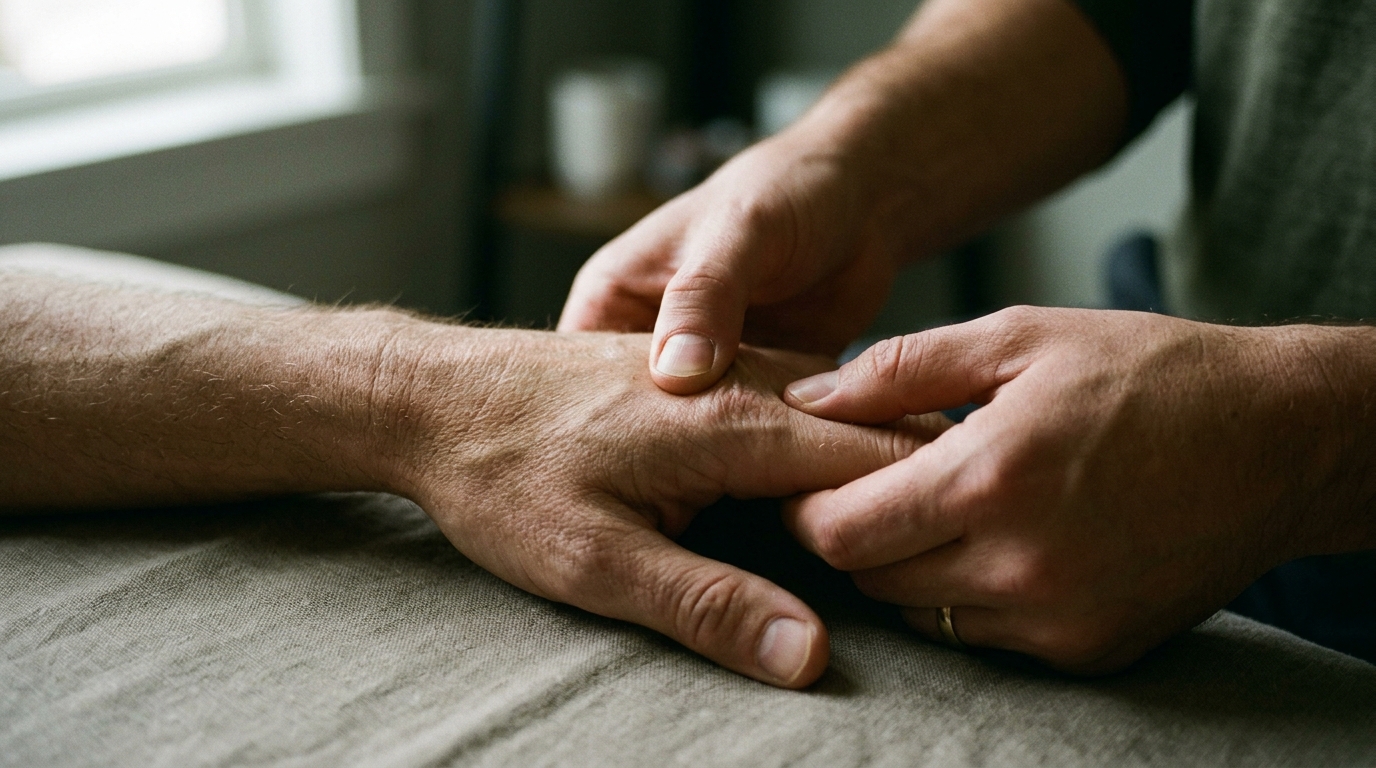
In an exploratory neuroimaging study, researchers evaluated how manual pressure applied through Chinese traditional massage, known as Tui Na, influences neural activity in the cerebral sensorimotor cortex. Investigating fifteen healthy adult participants, the research team used functional near-infrared spectroscopy to monitor continuous hemodynamic changes while manipulating the Hegu acupoint on the right hand. The investigators observed localized task-related increases in oxygenated hemoglobin within the left primary sensorimotor area during specific stimulation conditions compared to non-acupoint control manipulation. However, the authors noted that these exploratory statistical differences did not survive correction for multiple comparisons, underscoring the preliminary nature of the physiological observations.
The investigation was designed to clarify cortical hemodynamic patterns associated with acupoint stimulation and to test whether mechanical force variations alter cortical activation. Conducted by researchers affiliated with Shanghai University of Traditional Chinese Medicine, Hangzhou Hospital of Traditional Chinese Medicine, and Yueyang Hospital of Integrated Traditional Chinese and Western Medicine, the study focused on the Hegu acupoint, located on the hand, paired with a nearby non-acupoint control site situated one centimeter above the acupoint. The primary objective centered on recording cerebral sensorimotor cortical responses using a dedicated functional near-infrared spectroscopy channel montage during standardized manual pressure applications.
The experimental protocol employed a repeated block-design paradigm to capture real-time cortical hemodynamic changes rather than a pre-intervention and post-intervention assessment. Each stimulation block consisted of a thirty-second pre-task resting interval, ten seconds of active Tui Na manual pressing, and fifteen seconds of subsequent rest, with each sequence repeated across six stimuli. Measurements were recorded continuously throughout these task blocks using optical channels spanning sensorimotor regions. Fifteen healthy volunteers underwent the experimental procedure on their right hands, allowing the investigators to observe contralateral and ipsilateral cerebral cortex dynamics during defined mechanical interventions.
To compare acupoint versus non-acupoint responses, the investigators initially administered heavy manual pressing to the right Hegu acupoint until participants reported an obvious yet bearable sensation of sore distension. Following a three-minute rest interval, an identical heavy force was applied to the control site located one centimeter upward. In a separate experimental sequence evaluating mechanical intensity, practitioners applied three distinct force levels to the Hegu acupoint: a light force of two kilograms producing a gentle skin touch, a medium force of four kilograms eliciting mild soreness, and a heavy force of six kilograms causing pronounced but tolerable soreness, with three-minute rest periods separating each trial.
The hemodynamic data revealed regional differences between the experimental conditions across specific optode channels. When contrasting Hegu pressing against the control condition, cortical activation was higher in the left hemisphere than in the right hemisphere of the sensorimotor cortex. Specifically, channel 30, positioned over the left primary sensorimotor area, demonstrated significant uncorrected activation, yielding a t-statistic of 2.455, an uncorrected p-value of 0.028, Cohen’s d of 0.448, and a 95 percent confidence interval ranging from 0.048 to 0.836. In this channel, oxygenated hemoglobin concentrations increased during active Hegu manipulation and declined during rest periods, whereas no obvious oxygenated hemoglobin elevation occurred during non-acupoint pressing.
Varying the mechanical pressure applied to the Hegu acupoint produced measurable force-dependent effects across both hemispheres. Analysis of variance indicated a significant main effect of force intensity in channel 30 within the left primary sensorimotor area, recording an F-statistic of 5.609, a Greenhouse-Geisser corrected p-value of 0.021, and a partial eta-squared of 0.286 with a 90 percent confidence interval from 0.054 to 0.472. A corresponding main effect emerged in channel 8 over the right primary sensorimotor area, showing an F-statistic of 4.435, an uncorrected p-value of 0.021, and a partial eta-squared of 0.241 with a 90 percent confidence interval from 0.025 to 0.430. Linear mixed model analyses further demonstrated statistically significant linear trends in channel 30 and channel 8, indicating that cortical activity strengthened progressively as manual stimulation increased from light to heavy levels.
Despite these measured physiological responses, the authors emphasized substantial methodological boundaries that prevent definitive clinical or anatomical conclusions. Because the observed cortical activation did not survive false discovery rate correction for multiple comparisons, the findings remain strictly exploratory. Furthermore, the small cohort of fifteen healthy subjects and the spatial proximity of the control site, placed just one centimeter away, preclude broader inferences regarding absolute acupoint specificity or meridian theories. The research team concluded that confirming whether manual Tui Na produces distinct cortical modulation will require larger study samples, rigorous control sites, and replicated trials under stringent multiple-testing corrections.
Subject of Research: Sensorimotor cortical hemodynamic responses to Hegu acupoint Tui Na massage
Article Title: Tui Na at Hegu modulates sensorimotor cortical activity in healthy adults: an exploratory fNIRS study revealing characteristic activation and force-dependent effects
Article References: Chen, Y., Mao, M., Xu, D., & Luo, H. (2026). Tui Na at Hegu modulates sensorimotor cortical activity in healthy adults: an exploratory fNIRS study revealing characteristic activation and force-dependent effects. Frontiers in Neurology, 17, Article 1930350. https://doi.org/10.3389/fneur.2026.1930350
Image Credits: AI Generated
DOI: 10.3389/fneur.2026.1930350
Keywords: Tui Na, Hegu acupoint, functional near-infrared spectroscopy, sensorimotor cortex, hemodynamic response, oxygenated hemoglobin, primary sensorimotor area, channel 30, channel 8, force-dependent activation, mechanical pressure, block-design paradigm, cortical neuroactivity, exploratory neuroimaging, acupoint specificity, linear mixed model, Frontiers in Neurology
News Source: Colin Clarke. (November 27, 2026). Brain Imaging Study Examines Sensorimotor Cortical Responses to Hegu Acupoint Massage. Scienmag.