

• HOME
  • NEWS
  • EXPLORE
    • CAREER
      • Companies
      • Jobs
    • EVENTS
    • iGEM
      • News
      • Team
    • PHOTOS
    • VIDEO
    • WIKI
  • BLOG
  • COMMUNITY
    • FACEBOOK
    • INSTAGRAM
    • TWITTER
Wednesday, April 1, 2026
BIOENGINEER.ORG
No Result
View All Result
  • Login
  • HOME
  • NEWS
  • EXPLORE
    • CAREER
      • Companies
      • Jobs
        • Lecturer
        • PhD Studentship
        • Postdoc
        • Research Assistant
    • EVENTS
    • iGEM
      • News
      • Team
    • PHOTOS
    • VIDEO
    • WIKI
  • BLOG
  • COMMUNITY
    • FACEBOOK
    • INSTAGRAM
    • TWITTER
  • HOME
  • NEWS
  • EXPLORE
    • CAREER
      • Companies
      • Jobs
        • Lecturer
        • PhD Studentship
        • Postdoc
        • Research Assistant
    • EVENTS
    • iGEM
      • News
      • Team
    • PHOTOS
    • VIDEO
    • WIKI
  • BLOG
  • COMMUNITY
    • FACEBOOK
    • INSTAGRAM
    • TWITTER
No Result
View All Result
Bioengineer.org
No Result
View All Result
Home NEWS Science News Chemistry

Bound-state electrons synergy over photochromic high-crystalline C₃N₅ nanosheets in enhancing charge separation for photocatalytic H₂ production

Bioengineer by Bioengineer
June 11, 2024
in Chemistry
Reading Time: 3 mins read
0
Schematic illustration for the mechanism of photochromic enhanced hydrogen production process over HC-C₃N₅ nanosheets
Share on FacebookShare on TwitterShare on LinkedinShare on RedditShare on Telegram

Photocatalytic water splitting, a sustainable energy strategy, utilizes solar energy to produce clean hydrogen fuel. While it offers a promising solution to the global energy crisis and environmental pollution, the slow kinetics of photogenerated electron-hole pairs result in low activity for most semiconductor materials, even with sacrificial agents. To that end, integrating electron traps and reactive centers could be a feasible strategy to enhance charge separation and catalytic performance.
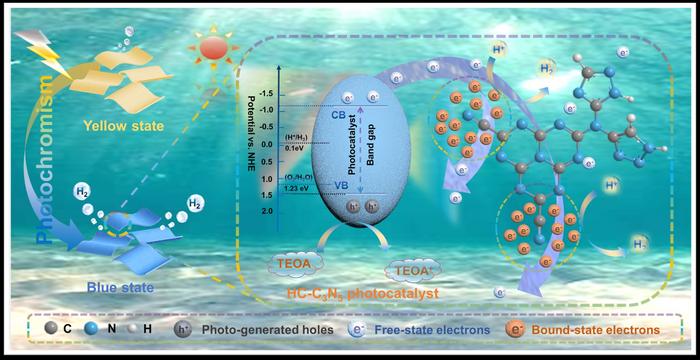
Schematic illustration for the mechanism of photochromic enhanced hydrogen production process over HC-C₃N₅ nanosheets

Credit: Shen, Yu, et al.

Photocatalytic water splitting, a sustainable energy strategy, utilizes solar energy to produce clean hydrogen fuel. While it offers a promising solution to the global energy crisis and environmental pollution, the slow kinetics of photogenerated electron-hole pairs result in low activity for most semiconductor materials, even with sacrificial agents. To that end, integrating electron traps and reactive centers could be a feasible strategy to enhance charge separation and catalytic performance.

In a new study, researchers at Jiangsu University of Science and Technology and Zhejiang Ocean University synthesized high-crystallinity nitrogen-rich carbon nitride nanosheet photocatalysts via an alkali potassium salt-assisted molten salt method, promoting photocatalytic hydrogen evolution.

“We elucidated the role of bound-state electrons in broadening the absorption spectrum and generating photogenerated charges and verified the electron migration pathway induced by cyanide groups, coordinating the transition of photoexcited electrons from an unbound to a bound state,” shares co-corresponding author Shijie Li.

The team synthesized the exceptional performance of highly crystalline C3N5 (HC–C3N5) nanosheet as a photocatalyst, demonstrating a e hydrogen evolution rate of 3.01 ​mmol ​h−1 ​g−1, which surpasses that of bulk C3N5 (B– C3N5) by a factor of 3.27.

“Experimental and theoretical analyses reveal that HC-C3N5 nanosheets exhibit macroscopic photoinduced color changes, effectively broadening the absorption spectrum and significantly enhancing the generation of excitons,” explains Weilong Shi.  

Notably, the team discovered potential electron capture sites, which contributed to understanding complex reaction kinetics, strengthening charge separation dynamics during photocatalytic hydrogen production.

The researchers published their findings in the KeAi journal Advanced Powder Materials.

###

Contact the author: Shijie Li, Zhejiang Ocean University, Zhoushan, P.R. China, [email protected]; Weilong Shi, Jiangsu University of Science and Technology, Zhenjiang, PR. China, [email protected]

The publisher KeAi was established by Elsevier and China Science Publishing & Media Ltd to unfold quality research globally. In 2013, our focus shifted to open access publishing. We now proudly publish more than 100 world-class, open access, English language journals, spanning all scientific disciplines. Many of these are titles we publish in partnership with prestigious societies and academic institutions, such as the National Natural Science Foundation of China (NSFC).


Journal

Advanced Powder Materials

DOI

10.1016/j.apmate.2024.100202

Method of Research

Experimental study

Subject of Research

Not applicable

Article Title

Bound-state electrons synergy over photochromic high-crystalline C₃N₅ nanosheets in enhancing charge separation for photocatalytic H₂ production.

COI Statement

The authors declare that they have no known competing financial interests or personal relationships that could have appeared to influence the work reported in this paper.


Share12Tweet8Share2ShareShareShare2

Related Posts

Scientists Achieve Reliable Quantum Network Connections Across Kilometers of Noisy Fiber

Scientists Achieve Reliable Quantum Network Connections Across Kilometers of Noisy Fiber

April 1, 2026
Stretchy, Heat-Activated Skin Patch Offers Non-Surgical Melanoma Treatment

Stretchy, Heat-Activated Skin Patch Offers Non-Surgical Melanoma Treatment

April 1, 2026

Quantum switches perform best in extreme cold, new research finds

April 1, 2026

Manchester Professor Named Expert Reviewer for Government Nuclear Decommissioning Review

April 1, 2026

POPULAR NEWS

  • blank

    Revolutionary AI Model Enhances Precision in Detecting Food Contamination

    96 shares
    Share 38 Tweet 24
  • Imagine a Social Media Feed That Challenges Your Views Instead of Reinforcing Them

    1006 shares
    Share 398 Tweet 249
  • Promising Outcomes from First Clinical Trials of Gene Regulation in Epilepsy

    51 shares
    Share 20 Tweet 13
  • Popular Anti-Aging Compound Linked to Damage in Corpus Callosum, Study Finds

    44 shares
    Share 18 Tweet 11

About

We bring you the latest biotechnology news from best research centers and universities around the world. Check our website.

Follow us

Recent News

Paul Ohodnicki Leads Team Developing Transformers for High-Voltage DC Power Grids

Illinois Tech Computer Science Researcher Recognized with IEEE Chicago Section Award

Robotic Bronchoscopy: A Safer, Faster Breakthrough in Lung Cancer Diagnosis

Subscribe to Blog via Email

Enter your email address to subscribe to this blog and receive notifications of new posts by email.

Join 78 other subscribers
  • Contact Us

Bioengineer.org © Copyright 2023 All Rights Reserved.

Welcome Back!

Login to your account below

Forgotten Password?

Retrieve your password

Please enter your username or email address to reset your password.

Log In
No Result
View All Result
  • Homepages
    • Home Page 1
    • Home Page 2
  • News
  • National
  • Business
  • Health
  • Lifestyle
  • Science

Bioengineer.org © Copyright 2023 All Rights Reserved.
