Solar panels lose power every time they heat up, and the polymer films that seal them are a big part of the problem. Ethylene–vinyl acetate copolymer, known across the photovoltaic industry as EVA, has been the workhorse encapsulant for decades because it is cheap, transparent, and easy to laminate. But EVA is a thermal insulator, so heat generated inside a module lingers and slowly degrades both the cells and the film itself. A team of Chinese materials scientists now reports a way out of this long-standing trade-off, engineering an EVA composite that conducts heat more than twelve times better than the pristine polymer while still stretching, insulating, and shielding like a commercial encapsulant should.
The study, published open access in Advanced Composites and Hybrid Materials by Fanghua Luo of Northeast Petroleum University and colleagues, including Huaiyuan Wang of Tianjin University, describes a three-tier design strategy that tackles the problem at the molecular, filler, and interface levels simultaneously. The result is a composite film with a through-plane thermal conductivity of 2.96 watts per meter-kelvin, a 1245 percent enhancement over pure EVA, achieved at a filler loading of 110 parts per hundred resin. That combination of high loading and preserved mechanical performance is what has historically eluded researchers in this field.
The first tier of the strategy involves crosslinking the EVA matrix itself. Crosslinking ties the polymer chains together into a network, which raises the material’s structural integrity and helps it withstand the temperatures and mechanical stresses of lamination and long-term outdoor service. The researchers denote this crosslinked matrix as cEVA. Without this step, simply stuffing thermally conductive filler into EVA tends to produce a brittle film that cracks during module fabrication, defeating the purpose of the upgrade.
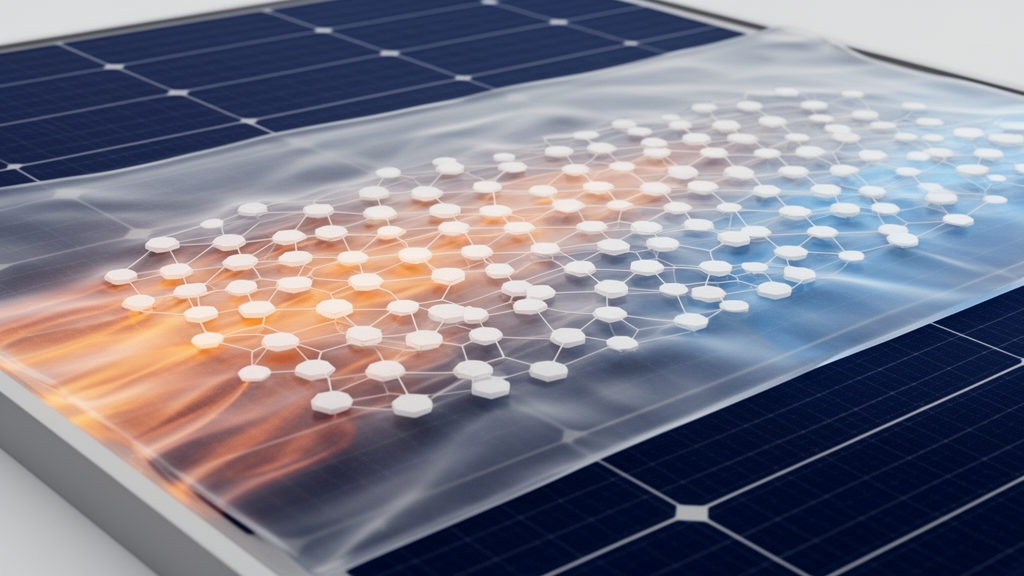
The second tier is the filler architecture, and it is where the design gets clever. Rather than using a single morphology of boron nitride, the team built what they call a sheet-sphere hybrid network, abbreviated f-BN, from two complementary building blocks: hexagonal boron nitride microplatelets and spherical boron nitride microspheres. Hexagonal boron nitride, sometimes nicknamed white graphene, is an electrical insulator with excellent intrinsic thermal conductivity, making it the filler of choice for encapsulants where any electrical leakage would be catastrophic. The platelets provide extended, high-conductivity surfaces, while the spheres pack into the gaps between them, improving contact and reducing the thermal resistance at filler-to-filler junctions. Together they form a more continuous percolating heat pathway than either morphology could achieve alone, allowing heat to flow through the thickness of the film, the direction that matters most for pulling heat out of a solar cell.
The third tier addresses the Achilles heel of all polymer composites: the interface. Heat and mechanical stress both struggle to cross the boundary between an inorganic filler and an organic polymer, because the two materials are chemically incompatible. The researchers solved this with what they term dual-anchored interfacial engineering. They grafted 3-aminopropyltriethoxysilane, a coupling agent known as KH550, onto both sides of the interface. On the EVA side, the silane was attached through radical coupling, and on the boron nitride surfaces it was attached through hydroxylation reactions. The result is an interface stitched together by both covalent bonds, which are strong and permanent, and hydrogen bonds, which are reversible and can dissipate energy. This dual anchoring means phonons, the carriers of heat, encounter less scattering at the interface, while mechanical loads are transferred efficiently between matrix and filler instead of tearing the composite apart.
The numbers tell the story of why this matters. At 110 phr of filler, the composite film retained a tensile strength of 8.99 megapascals and an elongation at break of 89.75 percent. Those are remarkable figures for a material carrying more than half its weight in ceramic filler, and they reflect the effectiveness of the covalent-plus-hydrogen-bond interface in preventing the embrittlement that usually accompanies high filler loadings. Just as important for a photovoltaic encapsulant, the film maintained a volume resistivity exceeding 10 to the 14th power ohm-centimeters, confirming that the boron nitride network did not create any conductive pathways that could compromise the electrical isolation of the module.
Perhaps the most surprising performance boost comes from a property that has nothing to do with conduction. The composite film exhibited a solar reflectance of 91.09 percent and an infrared emissivity of 96.17 percent. In plain terms, the film bounces most incoming sunlight that is not converted to electricity back out of the module, and then radiates the absorbed heat away efficiently in the infrared band. When these radiative effects are combined with the enhanced thermal conductivity, the researchers measured a photovoltaic module temperature reduction of 5.34 degrees Celsius compared with modules using conventional encapsulation. That may sound modest, but in photovoltaics every degree counts: silicon cells typically lose relative efficiency as they heat, and sustained high temperatures accelerate the chemical degradation pathways that shorten module lifetimes. A passive cooling effect that requires no fans, pumps, or extra components is therefore highly attractive for module manufacturers.
The broader significance of the work lies in the design framework rather than any single number. Many research groups have pursued thermally conductive encapsulants, and many have achieved impressive conductivity figures by loading polymers with boron nitride, graphene, or alumina. The recurring failure mode has been the property conflict: pushing conductivity higher usually means more filler, which means stiffer, more brittle films with worse processability and sometimes degraded insulation. The three-tier strategy of matrix crosslinking, hybrid filler architecture, and dual-anchored interfaces offers a template for resolving that conflict systematically. Because each tier addresses a distinct bottleneck, the approach should transfer to other polymer systems that need the same trio of heat dissipation, mechanical strength, and electrical insulation, from power electronics packaging to electric vehicle battery components.
There are, of course, steps between a laboratory demonstration and a production line. The filler loading of 110 phr is high, and the cost of spherical boron nitride microspheres exceeds that of commodity encapsulant ingredients, so economics will shape adoption. Long-term durability testing, including damp-heat aging, ultraviolet exposure, and thermal cycling under real module conditions, will be needed to confirm that the dual-anchored interface survives decades outdoors. The published study is also an accepted-manuscript version released early under open access, so some details may be refined in the final record. Still, the core demonstration stands: a 1245 percent conductivity gain with mechanical properties and insulation intact, plus a measurable module-level cooling benefit.
For an industry racing to squeeze more output and longer lifetimes out of every panel, the message is encouraging. The materials that surround a solar cell are no longer passive spectators; engineered correctly, the humble encapsulant can become an active thermal manager. By treating the interface, the filler network, and the polymer matrix as one integrated system, the Daqing and Tianjin team has shown that the properties photovoltaic manufacturers were told they must trade off against each other can, with sufficient molecular craftsmanship, be delivered together in a single film.
Subject of Research: Thermally conductive and mechanically robust EVA/boron nitride composite encapsulants for photovoltaic modules
Article Title: Dual-anchored interfacial and sheet-sphere hybrid network engineering for thermally conductive, mechanically robust EVA/BN photovoltaic encapsulants
Article References: Luo, F., Ma, X., Tao, L., Cui, Y., Wang, Y., & Wang, H. (2026). Dual-anchored interfacial and sheet-sphere hybrid network engineering for thermally conductive, mechanically robust EVA/BN photovoltaic encapsulants. Advanced Composites and Hybrid Materials. https://doi.org/10.1007/s42114-026-02087-w
Image Credits: AI Generated
DOI: 10.1007/s42114-026-02087-w
Keywords: EVA encapsulant, boron nitride, thermal conductivity, photovoltaic modules, polymer composites, interfacial engineering, sheet-sphere hybrid filler, crosslinked matrix, solar reflectance, volume resistivity, heat dissipation, mechanical properties
News Source: Denise Maddox. (October 19, 2026). Boron Nitride Hybrid Network Cools Solar Panels While Keeping Films Tough. Scienmag.