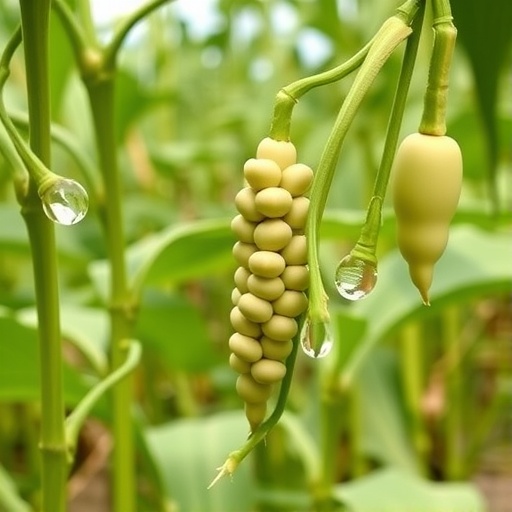
In a groundbreaking advancement in agricultural biotechnology, a team of scientists led by Gao et al. has achieved remarkable improvements in soybean crops, particularly in enhancing salt tolerance and oil content. Their study focuses on the strategic use of marker-assisted pyramiding techniques to combine the benefits of two significant genetic traits: GmSALT3, which confers salt tolerance, and various high-oil quantitative trait loci (QTLs). This dual approach not only aims to bolster the resilience of soybeans against salinity stress—an increasing concern due to climate change—but also strives to enhance the nutritional and economic value of these crucial crops.
Soybeans are among the most important leguminous plants cultivated worldwide, with extensive use in food, feed, and industrial applications. However, their productivity is often hindered by abiotic stressors, notably soil salinity. This issue exacerbates global food security concerns, especially in regions where irrigation practices inadvertently lead to salinization. The research conducted by Gao and colleagues sheds light on how genetic engineering and marker-assisted selection can mitigate these challenges, thus paving the way for more sustainable agricultural practices.
The scientific foundation of their study is deeply rooted in the principles of genetics and crop breeding. By employing marker-assisted pyramiding, researchers can effectively combine beneficial traits from multiple genomic loci in a single soybean variety. The GmSALT3 gene stands out as a crucial factor, providing a pathway to enhance the plant’s ability to cope with elevated salt levels. This gene has been identified as a key regulator of osmotic balance within the plant, enabling it to maintain cellular functions despite environmental stresses.
The pyramiding approach used by Gao et al. integrates high-oil QTLs, which are genetic segments associated with increased oil production in soybeans. The combination of these traits is not merely an additive effect; instead, the synergistic interaction can significantly amplify the overall yield and quality of soybean oil. Given the growing demand for high-quality oil both for culinary uses and for the production of biodiesel, this enhancement in oil content presents significant commercial opportunities.
One of the most compelling aspects of this research is its potential to directly address pressing environmental issues. With a projected increase in salinity affecting over 20% of irrigated lands globally, the application of such advanced genetic techniques is critical. The ability to cultivate salt-tolerant soybeans could lead to a transformation in agricultural practices, particularly in coastal regions and arid landscapes where salinity poses a major threat to traditional farming methods.
Furthermore, the study underscores the importance of interdisciplinary collaboration in tackling agricultural challenges. The team’s expertise in molecular biology, genetics, and agronomy exemplifies how varied scientific perspectives can converge to produce innovations that are not only scientifically robust but also practically applicable. These findings are likely to inspire further research into the genetic manipulation of other crops, emphasizing the versatility of advanced breeding techniques in enhancing plant resilience.
Accompanying the core findings, the researchers provided comprehensive data on field trials that demonstrated the improved performance of soybean varieties featuring the pyramided traits. Results indicated a marked increase in both growth and yield metrics when plants were subjected to saline conditions, showcasing the benefits of incorporating salt tolerance mechanisms within the crop’s genetic framework.
Moreover, oil composition analyses revealed that the enhanced varieties not only produced higher oil yields but also improved the nutritional profile of the oil. This is particularly significant as the emphasis on health and dietary preferences shifts towards oils with favorable fatty acid compositions. The dual improvement in both resilience and oil content aligns well with global trends toward healthier, more sustainable food sources.
In considering the broader implications of these findings, one cannot overlook the economic ramifications for farmers worldwide. By increasing the yield and quality of soybean oil, this research holds the promise of enhancing profitability for soybean growers. As markets continue to demand high-quality oil, farmers equipped with salt-tolerant soybean varieties may well gain a competitive edge, improving their livelihoods and supporting local economies.
Looking ahead, the researchers advocate for the accelerated adoption of these genetically enhanced soybean varieties in commercial agriculture. Regulatory frameworks will need to evolve to accommodate the rapid advancements in genetic engineering, ensuring safety and sustainability while fostering innovation. The call for integrated approaches, combining traditional agricultural practices with advanced biotechnology, is paramount in navigating the complexities of modern farming.
The potential of Gao et al.’s work extends beyond soybeans; it highlights a broader trend in agricultural biotechnology aimed at resilience and productivity. As climate change continues to disrupt traditional farming practices, such innovations are critical in assuring food security for future generations. The research not only sheds light on the genetic basis of plant resilience but reaffirms the role of scientific inquiry in addressing global challenges.
In summary, the study conducted by Gao, Bao, and Yang et al. represents a significant stride in agricultural research, merging cutting-edge genetic techniques with practical applications for improving crop resilience and nutritional value. Through collaborative scientific efforts, the possibilities for enhancing food systems are both exciting and imperative. As these advancements move from the lab to the field, they will undoubtedly influence the future of agriculture and play a crucial role in shaping sustainable solutions to emerging global challenges.
The impact of salt tolerance in soybean cultivation is a testament to the potential of genetic research to revolutionize the agricultural landscape. With the successful implementation of marker-assisted pyramiding, farmers may soon have access to crop varieties that not only withstand environmental stressors but also contribute to a healthier and more sustainable food supply chain. The ultimate goal remains to ensure that advancements in agricultural biotechnology lead us toward a greener and more food-secure world, benefitting both producers and consumers alike.
In conclusion, as the world grapples with the complexities of environmental change and food security, the work of Gao et al. serves as a beacon of hope. Their pioneering efforts showcase the power of scientific innovation to create impactful solutions that resonate across fields, industries, and communities. As we look to the future, the integration of such research into practical applications may well provide the key to tackling some of humanity’s most pressing challenges.
Subject of Research: Soybean salt tolerance and oil content enhancement through genetic engineering.
Article Title: Enhanced soybean salt tolerance and oil content via marker-assisted pyramiding of GmSALT3 and high-oil QTLs.
Article References:
Gao, C., Bao, L., Yang, X. et al. Enhanced soybean salt tolerance and oil content via marker-assisted pyramiding of GmSALT3 and high-oil QTLs. BMC Genomics (2026). https://doi.org/10.1186/s12864-025-12347-6
Image Credits: AI Generated
DOI:
Keywords: Soybean, salt tolerance, oil content, genetic engineering, marker-assisted selection, agricultural biotechnology.
Tags: agricultural biotechnology advancementsenhancing crop resiliencefood security and salinitygenetic engineering in agriculturegenetic traits in soybean breedingGmSALT3 genehigh-oil quantitative trait lociimproving soybean oil contentmarker-assisted pyramiding techniquessalinity stress in cropssoybean salt tolerancesustainable agricultural practices