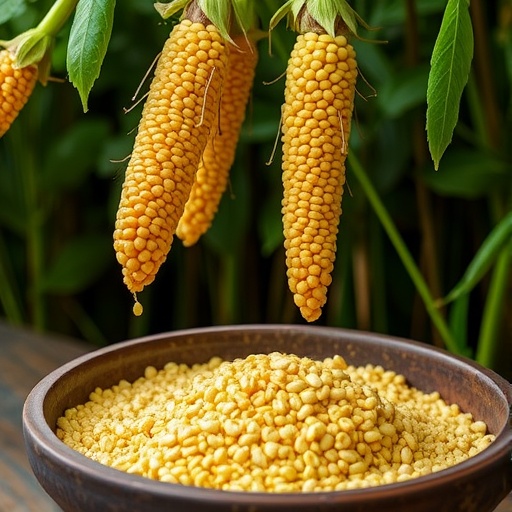
In a groundbreaking study that paves the way for nutritional innovation, researchers Kumar, Purohit, and Sharma have unveiled a transformative approach to enriching millet-based food products through the synergistic application of germination and probiotic fermentation. As the global food industry increasingly shifts its focus toward sustainable and health-promoting dietary solutions, this research taps into the untapped potential of ancient grains combined with modern biotechnological advancements. Their findings, published in Food Science and Biotechnology in December 2025, introduce a promising methodology for enhancing aromatic amino acids—key compounds pivotal not only for human health but also for flavor optimization in food matrices.
Millets, long valued as resilient cereal staples in many regions of the world, carry an impressive nutritional profile that is often underexploited in contemporary diets. While recognized for their high fiber, mineral content, and resilience to harsh growing conditions, millets’ contribution to amino acid profiles, particularly aromatic amino acids like phenylalanine, tyrosine, and tryptophan, has remained a challenge. These amino acids are essential precursors for neurotransmitters and vital components influencing metabolic pathways. Kumar and colleagues’ research focuses on enhancing these aromatic amino acid concentrations effectively, thereby linking traditional food substrates with next-generation nutritional science.
The team’s methodological innovation starts with germination, a process that activates endogenous enzymes within millet grains, catalyzing biochemical transformations. Germination dramatically alters millet’s nutrient bioavailability by beginning the breakdown of complex macromolecules like starch and proteins into simpler, more digestible forms. In this activated state, the millet exhibits amplified levels of free amino acids, setting the stage for the next phase of enrichment: probiotic fermentation. This two-tiered strategy is not merely additive but synergistic, yielding nutritional enhancements far exceeding those achieved by each process independently.
Probiotic fermentation introduces beneficial microbial strains capable of further modifying the millet matrix. These microbes, often lactic acid bacteria, metabolize the available substrates, producing metabolites that include aromatic amino acids and other flavor-enhancing compounds. Importantly, the fermentation process also contributes to the probiotic profile of the final product, imparting health benefits to the consumer beyond nutrient enrichment, such as gut microbiota modulation and improved digestive function. The study’s evaluation of specific probiotic strains underscores their role in optimizing amino acid yield and functional food potential.
The research delineates the biochemical mechanisms underpinning these enhancements with a technical depth that explains how protease enzymes liberated during germination facilitate the degradation of prolamins and glutelins—major millet storage proteins—liberating peptide chains that serve as substrates for fermenting microbes. This enzymatic cascade results in a rich pool of free amino acids, with a remarkable elevation of aromatic variants due to microbial action during fermentation. The elucidation of this pathway provides a robust scientific rationale for utilizing traditional biochemical transformations alongside modern probiotics for food matrix enhancement.
An intriguing aspect of the study is the meticulous optimization of parameters that govern germination and fermentation processes. Variables such as germination time, temperature, and moisture levels were finely tuned to maximize enzyme activity without compromising grain integrity. Similarly, fermentation conditions—including microbial strain selection, inoculum concentration, pH, temperature, and duration—were systematically evaluated to ensure optimal probiotic viability and amino acid biosynthesis. This rigorous experimental design ensures the reproducibility and scalability of the approach in industrial food production settings.
The authors also address the sensory implications of their approach, emphasizing that aromatic amino acids contribute significantly to flavor precursors that improve the organoleptic attributes of millet-based foods. This sensory enhancement is critical in overcoming consumer biases against alternative grains and promoting wider acceptance of millet-derived functional foods. The study describes advanced chromatographic and spectrometric analyses to characterize volatile compounds and non-volatile flavor molecules arising from the fermentation process, linking biochemical changes to perceptual improvements.
Beyond nutrition and flavor, the approach holds promise for sustainability and food security underlined throughout the article. Millets require fewer inputs and tolerate adverse climatic conditions, presenting a viable alternative to staple cereals threatened by climate change. By leveraging germination and fermentation to boost their nutritional profile, the researchers propose a value-added pathway to support global nutritional challenges, especially in regions vulnerable to food scarcity and micronutrient deficiencies.
The implications of this work extend into the realm of biotechnological food processing, where harnessing the metabolic capabilities of probiotics in traditional grains invigorates an old food matrix with modern functional attributes. This positions millet-based foods as strong candidates for functional food markets targeting consumers demanding natural, health-enhancing ingredients fortified through bioactive fermentation—not synthetic additives.
Kumar and his team envision a future where their strategy could be applied across a spectrum of cereal and pseudocereal grains, not just millets. The fundamental enzymatic and microbial principles revealed in the study offer a road map for enhancing amino acid content in diverse plant-based matrices. Their work lays a foundation for further exploration into the integration of germination-fermentation bioprocessing with emerging technologies such as precision fermentation and metabolomics-driven food design.
In conclusion, this pioneering research published in 2025 marks a significant advance in the field of food science, particularly in optimizing the nutritional potential of traditional cereal grains like millets. By merging ancient bioprocessing techniques with sophisticated probiotic fermentation, the study unlocks enhanced aromatic amino acid profiles, improved flavor, and added functional benefits, establishing a multifaceted upgrade to millet-based foods. This approach embodies the future of nutritional innovation: sustainable, scientifically grounded, and health-centric.
The study’s meticulous exploration and quantification of biochemical pathways, coupled with practical considerations for process optimization and consumer acceptance, position it as an exemplary model for leveraging natural food systems in the biofortification of essential nutrients. As dietary trends evolve toward embracing plant-based, nutrient-dense, and functional foods, this work stands out as a transformative contribution that bridges traditional wisdom with scientific rigor, fulfilling the promise of next-generation food design.
It is anticipated that the food industry, nutritionists, and public health stakeholders will take note of these advancements, potentially integrating germinated and probiotic-fermented millet products into mainstream food categories. Such integration could drive practical health outcomes including improved amino acid intake profiles among populations reliant on cereals, fortifying nutrition security, and diversifying diets sustainably.
The journey of millet—once a humble grain relegated to subsistence agriculture—to a scientifically enhanced superfood today reflects the evolving nexus of innovation, tradition, and human health. Kumar, Purohit, and Sharma’s study is a beacon of this journey, highlighting how leveraging biological potentials through innovative fermentation and germination strategies can revolutionize the nutritional landscape of foods globally.
Subject of Research: Enhancement of aromatic amino acids in millet-based food matrices through germination and probiotic fermentation techniques.
Article Title: Harnessing the potential of germination and probiotic fermentation for enhancing aromatic amino acids in a millet-based food matrix.
Article References:
Kumar, T., Purohit, S.R. & Sharma, V. Harnessing the potential of germination and probiotic fermentation for enhancing aromatic amino acids in a millet-based food matrix. Food Sci Biotechnol (2025). https://doi.org/10.1007/s10068-025-02041-4
Image Credits: AI Generated
DOI: https://doi.org/10.1007/s10068-025-02041-4
Tags: biotechnological advancements in foodenhancing aromatic amino acidsflavor optimization in foodgermination and fermentation synergyhealth benefits of milletsmillet nutritional profilemillet-based food productsnutritional innovation in ancient grainsprobiotic fermentation techniquesresilience of cereal staplessignificance of aromatic amino acidssustainable dietary solutions