


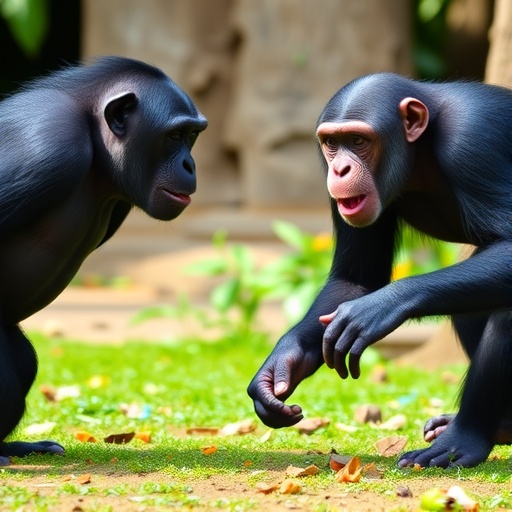
For decades, the dichotomy between chimpanzees and bonobos has served as a compelling lens through which scientists explore the dualities of human nature—aggressive versus peaceful, violent versus harmonious. Chimpanzees have long been cast as the archetypal aggressors, engaging in brutal intergroup conflicts and displaying pronounced male dominance. In contrast, bonobos, their closest evolutionary cousins, have been celebrated as paragons of social tolerance, sexual bonding, and female-led hierarchies. Yet, groundbreaking research from Utrecht University challenges these entrenched narratives by presenting evidence from controlled environments that complicates rather than confirms these stereotypes.
Over an extensive observational study encompassing 22 groups of zoo-housed chimpanzees and bonobos, behavioral biologists Emile Bryon, Edwin van Leeuwen, Tom Roth, and their colleagues meticulously quantified aggression’s frequency and distribution. Remarkably, the data revealed no significant difference in overall aggression rates between the two species when environmental variables were held constant. Instead, critical nuances emerged in who initiates aggression and who becomes its target, highlighting a more complex behavioral ecology than previously understood. Male chimpanzees predominantly instigated aggressive acts toward all individuals, reflecting their well-documented dominance in wild groups. Conversely, bonobo aggression was more diffusely initiated by multiple group members but focused overwhelmingly on male conspecifics, indicating a sex-based targeting strategy consistent with female dominance structures.
These revelations compel a re-examination of the evolutionary roots of aggression in hominids. The prevailing perception of chimpanzees as martial and warlike, juxtaposed with peaceful bonobos, has underpinned many speculative models of human behavioral evolution. However, this study articulates that humans share equal phylogenetic proximity to both taxa, making simplistic analogies fraught. The assumption of intrinsic aggressiveness in chimpanzees may stem more from their observed wild behaviors in complex, resource-competitive habitats rather than an unalterable species trait. This nuanced understanding stresses that behavioral plasticity and context-specific socioecological factors must be incorporated into models of aggression’s evolutionary development.
Historically, high-profile wild observations have fed the narrative of chimpanzee aggression with episodes of lethal intergroup violence and infanticide—behaviors not documented among wild bonobos. However, recent fieldwork disrupts this binary. Contradictory findings report elevated aggression levels among some bonobo males, and lethal intragroup conflicts have emerged in bonobo populations, blurring the neat distinctions. These discrepancies underscore the significance of environmental pressures, group composition, and data collection timeframes that have historically underrepresented bonobo aggression due to logistical challenges inherent to conflict zones and limited observation opportunities.
Methodologically, the Utrecht team deployed advanced statistical analyses to parse behavioral data into non-contact and contact aggression categories, encompassing displays like chasing and direct physical confrontations such as biting or wrestling. Their findings indicate that, within each species, aggression levels vary more among groups than between species overall. Intriguingly, bonobo groups included both those exhibiting the highest and lowest observed aggression rates, suggesting that intra-species variation may hold the key to understanding behavioral dynamics rather than broad species-wide generalizations.
Ecologically, the divergent habitats of chimpanzees and bonobos provide critical context for these behaviors. Chimpanzees occupy territories north of the Congo River, characterized by patchy and scarce food resources, competition with other large primates such as gorillas, and higher predation risks. In contrast, bonobos reside south of the Congo River in more stable environments with a more evenly distributed food supply and fewer dangerous competitors. These environmental pressures are hypothesized to influence social structures and behaviors, a foundational element of the “self-domestication hypothesis.”
The self-domestication hypothesis posits that bonobos’ less hostile environments favored the evolution of reduced aggression through female-led coalitions selecting against aggressive males, fostering increased prosociality and social tolerance. This theory analogizes the evolutionary trajectory of bonobos to domesticated animals and even human self-domestication, with selective pressures suppressing aggressive tendencies to facilitate social cohesion. However, the new zoo-based empirical evidence and recent field observations challenge this perspective by demonstrating that bonobo males are not markedly less aggressive than chimpanzee males, thereby calling for refinement or reconsideration of this influential hypothesis.
Intriguingly, the distribution of aggression in bonobo groups reflects their matriarchal social organization. While bonobo males exhibit significant aggression, it is predominantly directed towards other males rather than females. Female dominance is maintained not through physical aggression but through strategic coalition building and conflict mediation, often employing sociosexual behaviors as tension-reduction mechanisms. This pattern indicates a sophisticated social system where conflict resolution and hierarchy maintenance rely on complex affiliative interactions rather than direct suppression by violence.
Understanding these dynamics has profound implications for reconstructing the evolutionary pathways that shaped human social behavior. Human societies manifest an extraordinary blend of cooperation, aggression, and complex conflict resolution mechanisms. Insights from our closest living relatives suggest that neither aggression nor pacifism singularly defines our lineage; instead, an adaptive spectrum modulated by ecological, social, and cultural factors likely underpins our evolutionary narrative.
Although captive environments differ from the wild, zoos offer controlled settings where external variables are minimized, providing a unique vantage point for isolating inherent species-specific behavioral tendencies. The overlap in aggression levels observed in zoo settings underscores the plasticity and context-dependence of these behaviors. Further wild studies are indispensable for corroborating whether these patterns hold under natural ecological pressures, thereby enhancing our grasp of the interplay between environment, social structure, and aggression.
The study’s findings are a pivotal contribution to primatology and behavioral evolution, encouraging a paradigm shift away from simplistic dichotomies. They advocate for an integrative approach that accounts for environmental heterogeneity, intra-species group variation, and the multifaceted nature of social interactions. Such perspectives enrich our comprehension of primate behavior and provide essential frameworks for interpreting the complexities of human aggression and cooperation in evolutionary context.
In summary, chimpanzees and bonobos may be more alike in their aggressive propensities than previously thought, diverging mainly in how and against whom they direct aggression rather than how much aggression they exhibit overall. This nuanced understanding has far-reaching consequences for evolutionary theory, behavioral ecology, and the study of social dynamics among primates, including humans.
Subject of Research: Animals
Article Title: Chimpanzees are not more aggressive than bonobos, but target sexes differently
News Publication Date: 11-Mar-2026
Web References: 10.1126/sciadv.adz2433
Image Credits: Jake Brooker/Chimfunshi Wildlife Orphanage Trust
Keywords: Ethology, Primate behavior, Aggression, Social dynamics, Chimpanzees, Bonobos, Evolutionary biology
Tags: aggression levels in captive primatesbehavioral ecology of primatesbonobos and chimpanzees aggression comparisonchallenging stereotypes in primate behaviorcontrolled environment primate studiesevolutionary perspectives on primate aggressionfemale-led hierarchies in bonobosinterspecies aggression patternsmale dominance in chimpanzeesprimate social tolerance mythssex-based aggression targeting in bonoboszoo-housed primate behavior



