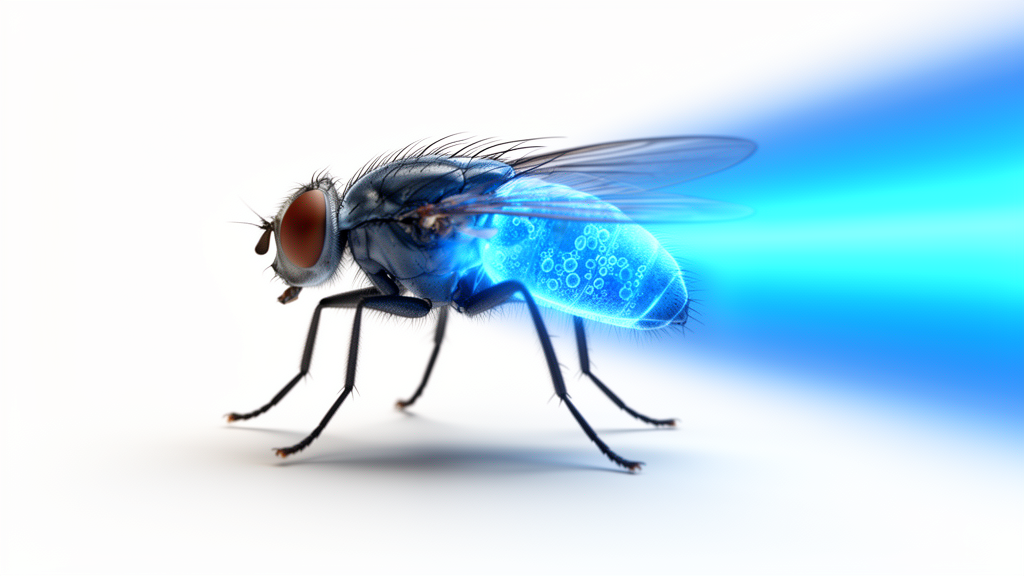
Irradiation with visible blue light causes severe mortality in adult fruit flies primarily through internal tissue damage caused by light penetrating the body wall rather than entering through the visual system, according to experimental findings published in Applied Entomology and Zoology. The investigation, conducted by researchers Atsuki Kobayashi and Masatoshi Hori, evaluated the physiological and physical routes through which short-wavelength optical radiation induces lethal biological trauma in the model organism Drosophila melanogaster. By exposing both wild-type flies and a broad battery of specialized anatomical and sensory mutants to calibrated wavelengths of ultraviolet A and blue light, the researchers systematically demonstrated that optical transmission directly across the abdominal cuticle drives fatal outcomes. In contrast, sensory inputs passing through the compound eyes, functional phototransduction pathways, and canonical visual photoreceptor proteins proved largely non-essential in mediating light-induced mortality.
For decades within insect physiology and pest management science, visible light wavelengths were considered largely benign to animal systems, with lethal radiative damage restricted almost entirely to high-energy ultraviolet bands such as UVC and UVB. However, work initiated over the past decade revealed that visible light between 400 and 500 nanometers also produces pronounced lethal effects across more than fifteen diverse insect species. Because the specific wavelengths exhibiting maximal insecticidal efficacy closely mirrored the wavelengths generating peak amounts of hydrogen peroxide, researchers hypothesized that light-induced death stems directly from reactive oxygen species produced when absorbed radiation interacts with internal cellular chromophores.
To evaluate whether lethal radiation enters insects through ocular structures or directly through the body wall, Kobayashi and Hori designed an experimental framework comparing two wild-type strains, Canton-S and Sumika Technoservice, against seven distinct genetic mutant lines of Drosophila melanogaster exhibiting altered pigmentation, morphology, or neural signaling. The ocular mutant group included white flies lacking screening pigments, sepia flies deficient in pteridine eye pigments, Bar mutants characterized by severely reduced ommatidia counts, and eye-missing mutants entirely devoid of compound eye structures. To assess the potential involvement of functional visual perception and photoreceptors, the team included no receptor potential A mutants lacking the phototransduction cascade and Cryb mutants deficient in cryptochrome, a principal blue-light receptor. To examine the role of body wall shielding, the scientists tested ebony mutants, which possess heavily melanized, dark cuticular integuments. The central hypothesis posited that if compound eyes or visual photoreceptors act as the primary blue-light entry portals, eye-deficient and blind strains would exhibit elevated survival rates compared to standard wild types.
The lethal irradiation experiments utilized specialized light-emitting diode panels housed within multi-room environmental incubators maintained at a constant temperature of twenty-five degrees Celsius and sixty percent relative humidity. Adult flies were collected within twenty-four hours of emergence and distributed in sealed glass Petri dishes containing standardized glucose, brewer’s yeast, agar, and propionic acid diets. Overhead illumination panels comprising uniformly arranged light-emitting diodes delivered continuous irradiation for seventy-two hours across seven discrete peak wavelengths, including 378 nanometer ultraviolet A as well as blue wavelengths centered at 408, 417, 438, 455, 466, and 494 nanometers. Each spectral band was calibrated in a dark chamber using high-resolution spectrometry through the dish lids to maintain an exact photon flux density of 10 × 10^18 photons per square meter per second. Across ten biological replicates per strain and wavelength, insect survival was assessed against parallel control cohorts kept under complete darkness, with mortality corrected using Abbott’s mathematical formula.
Across all evaluated strains, female flies displayed consistently greater overall tolerance to light stress than their male counterparts, yet lethal patterns across mutant lines contradicted the assumption that optical toxicity requires functional vision. Wild-type flies suffered extensive mortality under 378, 417, 438, and 466 nanometer exposures, while 408 and 455 nanometer bands caused noticeably lower mortality and 494 nanometer blue light produced negligible lethality. Strikingly, Bar and eye-missing mutants experienced exceptionally high mortality rates ranging from ninety-six to one hundred percent under 378, 417, 438, and 466 nanometer irradiation, despite possessing severely diminished or non-existent ocular structures. Strains carrying sepia, Cryb, and norpA mutations displayed mortality rates equivalent to or slightly higher than wild types, demonstrating that neither cryptochrome photoreceptors nor functional rhodopsin phototransduction cascades are necessary to produce fatal outcomes. Conversely, the heavily melanized ebony strain exhibited profound resilience across all tested wavelengths, suffering only zero to twenty percent mortality under identical irradiation regimens.
To rigorously verify whether the remarkable tolerance of ebony flies was driven specifically by cuticular shielding rather than confounding background genetic factors, the investigators generated stable hybrid lines by crossing ebony males with white, sepia, and eye-missing mutant females. The resulting F4 generation hybrids retained the dark melanic integument of the ebony parent while expressing the distinct eye phenotypes of the maternal strains, including black-bodied flies lacking eyes or carrying white or sepia ommatidia. When subjected to seventy-two hours of continuous irradiation at 378, 418, and 466 nanometers, the ebony hybrids exhibited significantly lower mortality than their non-hybrid eye-mutant counterparts. Under continuous dark conditions, mortality in all hybrid lines remained below five percent. Because introducing an ebony body wall into strains lacking compound eyes or eye pigments restored high survival against lethal irradiation, the researchers obtained direct functional evidence that cuticular melanin provides essential photoprotection by impeding light penetration into vulnerable internal tissues.
To quantify optical barrier properties, the researchers dissected the abdominal integuments of female flies within twenty-four hours of emergence, isolating cuticular samples free of visceral organs, ovaries, and Malpighian tubules. Using an upright microscope equipped with a xenon illumination burner and a hyperspectral imaging camera, cuticular transmittance spectra were measured across the central sections of the second through fourth abdominal segments between 400 and 500 nanometers. The hyperspectral data revealed that cuticular transmittance followed a consistent spectral shape across all strains, with transmission declining slightly below 410 nanometers and rising gradually above 415 nanometers without exhibiting sharp wavelength selectivity. However, the absolute magnitude of optical transmission varied dramatically among phenotypes, ranking from highest to lowest as white and eye-missing, followed by norpA, Cryb, Canton-S, Bar, Sumika, sepia, and ebony. In ebony flies, blue-light transmission through the abdominal cuticle was approximately half the level recorded in white and eye-missing mutants.
Correlating cuticular transmittance with survival metrics demonstrated that cuticle transparency directly predicts insect mortality when flies are exposed to biologically toxic wavelengths. For the highly lethal 417, 438, and 466 nanometer blue light bands, the researchers identified statistically significant positive correlations between mean abdominal transmittance and adult female mortality rates, yielding correlation coefficients of 0.697, 0.685, and 0.796, respectively. In contrast, wavelengths that exhibited low toxicity in wild types, specifically 408, 455, and 494 nanometers, showed no statistically significant correlation between cuticular transmittance and lethal effects. Similarly, spectroscopic measurements of the ebony hybrid lines confirmed that their abdominal cuticles transmitted only about half the light transmitted by non-hybrid eye mutants, closely matching the optical attenuation measured in pure ebony controls. These quantitative correlations established that light must physically penetrate through the insect body wall to trigger catastrophic biological damage inside the organism.
To evaluate whether internal oxidative stress tracks cuticular penetration, whole-body hydrogen peroxide levels were quantified in Canton-S, white, and ebony females exposed to 378, 418, and 466 nanometers over time intervals ranging from twenty-four to seventy-two hours. Surviving flies were homogenized in phosphate buffer solution and analyzed using bioluminescent reactive oxygen species assays. Irradiation with 378 nanometer ultraviolet A significantly stimulated hydrogen peroxide generation across all three phenotypes, although the magnitude of accumulation was markedly muted in ebony flies relative to Canton-S and white cohorts. Under blue wavelengths, Canton-S and white flies generated substantial, statistically significant spikes in hydrogen peroxide relative to dark controls at specific time points, whereas ebony flies exhibited no significant increase in hydrogen peroxide production at any evaluated duration. These biochemical observations indicate that cuticular melanin attenuates the generation of internal reactive oxygen species by preventing blue photons from reaching reactive chromophores inside the body.
Despite demonstrating the central role of cuticular penetration, the research highlights several nuanced physiological questions regarding internal damage mechanisms. Because the abdominal cuticle showed no narrow wavelength selectivity, the striking variation in mortality across different blue wavelengths appears to reflect the distinct absorption profiles of internal target molecules rather than differences in cuticular filtering. Mitochondria, which contain porphyrins that absorb intensely near 420 nanometers, represent likely intracellular targets whose disruption compromises cellular energy production and triggers cell death. However, lethal wavelengths varied slightly among strains, and whole-body hydrogen peroxide accumulation did not perfectly correlate with fatal outcomes in every experimental condition. The authors noted that whole-body homogenates may dilute critical localized oxidative trauma occurring within indispensable vital tissues. Kobayashi and Hori concluded that while cuticular penetration serves as the primary gateway for lethal blue radiation in adult Drosophila, fully identifying the specific internal chromophores and vulnerable organ systems remains the focus of ongoing investigation.
Subject of Research: Integumentary penetration pathways of lethal blue light in Drosophila melanogaster
Article Title: Blue light-input pathways causing lethal effects in Drosophila melanogaster (Diptera: Drosophilidae)
Article References: Kobayashi, A., & Hori, M. (2026). Blue light-input pathways causing lethal effects in Drosophila melanogaster (Diptera: Drosophilidae). Applied Entomology and Zoology, 61(2), 269-280. https://doi.org/10.1007/s13355-026-00971-x
Image Credits: AI Generated
DOI: 10.1007/s13355-026-00971-x
Keywords: Drosophila melanogaster, blue light toxicity, integument transmittance, reactive oxygen species, hydrogen peroxide, phototransduction, cryptochrome, ebony mutant, compound eyes, ultraviolet A, LED irradiation, hyperspectral imaging, mitochondrial damage, insect photobiology, Abbott formula, spectral sensitivity
News Source: Drew Townsend. (November 24, 2026). Blue Light Kills Fruit Flies Primarily Through Integument Rather Than Eyes. Scienmag.