In a groundbreaking forensic entomology study poised to reshape how investigators interpret crime scene evidence, Dr. Stanisław Matuszewski has unveiled striking new insights into the development of blow fly larvae within refrigerated environments. Published in the prestigious International Journal of Legal Medicine, this research meticulously dissects the enigmatic processes governing initial blow fly development and the formation of larval masses inside a funeral home cooler—an environment previously thought to significantly retard insect activity. The study emerges from a puzzling case involving the suspected desecration of a cadaver, spotlighting the critical forensic importance of understanding insect behavior in controlled, low-temperature settings.
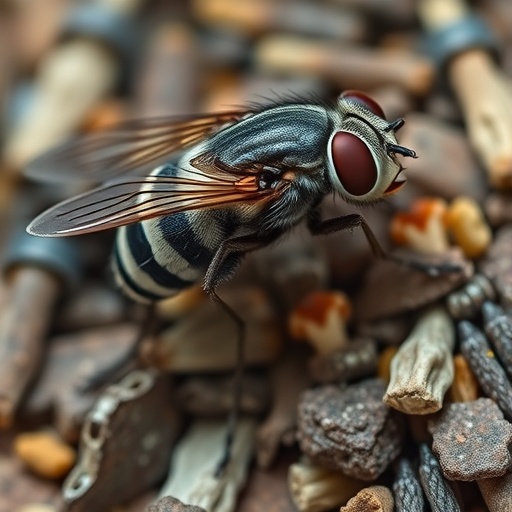
Forensic entomology, the study of insects in criminal investigations, always hinges on robust, accurate data about insect life cycles. Blow flies (family Calliphoridae) are regularly among the first colonizers of decomposing remains, making them invaluable biological clocks for postmortem interval (PMI) estimates. However, traditional developmental data has focused almost exclusively on ambient temperature conditions, leaving a knowledge void regarding how refrigeration—a common practice in funeral homes and morgues—affects larval growth patterns. Dr. Matuszewski’s research innovatively targets this gap, analyzing how cooler temperatures influence both the timing of developmental milestones and the physical characteristics of larval aggregations, or masses.
The impetus for this study arose from an anomalous forensic case where insect evidence found on a cadaver stored within a funeral home cooler presented a puzzle. Typically, blow fly larvae development markedly slows or nearly halts at cooler temperatures, complicating PMI calculations. Yet, in this case, larvae exhibited unexpected growth, suggesting adaptive physiological or behavioral mechanisms. Through controlled experiments simulating the funeral home’s cooling conditions, the research details the formation dynamics of larval masses, revealing how the larvae generate localized heat to sustain development despite the ambient chill.
One of the pivotal discoveries concerns the thermoregulation capabilities of larval masses in confined cold environments. The study demonstrates that as larvae cluster, their collective metabolic activity produces measurable heat, elevating the temperature within the mass. This thermogenesis effectively creates a microenvironment distinct from the surrounding cooler air, enabling continued growth that defies prior assumptions. Understanding this self-generated thermal microhabitat not only clarifies the developmental kinetics but also signals that PMI estimations must account for heat generated by larvae themselves—a nuance vital for forensic accuracy.
Moreover, Dr. Matuszewski’s work reveals that incubation periods within the cooler differ substantially from those at standard environmental temperatures, yet the developmental sequences follow familiar patterns. Early instar stages proceed with elongation periods modified by the interplay between cooler ambient temperatures and internal larval mass heat. These findings imply that larval age markers, commonly employed to estimate time since death, require recalibration in refrigerated scenarios to avoid underestimating PMI. This adjustment is instrumental in avoiding miscarriages of justice founded on flawed timelines.
The study also examined larval morphology and mass formation dynamics, noting subtle but meaningful changes in larval appearance and size at each stage compared with traditional datasets. These phenotypic variations parallel altered metabolic rates driven by temperature and oxygen availability differences inside the cooler. By documenting these morphological markers, Dr. Matuszewski provides forensic specialists with improved diagnostic criteria to distinguish larvae developed under refrigeration from those grown in outdoor conditions.
Beyond direct PMI implications, the research touches upon how insect evidence can serve as correlative data for investigating postmortem manipulation. In this case, the presence and developmental state of larvae within a controlled refrigeration setting hinted at unauthorized cadaver exposure. Such forensic entomological evidence complements forensic pathology and law enforcement findings, enhancing multidisciplinary investigative approaches to suspected desecration or tampering prior to official discovery.
Technically, the study employed rigorous entomological protocols, including carefully controlled temperature gradients, precise larval age assessments via morphometric analyses, and thermal imaging of larval masses to quantify internal temperature differentials. The integration of these methodologies underscores a step change in forensic insect ecology by marrying traditional developmental biology with advanced physical instrumentation. This multidisciplinary methodological fusion positions the research as a benchmark for future forensic investigations under varied environmental constraints.
Importantly, this research provokes a reevaluation of standardized forensic entomology protocols. Many legal frameworks currently available were developed with assumptions about steady, ambient temperature cycles. The data presented advises forensic practitioners to integrate adaptive models accounting for microenvironmental insect thermoregulation. Forensic entomology textbooks and training programs may thus require updates to incorporate low-temperature developmental paradigms to ensure that entomological timelines remain scientifically sound amid diverse crime scene conditions.
Dr. Matuszewski’s findings also pave the way for more nuanced computational modeling of postmortem insect activity. By quantifying larval mass heat outputs relative to ambient conditions, predictive software can be refined to simulate developmental trajectories with increasing precision. Such virtual modeling capabilities would empower forensic entomologists to rapidly generate case-specific PMI estimates without the extensive empirical benchmarks currently needed, accelerating evidence-driven justice outcomes.
The forensic community is further intrigued by the ethical and procedural ramifications that emerge. Funeral homes, morgues, and law enforcement custodians may need to revise cadaver storage protocols to minimize unintended insect colonization, considering that larvae can adapt to refrigeration and continue growth unbeknownst to human observers. The study serves as a clarion call highlighting that even controlled environments are not immune to forensic insect activity, and concealment of such evidence is a realistic possibility.
In summation, this transformative research decisively enhances our understanding of blow fly larval biology within refrigeration contexts, offering critical clarity on survival, growth, and larvae aggregation phenomena that directly impact forensic timelines. The forensic field now benefits from a refined analytical lens to better interpret complex entomological evidence reflecting concealed tampering or extended cooling periods, hallmarks of evolving investigative challenges in modern legal medicine.
With its combination of scientific rigor and practical forensic insights, Dr. Matuszewski’s study is destined to influence courtroom testimonies, investigative protocols, and forensic entomology curricula worldwide. By elucidating the nuanced relationships between environmental temperature, larval physiology, and mass thermogenesis, the research provides a comprehensive framework applicable across jurisdictions where refrigerated cadaver storage and forensic entomology intersect.
As forensic entomology advances in the coming years, studies like this will likely serve as springboards for broader environmental adaptability research, including investigations into diverse storage, burial, and exposure conditions. The evolving sophistication in insect evidence interpretation propels the forensic sciences toward greater reliability, reinforcing the indispensable role of biological insights in legal justice.
The research reported also underscores the importance of ongoing cross-disciplinary collaboration, uniting entomologists, forensic pathologists, legal experts, and bioengineers to confront increasingly complex scenarios in death investigations. This confluence empowers science to meet legal demands with ever more nuanced and scientifically validated tools, ultimately benefitting the pursuit of truth in forensic cases.
The implications extend beyond legal medicine into ecological and biological sciences as well, as understanding insect adaptation to atypical and anthropogenic environments sheds light on evolutionary processes and species resilience. Such insights enrich broader biological inquiries even as they serve pressing practical needs in forensic arenas.
In conclusion, the landmark investigation conducted by Dr. Stanisław Matuszewski not only deciphers enigmatic blow fly larval development in refrigerated conditions but also signals an essential recalibration in forensic entomology’s interpretative frameworks. This development marks a critical milestone in aligning forensic insect evidence with real-world complexities, thereby advancing justice through science and evidence-based clarity.
Subject of Research: Initial blow fly development and larval mass formation in refrigerated environments with forensic applications.
Article Title: Initial blow fly development and larval mass formation in a funeral home cooler: analysis of insect evidence in the suspected desecration of a cadaver.
Article References:
Matuszewski, S. Initial blow fly development and larval mass formation in a funeral home cooler: analysis of insect evidence in the suspected desecration of a cadaver. Int J Legal Med (2025). https://doi.org/10.1007/s00414-025-03670-4
Image Credits: AI Generated
DOI: https://doi.org/10.1007/s00414-025-03670-4
Tags: blow fly larvae development in refrigerationcadaver desecration case studyCalliphoridae family significancecontrolled temperature effects on insectsdevelopmental milestones of blow fliesforensic entomology researchforensic evidence interpretationfuneral home cooler conditionsinsect behavior in low temperatureslarval growth patterns in cool environmentslegal implications of insect evidencepostmortem interval estimation techniques