


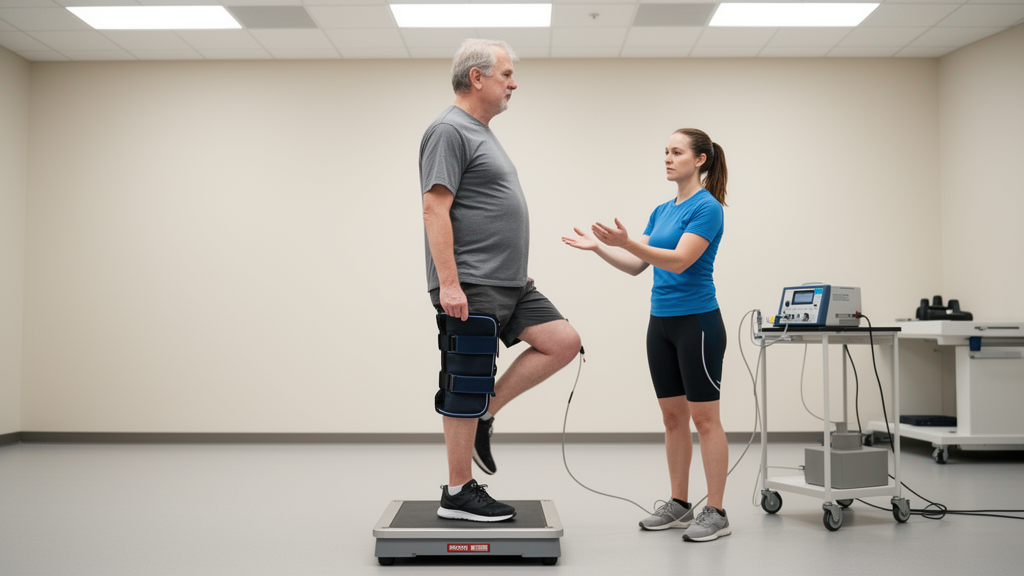
A randomized controlled trial from Biruni University in Istanbul, Türkiye, has found that adding blood flow restriction (BFR) to a single session of balance exercise did not deliver any additional acute benefits for postural control, proprioception, functional performance, or perceived exertion in healthy sedentary young adults.
The research team, led by Berivan Beril Kılıç and Begüm Kara Kaya, recruited 74 healthy adults aged 18 to 35 years and randomly assigned them to one of three groups: a control group performing balance exercise alone, a sham BFR group, and a true BFR group. The three-arm trial was conducted between November 2025 and February 2026. Each participant completed a single exercise session, and all outcomes were measured immediately before and after that session, allowing the researchers to isolate the acute response rather than the effects of a training program.
The primary outcomes were static postural control, assessed with the PerformaNZ system, and dynamic postural control, assessed with the Y Balance Test. Secondary outcomes included joint position sense as a measure of proprioception, single-leg hop performance as a measure of functional performance, and perceived exertion recorded on the Rating of Perceived Exertion Scale. Baseline characteristics were similar across the three groups, with no statistically significant differences reported.
When the data were analyzed, the results showed significant main effects of time for several measures. Static postural control improved in the dominant, non-dominant, and bilateral conditions, while Y Balance Test composite scores improved for both the dominant and non-dominant limbs. Significant time effects also appeared for dominant knee flexion proprioception and non-dominant ankle plantarflexion proprioception, and single-leg hop performance improved in both limbs. Perceived exertion increased following exercise, an expected response to physical activity.
Crucially, however, the analysis found no significant group by time interactions for any outcome. In other words, the improvements observed after the exercise session occurred regardless of whether blood flow restriction was applied, and the BFR condition offered no measurable acute advantage over the sham or control conditions. The authors concluded that adding BFR to a single balance exercise session did not provide additional acute benefits in healthy sedentary young adults.
The findings temper expectations for BFR as an immediate enhancer of balance-related performance. Blood flow restriction training is often promoted as a low-load strategy that can influence sensorimotor responses, and the study’s background notes that sedentary behavior may negatively affect sensorimotor function and postural control. Yet in this trial, a single bout of BFR-supported balance exercise did not outperform the same exercise without restriction on any measured outcome, even though the exercise session itself produced acute improvements across several measures.
The authors point to an important direction for future work: the effects of repeated BFR-supported balance training sessions remain to be investigated. Because the present study captured only the immediate response to one session, it cannot speak to whether cumulative BFR-supported balance training over weeks might produce benefits that a single session does not. The trial’s scope is also limited to healthy sedentary young adults, so the results should not be generalized to clinical populations, older adults, or athletes without further evidence.
For now, the study offers a clear and carefully controlled answer to a narrow question: within a single session, in sedentary young adults, blood flow restriction does not amplify the acute effects of balance exercise on postural control, proprioception, or functional performance, and it raises perceived exertion just as any exercise bout would. Whether longer-term programs change that picture is the question the researchers say future studies should address.
Subject of Research: Acute effects of blood flow restriction combined with balance exercise on postural control and neuromuscular responses in sedentary adults
Article Title: Acute neuromuscular and postural control responses to balance exercise with blood flow restriction in sedentary adults: a randomized controlled trial
Article References: Kılıç, B. B., & Kara Kaya, B. (2026). Acute neuromuscular and postural control responses to balance exercise with blood flow restriction in sedentary adults: a randomized controlled trial. BMC Sports Science, Medicine and Rehabilitation. https://doi.org/10.1186/s13102-026-02193-8
Image Credits: AI Generated
DOI: 10.1186/s13102-026-02193-8
Keywords: blood flow restriction, balance exercise, postural control, proprioception, randomized controlled trial, sedentary adults, Y Balance Test, perceived exertion, neuromuscular response, single-leg hop, Acute, neuromuscular
News Source: Ophelia Keating. (October 28, 2026). Blood Flow Restriction Adds No Acute Boost to Balance Exercise in Sedentary Adults. Scienmag.



