Credit: Taltech
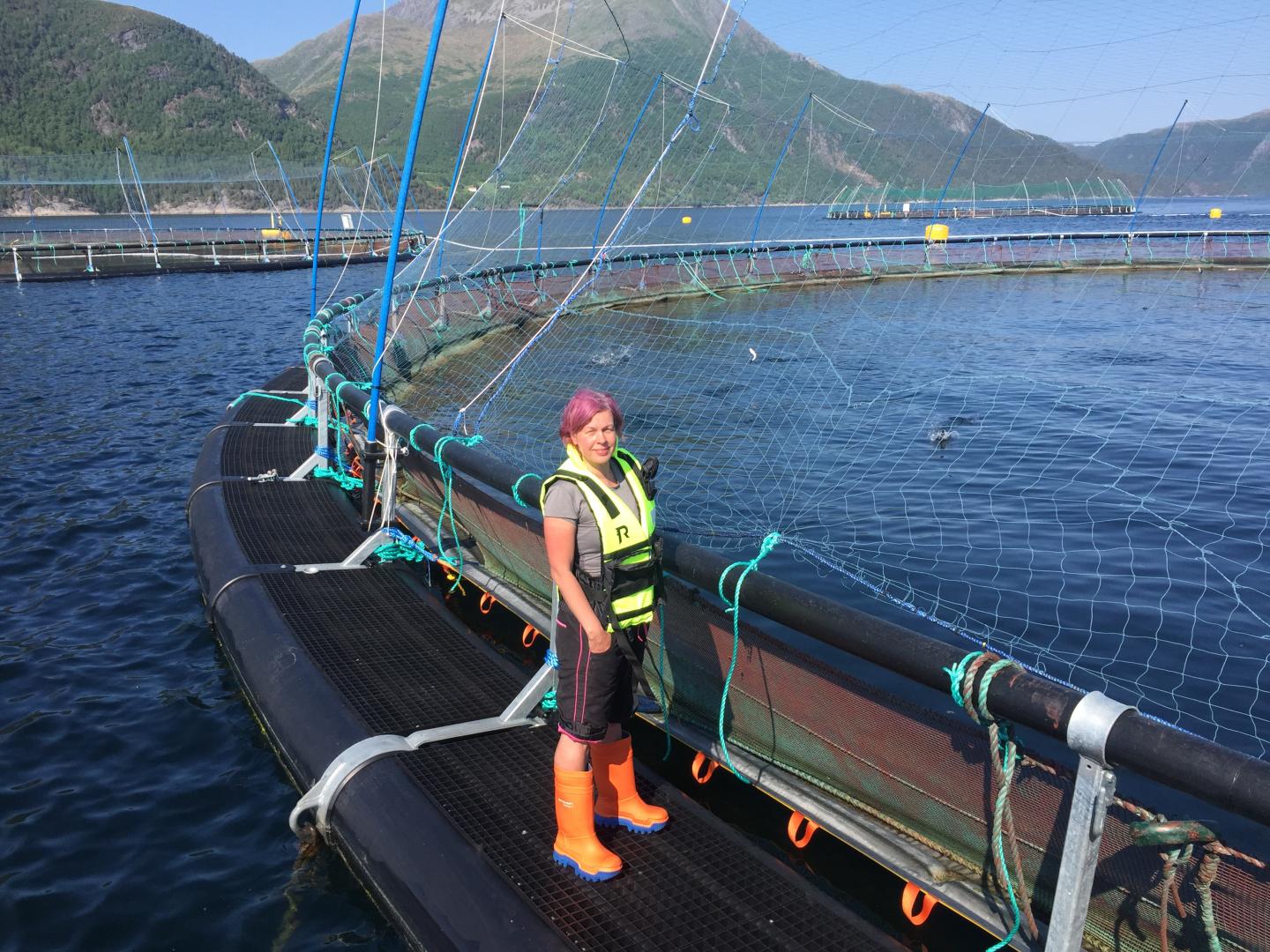
Several hundred thousand salmon swim closely together in fish farms. For at least some time, the fish farmer and the fish have the same goal: to keep the fish healthy, eating and growing. Therefore it is necessary to provide fish with environmental conditions, where the stress level is low, parasites do not pose a risk to their health and there is enough food. Stressed and sick fish do not eat or grow or bring profit to the fish farmer.
The Head of TalTech Centre for Biorobotics, Professor Maarja Kruusmaa says, “In order to effectively observe fish in their natural state, a technology is needed, which would enable reaching each nook of the fish farm, where e.g. frightened specimens might be hiding. It must be observed whether the feed reaches all the fish or only the more aggressive alpha specimens, whether the fish have parasites or any other health problems, etc.”
The behaviour of fish in a fish cage is traditionally investigated by using human divers or underwater robots. Divers’ work is expensive and, most importantly, fish are afraid of the invader and therefore by diving it is not possible to observe fish in their natural state. The same problem applies to use of big underwater robots.
Therefore, researchers from Tallinn University of Technology, Estonian University of Life Sciences and Norwegian University of Science and Technology, in collaboration with the research organization SINTEF and one of the world’s largest fish farm companies SalMar, conducted experiments to find out what kind of inspection robots should be used for observing fish in their natural state. The behavior of fish in the presence of a diver and different robots was analyzed and compared to identify what features are important in the development of robots for more efficient monitoring of animals.
The results of the experiments showed that fish behave very calmly and naturally in the presence of the small and slowly moving robot turtle U-CAT invented by TalTech biorobotics researchers. A conventional commercial underwater robot scares fish off and forces them to flee rapidly and a diver does not get close enough to the fish at all to observe them underwater, while U-CAT is able to get closest to the fish in the fish farm and provide valuable insight of their state. The study provided other useful cues for the development of robots intended for observing animals, such as what colour should the robot be or how should it move.
Professor Maarja Kruusmaa says, “Robot-human interactions have been investigated for decades, but animal-robot interactions and communication is almost unexplored. However, these studies are of considerable importance: they would inspire advances in environmental monitoring and agriculture automation, and would help to build robots facilitating wildlife research.”
Fish farming has a larger market share compared to wild fishing worldwide and the share is increasing steadily, constituting currently an industry with the turnover of over 3 billion dollars.
###
The findings of the study were published in the journal Royal Society Open Science in the article entitled “Salmon behavioural response to robots in an aquaculture sea cage” on 11.03.2020. https:/
Additional information: Head of TalTech Centre for Biorobotics, Professor Maarja Kruusmaa, [email protected]
Kersti Vähi, TalTech Research Administration Office
Media Contact
Maarja Kruusmaa
[email protected]
Related Journal Article
http://dx.