• HOME
  • NEWS
  • EXPLORE
    • CAREER
      • Companies
      • Jobs
    • EVENTS
    • iGEM
      • News
      • Team
    • PHOTOS
    • VIDEO
    • WIKI
  • BLOG
  • COMMUNITY
    • FACEBOOK
    • INSTAGRAM
    • TWITTER
Monday, December 15, 2025
BIOENGINEER.ORG
No Result
View All Result
  • Login
  • HOME
  • NEWS
  • EXPLORE
    • CAREER
      • Companies
      • Jobs
        • Lecturer
        • PhD Studentship
        • Postdoc
        • Research Assistant
    • EVENTS
    • iGEM
      • News
      • Team
    • PHOTOS
    • VIDEO
    • WIKI
  • BLOG
  • COMMUNITY
    • FACEBOOK
    • INSTAGRAM
    • TWITTER
  • HOME
  • NEWS
  • EXPLORE
    • CAREER
      • Companies
      • Jobs
        • Lecturer
        • PhD Studentship
        • Postdoc
        • Research Assistant
    • EVENTS
    • iGEM
      • News
      • Team
    • PHOTOS
    • VIDEO
    • WIKI
  • BLOG
  • COMMUNITY
    • FACEBOOK
    • INSTAGRAM
    • TWITTER
No Result
View All Result
Bioengineer.org
No Result
View All Result
Home NEWS Science News Chemistry

Biologically inspired ultrathin arrayed camera for high-contrast and high-resolution imaging

Bioengineer by Bioengineer
March 3, 2020
in Chemistry
Reading Time: 2 mins read
0
IMAGE
Share on FacebookShare on TwitterShare on LinkedinShare on RedditShare on Telegram

IMAGE

Credit: by Kisoo Kim, Kyung-Won Jang, Jae-Kwan Ryu and Ki-Hun Jeong


An insect’s compound eye has superior visual characteristics such as wide viewing angle, high motion sensitivity, and large depth of field while maintaining a small volume of visual structure with a small focal length. Among them, Xenos peckii, an endoparasite of paper wasps, eyes have hundreds of photoreceptors in a single lens unlike conventional compound eyes with a few light-sensing cells in an individual eyelet. This unique structure offers higher visual resolution than other insect eyes. The Xenos peckii eye also perceives partial images through pigmented cups that block incoming light between eyelets.

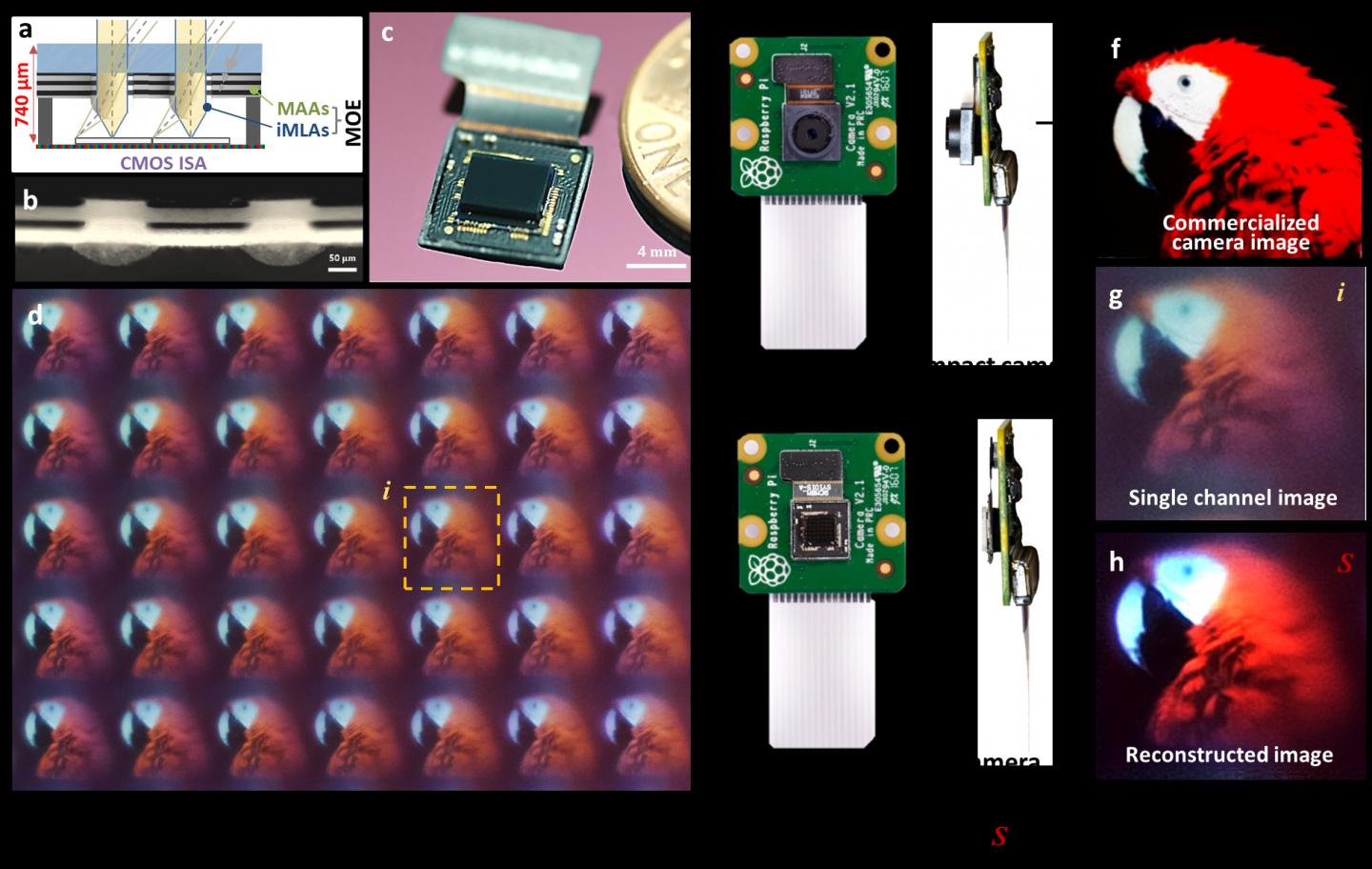
Inspired from Xenos peckii eye structure, a KAIST research team led by Professor Jeong Ki-Hun demonstrated a fully packaged ultrathin insect eye camera. They developed a unique and new configuration of micro-optical element to completely suppress the optical noise between microlenses while reducing camera thickness. This optical component was integrated with a complementary metal oxide semiconductor (CMOS) image sensor and the final thickness of fully packaged camera lens is only 740 μm.

The fully packaged ultrathin arrayed camera has successfully demonstrated high contrast clear array images acquired from tiny microlenses. To further enhance image quality of the captured image, they have discussed the vision principle of insect eye and combined the array images into one image through super-resolution imaging. This work also shows the first demonstration of super-resolution imaging, which acquires a single integrated image with high contrast and high resolving power reconstructed from high contrast array images.

“This work reports the first demonstration of ultrathin arrayed camera for high contrast and super resolution imaging. We strongly believe our study will make solely technical advances and also have significant impacts on multidisciplinary communities of micro and nanotechnology mining the smartness from natural photonic structures,” said Jeong.

###

Media Contact
Ki-Hun Jeong
[email protected]

Related Journal Article

http://dx.doi.org/10.1038/s41377-020-0261-8

Tags: Chemistry/Physics/Materials SciencesOptics
Share12Tweet8Share2ShareShareShare2

Related Posts

Microenvironment Shapes Gold-Catalysed CO2 Electroreduction

Microenvironment Shapes Gold-Catalysed CO2 Electroreduction

December 11, 2025
Photoswitchable Olefins Enable Controlled Polymerization

Photoswitchable Olefins Enable Controlled Polymerization

December 11, 2025

Cation Hydration Entropy Controls Chloride Ion Diffusion

December 10, 2025

Iridium Catalysis Enables Piperidine Synthesis from Pyridines

December 3, 2025
Please login to join discussion

POPULAR NEWS

  • Scientists Uncover Chameleon’s Telephone-Cord-Like Optic Nerves, A Feature Missed by Aristotle and Newton

    Scientists Uncover Chameleon’s Telephone-Cord-Like Optic Nerves, A Feature Missed by Aristotle and Newton

    122 shares
    Share 49 Tweet 31
  • Nurses’ Views on Online Learning: Effects on Performance

    69 shares
    Share 28 Tweet 17
  • NSF funds machine-learning research at UNO and UNL to study energy requirements of walking in older adults

    70 shares
    Share 28 Tweet 18
  • MoCK2 Kinase Shapes Mitochondrial Dynamics in Rice Fungal Pathogen

    71 shares
    Share 28 Tweet 18

About

We bring you the latest biotechnology news from best research centers and universities around the world. Check our website.

Follow us

Recent News

Reinforced Optical Cages Ensure Drift-Free Molecule Imaging

iPS-Derived 3D Model Advances Brain Barrier Research

Advancing Neonatal Brain Prognosis with Diffusion Kurtosis

Subscribe to Blog via Email

Enter your email address to subscribe to this blog and receive notifications of new posts by email.

Join 69 other subscribers
  • Contact Us

Bioengineer.org © Copyright 2023 All Rights Reserved.

Welcome Back!

Login to your account below

Forgotten Password?

Retrieve your password

Please enter your username or email address to reset your password.

Log In
No Result
View All Result
  • Homepages
    • Home Page 1
    • Home Page 2
  • News
  • National
  • Business
  • Health
  • Lifestyle
  • Science

Bioengineer.org © Copyright 2023 All Rights Reserved.