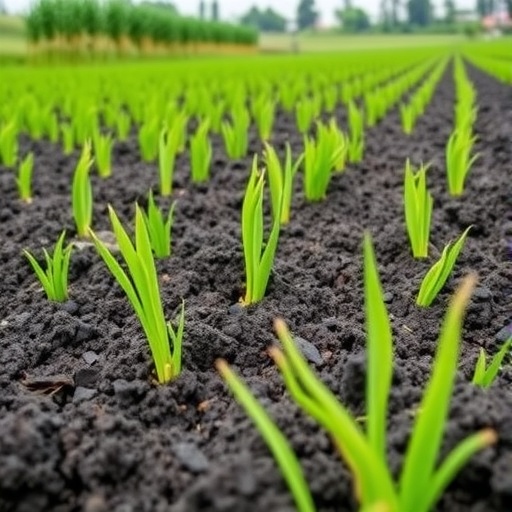
A recent breakthrough study illuminates the intricate relationship between biochar application and methane emissions in rice agriculture, revealing that the climate mitigation benefits of biochar are profoundly influenced by mineral nitrogen fertilizer inputs. As rice cultivation remains a crucial food resource worldwide—feeding nearly half of the global population—it also stands as a significant contributor to methane emissions, a greenhouse gas with a warming potential far exceeding that of carbon dioxide. This research, which bridges expansive data analysis with rigorous field experimentation, uncovers the nuanced dynamics governing biochar’s role in reducing methane fluxes from rice paddies.
The team of scientists compiled and analyzed 146 datasets sourced from 51 independent studies scattered globally, employing sophisticated statistical techniques including network meta-analysis and advanced machine learning algorithms. Through this comprehensive meta-analysis, the researchers evaluated various organic soil amendments such as straw, compost, manure, and biochar, assessing their impacts on methane emissions under diverse agronomic and environmental conditions. Among these treatments, biochar emerged as a distinctively effective mediator in curtailing methane release, outperforming the other organic inputs tested.
Despite this promising outlook, the study reveals a complex caveat: the efficacy of biochar in methane mitigation is highly contingent upon the quantity of mineral nitrogen fertilizer applied to rice fields. Findings demonstrated a critical threshold of approximately 291 kilograms of nitrogen per hectare. Below this threshold, biochar incorporation consistently led to a reduction in methane emissions. Contrastingly, when nitrogen inputs surpassed this limit, biochar application paradoxically intensified methane fluxes, thereby potentially aggravating greenhouse gas emissions.
To validate these globally synthesized insights, the researchers conducted meticulous field trials in an established rice-growing region of eastern China. These experiments corroborated the meta-analytical patterns, showing significant increases in methane production associated with biochar treatments under high nitrogen fertilization regimes. This counterintuitive outcome suggests that nitrogen availability may modulate the microbial processes that govern methane cycling in flooded rice soils, underscoring the complexity of biogeochemical interactions involved.
At a mechanistic level, the interplay between nitrogen fertilization and microbial community dynamics offers a plausible explanation for these observations. Elevated nitrogen inputs can boost plant biomass and stimulate microbial consortia responsible for methane generation by furnishing abundant substrates. Simultaneously, excessive nitrogen may inhibit methane-oxidizing bacteria that typically act as biofilters by consuming methane before it escapes into the atmosphere. The result is an ecological shift favoring methane production over oxidation, thereby amplifying net emissions.
The research further delved into the intrinsic properties of biochar and their environmental ramifications. A key discovery centers on the carbon-to-nitrogen (C:N) ratio of the biochar material itself. Biochars derived from crop residues generally possess lower C:N ratios and demonstrated heightened methane mitigation potential compared to biochars with higher C:N ratios. This suggests that the physicochemical composition of biochar fundamentally influences soil microbial metabolism and redox processes, inviting a broader consideration of biochar feedstock selection in designing effective climate-smart agricultural interventions.
These nuanced findings challenge the prevailing notion of biochar as a universally beneficial soil amendment for mitigating greenhouse gases. Instead, they advocate for an integrative approach that harmonizes biochar characteristics with tailored nitrogen fertilizer management strategies. The delicate balance between nutrient input and organic amendment underscores the necessity for site-specific recommendations that maximize environmental gains while maintaining agronomic productivity.
This study’s implications extend beyond rice paddies, offering critical insights into sustainable agricultural practices aiming to reduce the carbon footprint of food production systems. With methane accounting for a substantial fraction of agriculture-related greenhouse gas emissions, optimizing amendment schedules and fertilization regimes represents a tangible leverage point for climate mitigation. The work also underscores the value of coupling empirical field research with global data synthesis to unravel complex agroecological interactions.
As the scientific community and policymakers advance toward more sustainable agricultural frameworks, this research foregrounds the importance of precision management practices. It highlights that the climate benefits of biochar are conditional rather than absolute, hinging on intelligently balancing nitrogen fertilizer applications. By embracing this complexity, farmers may harness biochar’s full potential as a climate mitigation tool while sustaining rice yield and soil health.
The comprehensive investigation contributes one of the most integrative assessments to date regarding how biochar interacts with nitrogen management to influence methane emissions in flooded rice ecosystems. By elucidating these mechanisms, it paves the way for improved agronomic guidelines and optimized biochar formulations aimed at mitigating methane emissions at scale. This approach promises to enhance the sustainability and environmental resilience of one of the world’s most vital food production systems.
Ultimately, the findings serve as a clarion call for further interdisciplinary research, exploring the microbial ecology underpinning biochar-nitrogen interactions and their environmental feedbacks. Such endeavors will be essential to refine biochar technology and fertilization strategies, ultimately aiding global climate mitigation efforts and ensuring food security in the face of a changing climate.
Subject of Research: Methane mitigation in rice cultivation through biochar application and nitrogen fertilizer management
Article Title: Mineral nitrogen input modulates the methane mitigation potential of biochar in rice systems: based on meta-analysis and field experiment demonstration
News Publication Date: 21-Feb-2026
Web References: http://dx.doi.org/10.1007/s42773-025-00563-y
References: Huang, W., Liu, X., Deng, Y. et al. Mineral nitrogen input modulates the methane mitigation potential of biochar in rice systems: based on meta-analysis and field experiment demonstration. Biochar 8, 60 (2026).
Image Credits: Weijie Huang, Xingyan Liu, Yu Deng, Daoyuan Zhao, Jun Yuan, Qirong Shen & Chao Xue
Keywords
Biochar, Methane Emissions, Rice Cultivation, Nitrogen Fertilization, Greenhouse Gas Mitigation, Meta-Analysis, Field Experiments, Microbial Ecology, Carbon-to-Nitrogen Ratio, Sustainable Agriculture, Climate Change, Nutrient Management
Tags: biochar application in sustainable farmingbiochar methane reduction in rice fieldsbiochar vs organic soil amendmentsclimate change mitigation in rice cultivationglobal rice production and environmental impactimpact of nitrogen fertilizer on methane emissionsmachine learning in agricultural researchmeta-analysis of biochar studiesmethane emissions in rice agriculturenitrogen levels influence on biochar effectivenessorganic amendments and methane fluxesrice paddy greenhouse gas mitigation