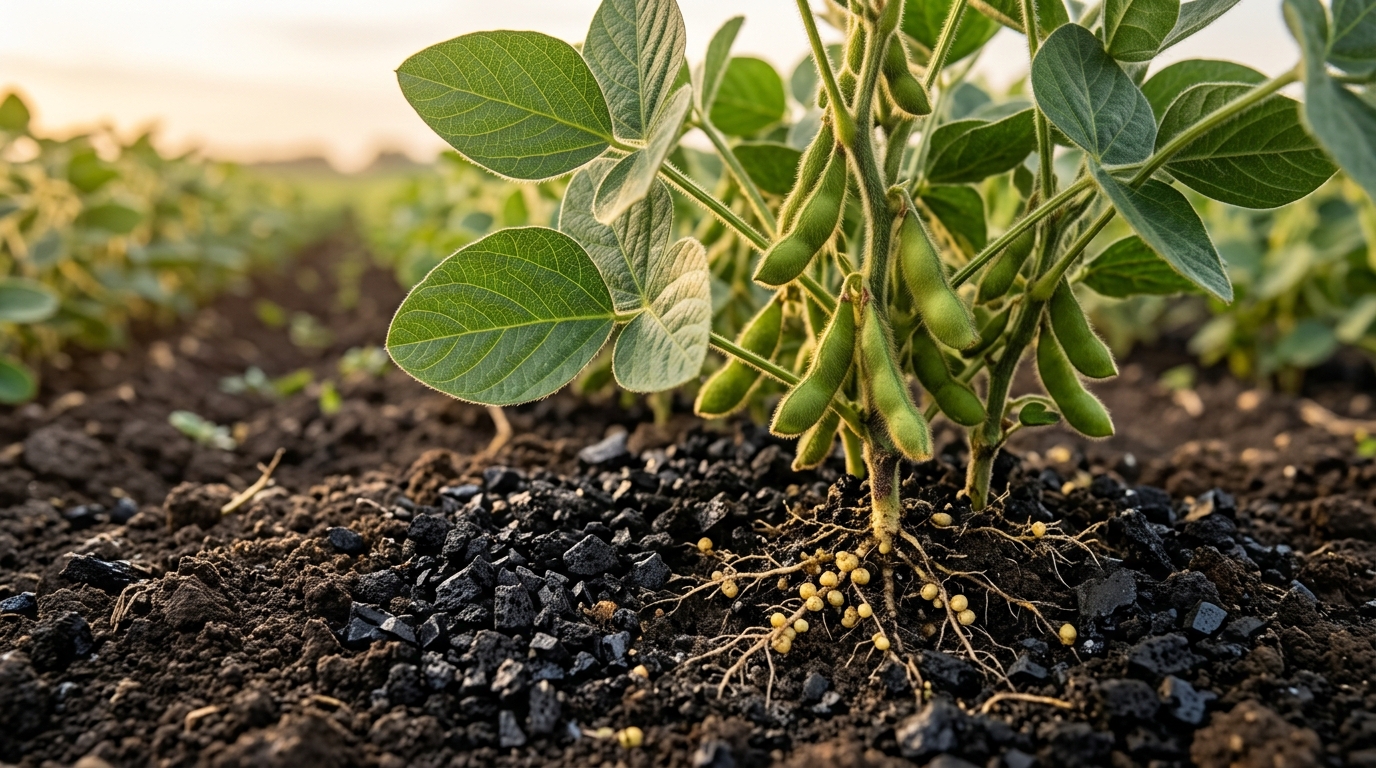
Researchers from Hebei University of Technology have demonstrated that nitrogen-enriched biochar nanoparticles can enter soybean plant roots, migrate into aboveground tissues, and enhance nitrogen delivery under controlled greenhouse conditions. Using advanced stable isotope tracing and imaging techniques, the team found that the nanoscale carbon carriers actively deliver nutrients to plant metabolic pathways, improving both grain production and nutritional quality.
Nitrogen is essential for crop development, yet substantial portions of nitrogen applied through conventional fertilizers remain unabsorbed by crops. This nutrient inefficiency escalates agricultural operating costs and contributes to widespread environmental pollution. While conventional biochar, produced by heating biomass under oxygen-limited conditions, is widely recognized for improving soil health, its nanoscale particles have remained largely unexplored as microscopic vehicles for targeted nutrient delivery.
To investigate whether nanoscale biochar could serve as a nutrient delivery platform, the investigators produced nitrogen-enriched biochar nanoparticles from corn stalk residues combined with nitrogen-labeled urea. As detailed in their experimental study published in Sustainable Carbon Materials, the researchers synthesized two distinct materials at thermal processing temperatures of 400°C and 700°C before applying them to soybean plants grown in soil.
At an application rate of 5 milligrams per kilogram of soil, the nanoparticle treatments produced measurable agronomic improvements over untreated control plants. Soybean grain counts increased by 35% to 45%, accompanied by gains in individual grain weight. Furthermore, the concentrations of individual amino acids within the harvested grain rose by 6.5% to 97.1%, demonstrating substantial enhancements in crop nutritional composition.
To determine the precise mechanism driving these gains, the research team incorporated the stable isotope ¹⁵N into the nanoparticles to monitor nitrogen transport through plant systems. Isotope tracking revealed that one nanoparticle formulation increased ¹⁵N enrichment in soybean root nodules by 127.8% and in grains by 47.9%, alongside substantial isotope enrichment across grain amino acids. Complementary microscopic examinations confirmed that the biochar nanoparticles physically penetrated root structures and traveled upward into aerial plant tissues.
Beyond physical uptake and translocation, the nanoparticle treatments stimulated the internal nitrogen-processing machinery of the soybean plants. Laboratory measurements detected elevated activity in enzymes responsible for transforming absorbed nitrogen into essential growth compounds, accompanied by expression changes in nitrogen metabolism-related genes. The researchers proposed that nanoparticles partially degrade within plant tissues, releasing assimilable nitrogen compounds into active metabolic pathways, a pathway corroborated by laboratory simulations.
The application of biochar nanoparticles also altered beneficial soil microorganisms without causing significant disruptions to overall soil bacterial diversity. Corresponding author Professor Fei Lian noted that these microscopic carriers accomplish functions well beyond traditional soil conditioning, showing that agricultural biomass waste can be converted into functional nanomaterials that support precision nutrient management and reduce reliance on synthetic fertilizers.
Despite the positive outcomes observed in greenhouse trials, the study authors emphasized that key limitations remain to be addressed before practical adoption. Comprehensive field studies are required to determine real-world application methods, assess performance variations across diverse agricultural environments and soil types, and rigorously establish the long-term environmental safety of biochar nanoparticles.
Subject of Research: Biochar nanoparticles for nitrogen delivery and yield improvement in soybeans
Article Title: Tiny biochar particles could help soybeans absorb more nitrogen and produce higher yields
Article References: Tiny biochar particles could help soybeans absorb more nitrogen and produce higher yields. Original publication (Bibliographic details unavailable.)
Image Credits: AI Generated
DOI: Not provided
Keywords: biochar nanoparticles, soybean cultivation, nitrogen delivery, sustainable agriculture, crop nutrition, plant metabolism, isotope tracing, agricultural waste, Tiny, biochar, particles, help
News Source: Alan Morgan. (November 8, 2026). Biochar Nanoparticles Boost Soybean Nitrogen Delivery and Grain Yields. Scienmag.