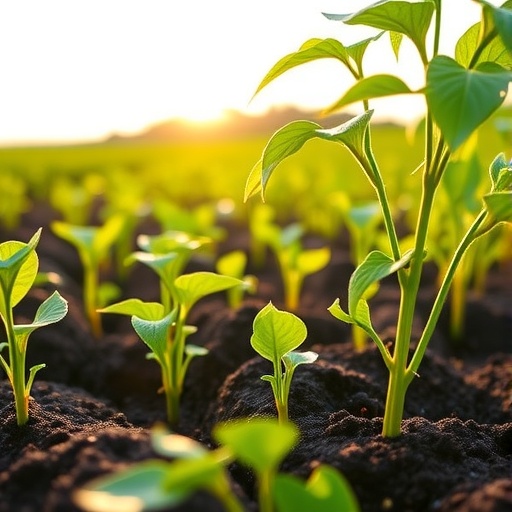
Recent advancements in agricultural science have spotlighted biochar, a carbon-rich material produced through pyrolysis of organic matter, and its potential role in sustainable farming practices. A comprehensive study titled “Biochar can promote the growth of peanuts in saline alkali soil by enhancing peanut resistance and improving soil properties,” authored by Zhiliang, Z., Dong, T., and Tao, L., has been published in Scientific Reports. This research serves as a pivotal exploration of biochar’s impact on peanut cultivation, particularly in challenging saline and alkali soils that have historically posed a significant barrier to optimal crop growth.
Saline alkali soils are notorious for their high salinity and alkalinity levels, which can detrimentally impact plant health by creating an inhospitable environment for root development and nutrient uptake. These soils are frequently found in arid and semi-arid regions, where improper irrigation and land management practices exacerbate salinization issues. The consequences for agriculture can be dire, including reduced yields, plant stress, and even crop failure. However, the introduction of biochar offers an innovative solution to mitigate these problems, as demonstrated by the research findings.
The study utilized carefully controlled experiments to assess the effect of biochar amendments on peanut plants under saline alkali conditions. Various concentrations of biochar were incorporated into the soil, and its influence on several variables such as plant growth, physiological responses, and soil parameters was meticulously monitored. The results revealed that biochar not only improved the physical and chemical attributes of the soil but also played a crucial role in enhancing the resilience of the peanut plants against salinity stress.
One of the significant findings of the research was the enhancement of soil properties post-biochar application. Biochar was shown to improve soil structure, increase porosity, and enhance water retention capabilities. These characteristics are pivotal in saline environments, where water availability can be limited. With improved soil structure, the root systems of peanut plants can establish more effectively, leading to healthier plant growth and development. Furthermore, the increased water retention capacity allows for better hydration of the plants during periods of drought, reducing the overall water stress they experience.
Additionally, the addition of biochar was observed to intensify nutrient availability within the soil. Nutrient absorption is crucial for any crop, and peanuts, being legumes, have specific requirements for nitrogen and phosphorus. The biochar contributed to creating an environment rich in these essential nutrients, thereby not only promoting plant growth but also enhancing the biochemical activities of soil microorganisms. This biological activity plays a vital role in nutrient cycling and overall soil health, which is often compromised in saline alkali environments.
In terms of physiological responses, the peanut plants treated with biochar displayed improved growth metrics. Parameters such as plant height, number of leaves, and overall biomass increased significantly relative to control groups. Such growth stimulation is indicative of the biochar’s ability to buffer salinity effects, providing the plants with an environment more conducive to growth. The enhanced resistance to salinity stress exhibited by the peanut plants is a critical finding, suggesting that biochar may serve as a practical amendment to support crop resilience in challenging soil conditions.
Importantly, this research aligns with the growing discourse around sustainable agriculture practices amidst the pressing challenges of climate change and food security. As global temperatures continue to rise and extreme weather events become more frequent, finding effective ways to grow crops in less-than-ideal conditions is of paramount importance. The integration of biochar into existing agricultural frameworks presents a promising avenue for enhancing soil health and crop productivity, particularly in regions susceptible to salinization.
Moreover, the implications of this study extend beyond just peanuts. The principles derived from these findings could be applicable to other crops vulnerable to saline environments. Understanding the mechanisms through which biochar influences growth can facilitate the formulation of tailored applications across various agricultural systems. Consequently, this could lead to the development of more resilient farming techniques that mitigate the adverse impacts of climate change on global food production.
The research conducted by Zhiliang, Dong, and Tao serves as a reminder of the interconnectedness of soil health, plant growth, and sustainable farming practices. By leveraging innovative materials like biochar, farmers and agricultural scientists can work together to enhance the resilience of crops, paving the way for sustainable food systems that can withstand the challenges posed by environmental stressors.
As interest in biochar continues to grow, further research is needed to explore its long-term impacts on soil ecosystems, various crop types, and the broader implications for food security. This research lays the groundwork for future studies, encouraging prioritization of sustainable soil management practices. By advancing our understanding of biochar’s role in agriculture, we can move toward a more adaptable and sustainable approach to food production, ultimately benefiting farmers, consumers, and the environment alike.
As we continue to explore the nexus of sustainable agriculture and environmental stewardship, the findings presented by the research team offer hope and practical solutions in the face of a challenging agronomic landscape. With innovative strategies such as biochar application, we can cultivate a future where crops thrive, even in the most adverse conditions, ensuring food security for generations to come.
Subject of Research: Effects of biochar on peanut growth in saline alkali soil
Article Title: Biochar can promote the growth of peanuts in saline alkali soil by enhancing peanut resistance and improving soil properties.
Article References:
Zhiliang, Z., Dong, T., Tao, L. et al. Biochar can promote the growth of peanuts in saline alkali soil by enhancing peanut resistance and improving soil properties.
Sci Rep 15, 40232 (2025). https://doi.org/10.1038/s41598-025-24098-1
Image Credits: AI Generated
DOI: https://doi.org/10.1038/s41598-025-24098-1
Keywords: Biochar, saline alkali soil, peanut growth, sustainable agriculture, soil properties, crop resilience.
Tags: arid region agriculture solutionsbiochar in agriculturecarbon-rich materials in farmingcrop yield enhancement techniquesenhancing plant resistance with biocharimproving soil properties with biocharinnovative uses of organic wastemitigating salinity in crop productionpeanut growth in saline soilsresearch on biochar effectssaline alkali soil managementsustainable farming practices