Credit: ©Science China Press
Photosynthesis in nature uses the CaMn4O5 cluster as the oxygen-evolving center to catalyze the water oxidation efficiently in photosystem II (PS II). Synergistic effect among the multi-metal centers of PSII plays a key role for the high catalytic activity. Mimicking the natural photosynthesis, light-driven overall water splitting to produce H2 and O2 including both hydrogen evolution reaction (HER) and oxygen evolution reaction (OER), is a promising pathway for artificial conversion and storage of solar energy. In the past, various inorganic and organic systems have been developed as overall water splitting photocatalysts. However, direct photocatalytic overall water splitting, including hydrogen evolution reaction (HER) and oxygen evolution reaction (OER), still faces great challenges of low activity.
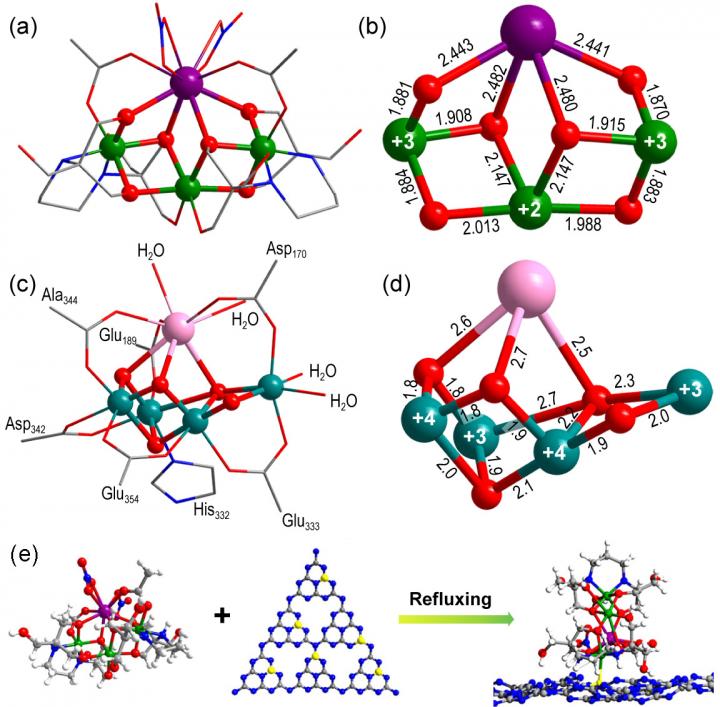
Recently, researches from Xiamen university demonstrated a bio-inspired heterometallic cluster LnCo3 (Ln = Nd, Eu and Ce) clusters, which can be viewed as synthetic analogs of CaMn4O5 cluster. Anchoring LnCo3 on phosphorus-doped graphitic carbon nitrides (PCN) shows efficient overall water splitting activity without any sacrificial reagents and a quantum efficiency of 2.0 % at 350 nm.
Lanthanide-transition metal cluster mimics the structure of CaMn4O5 of PSII. The NdCo3 cluster can be viewed as the CaMn4O5 missing one metal vertex from the cubane and adding one bridging-O atom between Nd3+ and Co3+. In addition, the coordination mode of bridging-O in NdCo3 cluster is also very similar to that in CaMn4O5 of PSII, except for the five bridging-O atoms are O2- in biological CaMn4O5-cluster, while six bridging-O atoms are come from the -OH groups of two btp-3H ligands in NdCo3. Notably, the mixed oxidation states of the cobalt ions (+2 and +3) in NdCo3 cluster are similar to the mixed oxidation states of manganese ions (+3 and +4) in CaMn4O5, suggesting that the NdCo3 cluster can be viewed as a synthetic model of the OEC. Notably, the NdCo3 cluster shows high stability because of the presence of a chelating btp-3H ligand.
Considering the monotonic change in radius and chemical properties of the lanthanides, it was an attractive choice for investigating the physical characteristics of the clusters. “The synthetic biomimetic OECs should also be studied in an integrated system to reveal their true potentials and provide better understanding of the synergistic effect in catalysis on atomic level.” They emphasized. By anchoring the bio-inspired LnCo3 as OEC on phosphorus-doped graphitic carbon nitrides (PCN), they realized light-driven spontaneous overall water splitting to efficiently produce O2 and H2.
“Traditionally, overall water splitting is composed of two half reactions, hydrogen evolution reaction and oxygen evolution reaction, lanthanide-transition cluster serve as the oxygen evolution catalyst and the P-doped carbon nitride as the hydrogen evolution catalyst. The NdCo3/PCN-c exhibited remarkable water-splitting activity with high H2 production rate of ~297.7 μmol h-1 g-1 and O2 evolution rate of 148.9 μmol h-1 g-1 under light irradiation.” They state in an article titled “Integration of Bio-Inspired Lanthanide-Transition Metal Cluster and P-doped Carbon Nitride for Efficient Photocatalytic Overall Water Splitting.”
“The lanthanide-transition cluster based photocatalysts not only performed a synthetic model of bio-inspired oxygen-evolving center but also an effective catalyst to realize light-driven overall water splitting. This is a promising way to artificially convert and store solar energy.” Interestingly, ultrafast transient absorption spectroscopy revealed the transfer of photoexcited electron and hole into the PCN and LnCo3 for hydrogen and oxygen evolution reactions, respectively. DFT calculation showed the cooperative water activation of O-O bond formation on lanthanide and transition metal for water oxidation. This work provided an effective strategy to realize light-driven overall water splitting.
###
See the article:
Rong Chen, Gui-Lin Zhuang, Zhi-Ye Wang, Yi-Jing Gao, Zhe Li, Cheng Wang, Yang Zhou, Ming-Hao Du, Suyuan Zeng, La-Sheng Long, Xiang-Jian Kong, and Lan-Sun Zheng
Integration of Bio-Inspired Lanthanide-Transition Metal Cluster and P-doped Carbon Nitride for Efficient Photocatalytic Overall Water Splitting
Natl Sci Rev
https:/
Media Contact
Xiang-Jian Kong
[email protected]
Related Journal Article
http://dx.