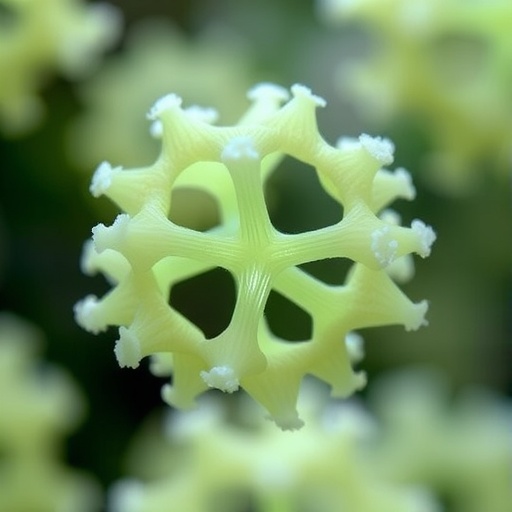
In a groundbreaking advancement poised to reshape sustainable chemistry, researchers have unveiled a novel bio-based catalyst that can efficiently convert fructose into 5-Hydroxymethylfurfural (5-HMF), a versatile platform chemical with vast industrial applications. This pioneering work centers around a sulfonated cyclodextrin polymer, a catalyst distinguished by its renewable origins and exceptional catalytic performance. The development represents a significant step toward greener chemical processes by leveraging biomass derivatives instead of fossil fuels, thereby reducing environmental impact and maximizing resource efficiency.
The synthesis of 5-HMF from fructose has long been a coveted goal in green chemistry due to the molecule’s central role as a precursor for biofuels, bioplastics, and other high-value chemicals. Traditional methods for producing 5-HMF often rely on harsh conditions and non-renewable catalysts that pose scalability and sustainability challenges. This research addresses these hurdles by utilizing cyclodextrin polymers—cyclic oligosaccharides derived from starch—and imparting sulfonic acid groups to them, thereby transforming these biopolymers into highly active, recyclable solid acid catalysts.
The sulfonation of cyclodextrin not only enhances the polymer’s acid strength but also preserves its biocompatible and environmentally benign nature, making it an ideal candidate for catalytic applications in carbohydrate conversion. The resulting sulfonated cyclodextrin polymer exhibits remarkable thermal stability and structural integrity, enabling it to facilitate the selective dehydration of fructose under mild reaction conditions. This finding is particularly exciting as it circumvents the typical trade-off between catalytic efficiency and environmental sustainability.
Extensive characterization techniques including Fourier-transform infrared spectroscopy (FTIR), nuclear magnetic resonance (NMR), and scanning electron microscopy (SEM) revealed the successful incorporation of sulfonic acid groups onto the cyclodextrin backbone. The morphology studies confirmed a uniform distribution of active sites, which is critical for achieving high catalytic activity and selectivity. These structural insights were fundamental to understanding the underlying catalytic mechanisms and optimizing reaction parameters.
A series of catalytic tests demonstrated that the sulfonated polymer could achieve an unprecedented conversion rate of fructose to 5-HMF with excellent selectivity exceeding 90%. This level of efficiency not only outperforms many conventional solid acid catalysts but also rivals state-of-the-art homogeneous acid systems while mitigating common disadvantages such as corrosiveness and difficult catalyst recovery. Importantly, the polymer catalyst could be reused multiple times with minimal activity loss, highlighting its potential for sustainable industrial applications.
The reaction kinetics indicated a pseudo-first-order mechanism facilitated by proton donation from the sulfonic groups, which assists in the dehydration step of fructose molecules leading to the formation of the furan ring of 5-HMF. The enhanced acidity combined with the molecular recognition properties of cyclodextrin promotes substrate accessibility and intermediate stabilization, which are pivotal factors contributing to the catalyst’s superior performance. Computational modeling corroborated these observations, offering insights into the interaction energies and active site geometries.
Moreover, the research team explored the effects of reaction solvents and temperatures on catalytic efficiency. Employing water or aqueous mixtures as solvents aligns the process with green chemistry principles by eliminating the need for toxic organic solvents. Optimal conditions were identified at relatively low temperatures (around 100-120°C), limiting thermal degradation of 5-HMF and minimizing side reactions that typically reduce yield and complicate product purification.
In addition to its catalytic prowess, the sulfonated cyclodextrin polymer presents advantages in terms of cost-effectiveness and scalability. The raw material—cyclodextrin—is abundantly accessible via enzymatic conversion of starch, a renewable agricultural product. Sulfonation is a straightforward chemical modification compatible with large-scale production, potentially facilitating the transition of this catalyst from laboratory to industry. This breakthrough aligns well with the global push for sustainable biorefineries and circular chemical economies.
The implications of this research extend beyond fructose conversion. The methodology of functionalizing biopolymers to create tailored solid acid catalysts may inspire new avenues in biomass valorization and fine chemical synthesis. By customizing polymer structures and functional groups, catalysts can be designed with specific activities for various carbohydrate feedstocks, expanding the portfolio of renewable chemicals derivable from biomass.
Industrial adoption of this technology could revolutionize the manufacture of bio-based chemicals, reducing dependence on non-renewable hydrocarbons and lowering carbon footprints. 5-HMF serves as a gateway molecule for producing biofuels like dimethylfuran and bioplastics such as polyethylene furanoate (PEF), positioning it as a cornerstone for sustainable materials and energy sectors. Enhancing production efficiency through this bio-based catalyst is a major stride toward environmental and economic sustainability.
Challenges remain to be addressed before commercialization, including catalyst longevity over extended continuous use, process integration with feedstock pretreatment, and large-scale reactor design optimization. The research team is actively investigating these aspects, leveraging interdisciplinary collaborations spanning materials science, chemical engineering, and computational chemistry to refine the catalytic system further.
This research epitomizes the synthesis of green chemistry principles and cutting-edge material science to solve pressing global challenges. By transforming abundant biopolymers into high-performance catalysts, it pioneers a path toward cleaner, more sustainable chemical industries. The success of the sulfonated cyclodextrin polymer highlights the vast potential of bio-based materials in catalysis, promising a future where environmentally friendly processes become the norm rather than the exception.
As the world intensifies its focus on climate action and sustainable development, innovations like this bio-based catalyst underscore the critical role of scientific research in steering us towards a greener, circular economy. Continued support and research into such transformative technologies will be essential for realizing a sustainable future where renewable resources supplant fossil-based feedstocks across chemical manufacturing.
Future investigations will likely explore further functionalization strategies, catalyst supports, and reaction system integrations to unlock even higher efficiencies and broader applications. Collaborative efforts with industry stakeholders will be crucial to scale and implement this promising catalyst in commercial settings, bridging the gap between academic breakthroughs and tangible environmental benefits.
This seminal work redefines the landscape of biomass conversion catalysis and reaffirms the potential of molecular engineering to design multifunctional, sustainable catalysts. It provides a compelling example of how leveraging nature-derived materials can drive innovation at the interface of chemistry, materials science, and environmental stewardship, marking a transformative milestone in green chemical technology.
Subject of Research:
The study focuses on the design and application of a sulfonated cyclodextrin polymer as a bio-based solid acid catalyst for the efficient synthesis of 5-Hydroxymethylfurfural (5-HMF) from fructose, advancing sustainable biomass conversion techniques.
Article Title:
Sulfonated cyclodextrin polymer as a bio-based catalyst for the synthesis of 5-HMF from fructose
Article References:
Yaghoubi, S., Sadjadi, S., Jahanian, A. et al. Sulfonated cyclodextrin polymer as a bio-based catalyst for the synthesis of 5-HMF from fructose. Sci Rep (2026). https://doi.org/10.1038/s41598-026-42551-7
Image Credits: AI Generated
Tags: 5-HMF synthesis from fructosebio-based catalyst for biofuel precursorsbio-based sulfonated cyclodextrin catalystbiocompatible polymer catalystscatalytic fructose dehydration methodsenvironmentally friendly chemical processesgreen chemistry platform chemicalsrenewable carbohydrate conversion catalystssolid acid catalysts for biomasssulfonated cyclodextrin polymer propertiessustainable biomass-derived catalyststhermal stability of sulfonated cyclodextrin