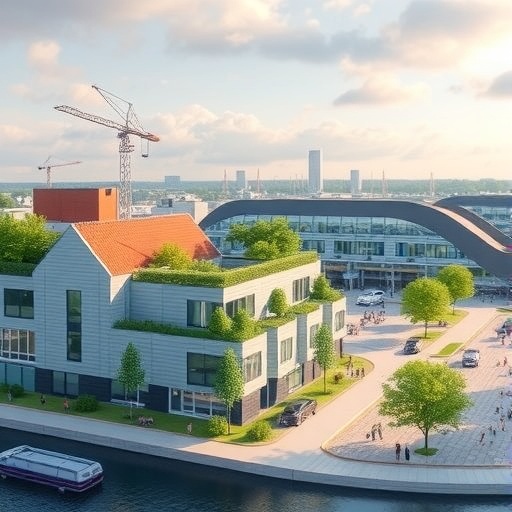
The construction industry accounts for an astonishing 37 percent of global CO2 emissions, positioning it as a critical sector in the battle against climate change. This enormous carbon footprint underscores the urgent necessity for transformative approaches to building and maintaining infrastructure worldwide. Amid this backdrop, a groundbreaking research initiative titled Civil Engineering and the Green Transition in the Built Environment (CEBE) is emerging, aiming to revolutionize sustainability practices across the entire lifecycle of constructed spaces. The program is poised to unlock new knowledge, methodologies, and materials that could drastically reduce resource consumption and environmental impact, setting a global precedent for green construction.
Denmark is spearheading this movement, having become the first nation to mandate stringent emissions regulations for new buildings. This forward-thinking policy has propelled Denmark to the forefront of Europe’s sustainable construction efforts, yielding rapid advances and substantial emission reductions within both manufacturing and construction domains. Despite these substantial achievements, the journey to a fully green construction sector requires moving beyond the initial gains—referred to metaphorically as “harvesting the low hanging fruits.” For further progress, intensified emphasis on research, development, and innovative solutions is crucial over the coming decade.
CEBE’s mission is deliberately ambitious: to cultivate cutting-edge knowledge, tools, and materials that collectively diminish the construction sector’s climate footprint while optimizing resource efficiency. Integral to the program’s success is an enhancement of educational standards and initiatives to entice fresh talent into this evolving field. By fostering a knowledgeable and skilled workforce, Denmark aims to simultaneously nurture scientific expertise and bolster industry readiness, ensuring that green construction principles are widely adopted and advanced within professional practice.
Committed to becoming a European exemplar in sustainable construction, the program embodies Denmark’s strategic vision for climate leadership. Per Heiselberg, Professor at Aalborg University and Programme Director of CEBE, articulated the global relevance of this endeavor, stressing the necessity for research outputs and innovations that transcend national boundaries. He highlighted Denmark’s existing strengths while expressing eagerness over the collaborative potential and transformative outcomes anticipated through the CEBE initiative.
This substantial undertaking is supported by an unprecedented allocation of resources: the Villum Foundation pledges a monumental one billion Danish kroner over ten years, marking its largest ever investment in research. Such funding reflects the foundation’s recognition that reducing construction’s environmental impact requires systemic change spanning from academic research and talent cultivation to tangible collaborations with industry stakeholders. The program’s holistic approach encapsulates a comprehensive ecosystem, aiming to drive sustainable evolution in the design, material production, construction processes, operation, and eventual reuse or recycling of built assets.
CEBE strategically integrates seven interdependent research domains, collectively addressing the lifecycle of built environments rather than fragmented components. This integrated methodology ensures innovations are not confined within academic silos but instead translate into practical, scalable solutions adaptable across varying contexts. From early design decision-making to long-term infrastructure management, these research fields synergize to effectuate measurable reductions in carbon emissions and environmental degradation.
The program’s first focus area involves developing precise analytical frameworks to assess and measure sustainability in construction comprehensively. This encompasses evaluating emissions and resource usage not only for new builds but crucially for extant infrastructure, leveraging dynamic models that inform sustainable interventions. These advanced assessment tools underpin evidence-based decision-making, enabling stakeholders to prioritize actions that align with stringent climate targets and sustainability mandates.
Another pivotal dimension emphasizes design principles oriented towards regeneration, circularity, and building longevity. Research here pioneers methodologies enabling buildings to contribute positively to ecological systems over time while maintaining indoor environments that are safe, healthy, and resilient to climatic variations. This vision extends to the development of modular, recirculatable components, ensuring that structures evolve through adaptive reuse and minimized waste, fostering genuine circular economy practices in construction.
A third critical area tackles the post-industrial challenge of radically lowering the carbon footprint associated with construction materials. Investigations encompass utilizing recycled and salvaged inputs while pushing innovation in novel regenerative materials that deliver comparable or superior durability and performance. Addressing this material dimension is fundamental given the sector’s vast consumption of embodied energy and resources, positioning material innovation as a decisive lever for emission reductions.
The incorporation of digitalization and automation is transforming traditional construction paradigms. CEBE explores advanced applications such as robotics, 3D printing, artificial intelligence, and computational modeling to optimize material use and advance precise carbon accounting. These technologies provide unprecedented opportunities to execute construction with minimal waste and energy consumption, while enhancing monitoring capabilities and facilitating responsive lifecycle management, thus accelerating the shift toward low-carbon practices.
Addressing the intensifying impacts of climate change on infrastructure, research into climate resilience and adaptive technologies is vital. This entails fortifying transportation networks, ports, and coastal defenses against severe weather events including storms, flooding, and cloudbursts. Nature-based solutions and innovative monitoring techniques complement upgrades to existing assets, enhancing predictive maintenance and emergency responsiveness—critical capabilities for sustaining societal functions amid increasing climate volatility.
The program also underscores the often-overlooked interplay between sustainability and human well-being. Reconceptualizing buildings as environments that simultaneously conserve energy and nurture occupant health, the sufficiency-focused research integrates considerations of indoor climate quality, thermal comfort, and resource efficiency. By optimizing these factors collectively, constructions can better support human productivity and quality of life while adhering to stringent environmental goals.
Finally, CEBE emphasizes the necessity of extending the lifespan of existing buildings as a quintessential sustainability strategy. Preservation, adaptive reuse, and sustainable renovation practices minimize the disruptive carbon emissions associated with new construction. Research develops robust methodologies for condition assessment, predictive lifespan modeling, and functional repurposing of structures, ensuring that visible and invisible value within the current building stock is leveraged more effectively and responsibly.
This ambitious program is not confined by national borders but actively pursues international collaboration and talent exchange to magnify its impact. Over 100 million kroner from the overall budget is earmarked for global partnerships, notably with the prestigious ETH Zurich. This transnational network facilitates knowledge sharing and accelerates the diffusion of innovative solutions across diverse economic and environmental contexts worldwide. By positioning Denmark as a nexus for international green construction expertise, CEBE aspires to drive systemic transformation on a continental and global scale.
The combined effect of research, education, and industry collaboration enabled by CEBE promises to reimagine the construction sector’s relationship with the environment fundamentally. As the program matures, it is expected to catalyze breakthroughs that redefine standards, inspire policy evolution, and provide actionable frameworks for sustainable urban development. Denmark’s model serves as an imperative example for other nations confronting the dual challenges of infrastructure growth and climate mitigation, demonstrating that proactive investment in knowledge and innovation can yield resilient, regenerative, and equitable construction futures.
In summary, the CEBE initiative stands as one of the most ambitious and comprehensive attempts worldwide to confront the climate crisis through transformative engineering and collaborative innovation in the built environment. Its success could herald a paradigm shift not only for Denmark and Europe but for the global construction industry, illustrating how research-driven capacity building, coupled with strategic foresight and international cooperation, can forge pathways toward a sustainable and climate-resilient built future.
Subject of Research: Sustainable Construction and Green Transition in Civil Engineering
Article Title: Denmark’s CEBE Program: Pioneering the Green Transition in Global Construction
News Publication Date: Not specified (Official launch date February 26, 2026)
Web References: www.cebe.dk
Keywords
Building construction, Architecture, Climate change, Sustainable construction, Green transition, Low carbon materials, Circular economy, Climate resilience, Digitalization in construction, Environmental impact assessment
Tags: advanced materials for eco-friendly buildingscarbon footprint reduction in infrastructureconstruction industry climate change solutionsDenmark emissions regulations for buildingsenvironmental impact of construction industryEurope sustainable construction initiativesgreen construction researchinnovative green construction technologieslifecycle sustainability in civil engineeringreducing CO2 emissions in constructionsustainable building materials developmenttransformative building practices