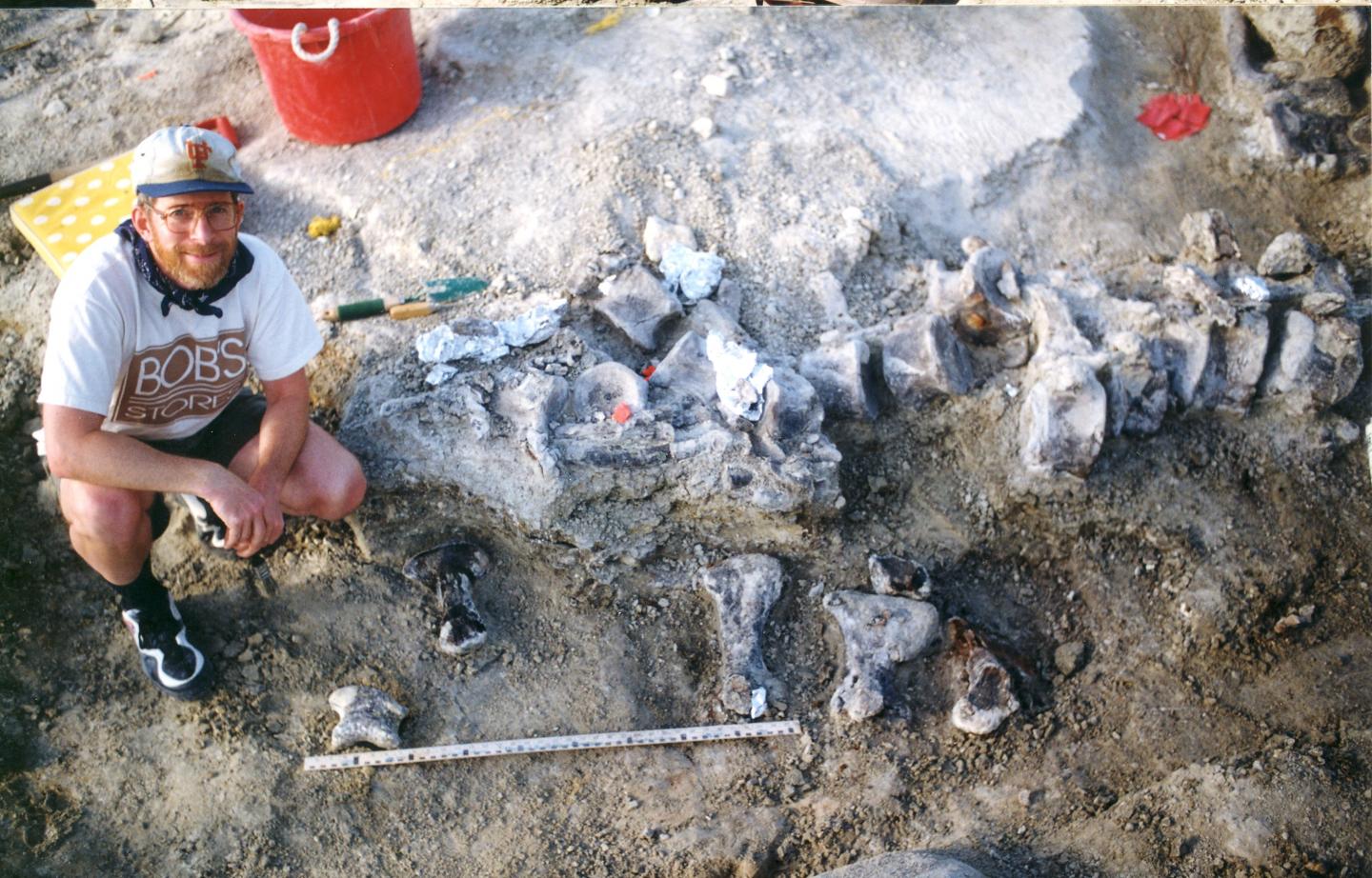
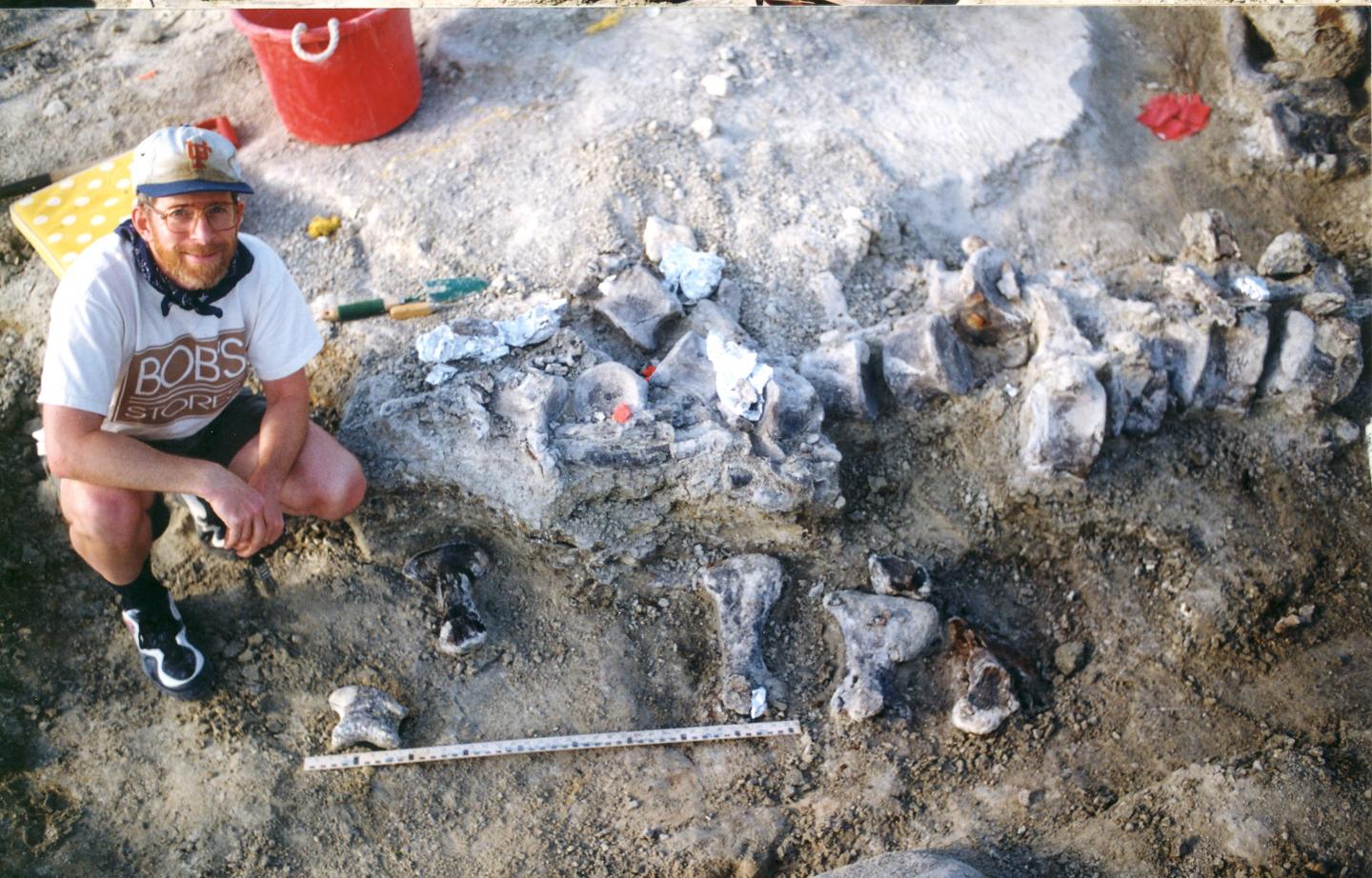
Credit: Photo courtesy of the KUVP archives.
The Black Hills region of the United States is famous today for tourist attractions like Deadwood and Mount Rushmore, but around 150 million years ago it was home to one of the largest dinosaurs known. This dinosaur was a member of the sauropod family with long necks and tails. These giant plant-eating dinosaurs like Brontosaurus and Diplodocus were the largest land animals that ever lived on this planet.
The foot described in a new scientific paper recently published in the open-access journal PeerJ – the Journal of Life and Environmental Sciences was excavated in 1998 by an expedition from the University of Kansas, with Anthony Maltese, lead author of the study, as member of the crew. As he writes, it was immediately apparent that the foot, nearly a meter wide, was from an extremely large animal – so the specimen was nicknamed "Bigfoot".
Now, after detailed preparation and study, Maltese and his international team of researchers from the USA, Switzerland, and Germany identified it as belonging to an animal very closely related to Brachiosaurus, famous for its appearance in the 1993 film Jurassic Park.
Anthony Maltese, Emanuel Tschopp, Femke Holwerda, and David Burnham used 3D scanning and detailed measurements to compare Bigfoot to sauropod feet from numerous species. Their research confirmed that this foot was unusually large. According to Holwerda, a Dutch PhD student at the Ludwig Maximilians University of Munich, Germany, comparisons with other sauropod feet showed that Bigfoot was clearly the largest dinosaur foot discovered to date.
It also confirmed that brachiosaurs inhabited a huge area from eastern Utah to northwestern Wyoming, 150 million years ago. "This is surprising", says Tschopp, a Swiss paleontologist working at the American Museum of Natural History in New York, "many other sauropod dinosaurs seem to have inhabited smaller areas during that time."
According to Maltese, who was part of the original University of Kansas team in 1998 but is now at the Rocky Mountain Dinosaur Resource Center in Woodland Park, Colorado, the rock outcrops that produced this fossil hold many more "fantastic dinosaur skeletons", and the research team hopes to continue their studies on fossils from there.
###
Contact details:
- Anthony Maltese: [email protected]; +1 719 494 6315 (English; USA time zones)
- Emanuel Tschopp: [email protected] (English, German, Italian; USA time zones); Requests for interviews for E. Tschopp should be sent to Kendra Snyder at the Department of Communications, American Museum of Natural History: [email protected] +1 212-496-3419
- Femke Holwerda: [email protected]; +31 72 511 4748 (English, Dutch; European time zones)
Media pack (including embargoed article and images): https://drive.google.com/drive/folders/1cwRSjapTT5fj9Bd9irwAGaE0yO3E4
Images:
Image credit: Photograph from the excavations in 1998, with the brachiosaur foot bones below a tail of a Camarasaurus. University of Kansas expedition crew member as a scale. Photo courtesy of the KUVP archives.
Image credit: A Brachiosaurus nibbling from an Araucaria tree. These dinosaurs had enormous necks and relatively short tails. The animal to which the foot belongs was nearly 4 meters high at its hip. Image copyright by Davide Bonadonna, Milan, Italy.
Link to the Published Version of the article (quote this link in your story – the link will ONLY work after the embargo lifts): https://peerj.com/articles/5250 your readers will be able to freely access this article at this URL.
Citation to the article: Maltese A, Tschopp E, Holwerda F, Burnham D. (2018) The real Bigfoot: a pes from Wyoming, USA is the largest sauropod pes ever reported and the northern-most occurrence of brachiosaurids in the Upper Jurassic Morrison Formation. PeerJ 6:e5250 https://doi.org/10.7717/peerj.5250
About:
PeerJ is an Open Access publisher of two peer-reviewed journals and a preprint server. PeerJ's mission is to help the world efficiently publish its knowledge. All works published by PeerJ are Open Access and published using a Creative Commons license (CC-BY 4.0). PeerJ is based in San Diego, CA and the UK and can be accessed at peerj.com
PeerJ is the peer-reviewed journal for Biology, Medicine and Environmental Sciences. PeerJ has recently added 15 areas in environmental science subject areas, including Natural Resource Management, Climate Change Biology, and Environmental Impacts. peerj.com/environmental-sciences
PeerJ has an Editorial Board of over 1,900 respected academics, including 5 Nobel Laureates. PeerJ was the recipient of the 2013 ALPSP Award for Publishing Innovation. PeerJ Media Resources (including logos) can be found at: peerj.com/about/press
Media Contacts
For the authors:
Anthony Maltese: [email protected]; +1 719 494 6315 (English; USA time zones)
Emanuel Tschopp: [email protected] (English, German, Italian; USA time zones); Requests for interviews for E. Tschopp should be sent to Kendra Snyder at the Department of Communications, American Museum of Natural History: [email protected] +1 212-496-3419 Femke Holwerda: [email protected]; +31 72 511 4748 (English, Dutch; European time zones)
For PeerJ: email: [email protected] , https://peerj.com/about/press/
Note: If you would like to join the PeerJ Press Release list, please register at: http://bit.ly/PressList
Media Contact
Anthony Maltese
[email protected]
719-494-6315
@ThePeerJ
http://https://peerj.com
Related Journal Article
http://dx.doi.org/10.7717/peerj.5250