How can inclusivity be achieved in cardiopulmonary exercise tests for individuals facing lower limb injuries or disabilities that make it impossible to pedal a bicycle? Conventional exercise assessments rely primarily on lower limb exercise to determine maximal oxygen uptake – a cardiopulmonary function metric that indicates the maximum amount of oxygen that can be taken into the body in one minute. If lower limbs cannot be exercised, it necessitates an upper limb alternative. However, no clear upper limb exercise test protocol has been fully established.
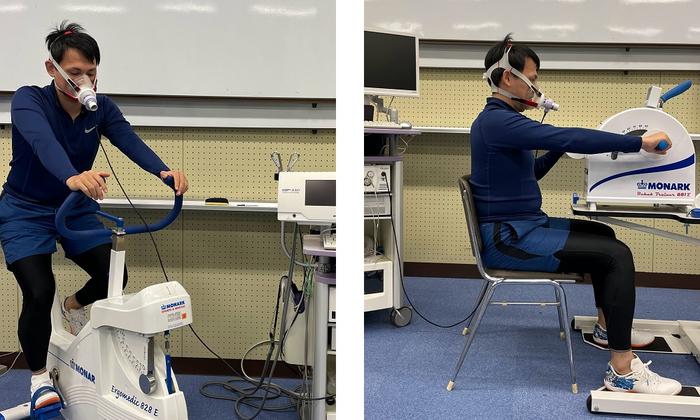
Credit: Osaka Metropolitan University
How can inclusivity be achieved in cardiopulmonary exercise tests for individuals facing lower limb injuries or disabilities that make it impossible to pedal a bicycle? Conventional exercise assessments rely primarily on lower limb exercise to determine maximal oxygen uptake – a cardiopulmonary function metric that indicates the maximum amount of oxygen that can be taken into the body in one minute. If lower limbs cannot be exercised, it necessitates an upper limb alternative. However, no clear upper limb exercise test protocol has been fully established.
A team of researchers from Osaka Metropolitan University led by Professor Hisayo Yokoyama of the Research Center for Urban Health and Sports, Specially Appointed Assistant Professor Miwako Deguchi and Specially Appointed Professor Nobuko Hongu of the Graduate School of Human Life and Ecology investigated whether cardiopulmonary exercise testing with the upper limbs can be considered as reliable as those conducted with the lower limbs. The study assessed the relationship between heart rate and oxygen uptake while estimating the maximal oxygen uptake during exercise testing using cycle and arm crank ergometers in 17 male collegiate athletes from rowing and cycling clubs, with excellent upper and lower limb function, respectively.
The results showed that the estimated maximal oxygen uptake was lower on the arm crank ergometer for both the rowing and cycling teams than on the cycle ergometer. “Exercise testing using arm crank ergometers underestimate cardiopulmonary function, regardless of upper limb training status,” said Dr. Deguchi. “In order to conduct exercise testing with arm crank ergometers in the future to assess cardiopulmonary function, it is necessary to clarify what factors affect the relationship between heart rate and oxygen uptake during exercise. We intend to use the results obtained in this study as a springboard for further research to expand the applicability of exercise testing using the upper limbs.”
Their findings were published in Applied Sciences.
###
About OMU
Osaka Metropolitan University is the third largest public university in Japan, formed by a merger between Osaka City University and Osaka Prefecture University in 2022. OMU upholds “Convergence of Knowledge” through 11 undergraduate schools, a college, and 15 graduate schools. For more research news, visit https://www.omu.ac.jp/en/ or follow us on Twitter: @OsakaMetUniv_en, or Facebook.
Journal
Applied Sciences
DOI
10.3390/app132312926
Method of Research
Experimental study
Subject of Research
People
Article Title
Does Exercise Testing with Arm Crank Ergometer Substitute for Cycle Ergometer to Evaluate Exercise Capacity?
Article Publication Date
3-Dec-2023