


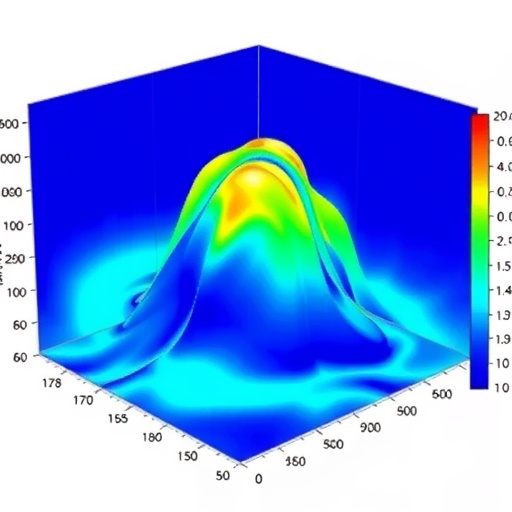
In the ever-evolving landscape of biomedical engineering, researchers are continuously seeking more efficient and reliable systems to simulate and model fluid dynamics in medical devices. A recent study led by Abeken, Gülan, and von Petersdorff-Campen has emerged, focusing on the intricate workings of a magnetically levitated blood pump. This groundbreaking research explores the validation of Large Eddy Simulation (LES) techniques against the traditional Reynolds-Averaged Navier-Stokes (RANS) flow modeling, a comparative analysis that holds significant implications for the future of blood pump technology.
The study primarily addresses the challenges faced in accurately predicting the behavior of complex fluid flows within medical devices. Blood pumps, essential for numerous medical applications, require precise fluid dynamics modeling to ensure efficiency and safety. Traditional computational fluid dynamics methods, particularly RANS, though widely utilized, often fall short in capturing the unsteady, turbulent nature of blood flow in real-time scenarios. This study advocates for the adoption of LES as a promising alternative, claiming that it can provide a more nuanced depiction of turbulence and flow separation that typically occurs in these devices.
To establish a robust framework for this study, the researchers undertook a meticulous experimental validation process. They meticulously designed and executed a set of controlled experiments, measuring the fluid flow patterns generated within a prototype blood pump. By utilizing advanced diagnostic tools such as Particle Image Velocimetry (PIV), they were able to capture high-fidelity velocity fields and turbulence characteristics. These measurements served as a benchmark for validating their LES models, offering unprecedented insights into the flow behaviors that occur in a magnetically levitated blood pump.
The findings of this research demonstrate a marked improvement in predictive accuracy when using LES models compared to RANS. The LES framework exhibited a superior ability to replicate the time-dependent flow structures and turbulence intensities observed in the experiments. This correlation emphasizes the importance of accurately simulating the complex interactions between blood and the pumping mechanism, which could potentially revolutionize the design and optimization of blood pumps in clinical settings.
Moreover, the research outlines the potential for adopting LES methodologies in other biomedical applications that require precise fluid dynamics modeling. The implications of this study extend beyond just the blood pump domain; numerous medical devices rely on accurate fluid flow simulations for operational efficiency and patient safety. The transition towards more advanced simulation techniques could lead to more sophisticated designs and improved outcomes in devices such as stents, heart valves, and other fluid transport technologies.
In evaluating the future of this technology, the authors suggest that an interdisciplinary approach, merging engineering, medicine, and computational sciences, is crucial. They advocate for collaborative research efforts, emphasizing the need for a synergy between experimental validation and computational modeling. The progression towards more refined and accurate predictive models will inevitably enhance our understanding of complex blood flow dynamics, contributing to the development of next-generation medical devices that are safer and more effective.
As advancements in computational power and algorithms continue to proliferate, the adoption of LES in the medical field will become more viable. The sophistication of these tools enables researchers to delve deeper into the nuances of fluid dynamics, analyzing intricate details that were previously beyond reach. This capability not only enriches our understanding but also paves the way for tailoring medical devices to meet the unique demands of individual patients, thus enhancing personalized medicine.
The researchers also highlight potential challenges in the implementation of LES in clinical practice. While the accuracy and depth of insights provided by LES are impressive, the computational resources and time required for simulation pose significant hurdles. As such, further technological advancements in computational efficiency will be essential to making these techniques accessible and viable for everyday use in medical device development.
In conclusion, the experimental validation of LES as a benchmark for RANS flow modeling represents a significant stride in the biomedical engineering field. The research conducted by Abeken, Gülan, and von Petersdorff-Campen not only underscores the importance of accurate fluid dynamics in blood pump technology but also highlights the broader implications for medical device development. As we move forward, embracing advanced modeling techniques such as LES may very well transform the landscape of biomedical engineering, offering new possibilities for improving patient care through innovative device design.
The impact of this study resonates with a broader community of researchers and innovators in the field of engineering and medicine. As academia and industry collaborate to harness these groundbreaking techniques, the potential for developing safer, more efficient biomedical devices will continue to grow. Ultimately, the synergistic fusion of experimental validation and computational modeling stands as a beacon of hope for the future of medical technology, promising advancements that could profoundly alter the treatment landscape.
The research underscores a critical narrative in the evolution of biomedical engineering: continuous improvement through scientific inquiry, interdisciplinary collaboration, and the integration of advanced computational methods will lead to a brighter future for medical device innovation. In reflecting upon the findings and implications of this study, the scientific community is called to action – to embrace these advancements not just as theoretical constructs but as a viable pathway to improve the lives of patients around the globe.
Subject of Research: Large Eddy Simulation in Blood Pumps
Article Title: Experimental Validation of Large Eddy Simulation as a Benchmark for Reynolds-Averaged Navier-Stokes Flow Modeling in a Magnetically Levitated Blood Pump.
Article References: Abeken, J., Gülan, U., von Petersdorff-Campen, K. et al. Experimental Validation of Large Eddy Simulation as a Benchmark for Reynolds-Averaged Navier-Stokes Flow Modeling in a Magnetically Levitated Blood Pump. Ann Biomed Eng (2025). https://doi.org/10.1007/s10439-025-03846-4
Image Credits: AI Generated
DOI: https://doi.org/10.1007/s10439-025-03846-4
Keywords: Fluid Dynamics, Biomedical Engineering, Blood Pumps, Large Eddy Simulation, Reynolds-Averaged Navier-Stokes, Experimental Validation
Tags: biomedical engineering fluid dynamicsblood pump technology advancementscomplex fluid flow predictioncomputational fluid dynamics methodsefficiency and safety in medical devicesexperimental validation in engineeringLarge Eddy Simulationsmagnetically levitated blood pumpRANS modelsturbulence modeling in medical devicesunsteady blood flow dynamicsvalidation of flow models



