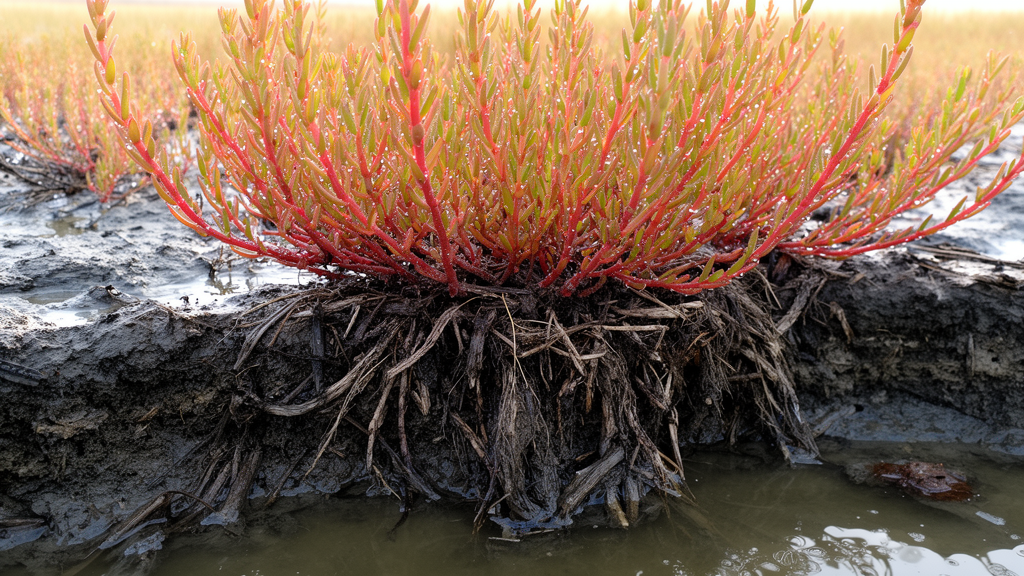
Hydrological changes and litter accumulation are critical factors affecting the ecological restoration of coastal saline-alkali wetlands. To elucidate the physiological adaptation mechanisms of the dominant species Suaeda salsa (L.) Pall. to the combined effects of flooding and litter addition, a study published in BMC Plant Biology established three waterlogging regimes and four litter addition treatments. The research systematically examined the response patterns of growth performance, photosynthetic capacity, and physiological and biochemical traits in Suaeda salsa.
The experimental design involved three distinct waterlogging conditions: non-waterlogged, intermittently waterlogged, and continuously waterlogged. In parallel, four litter addition treatments were applied: no litter addition, aboveground litter addition only, belowground litter addition only, and a combination of both additions.
The results indicated that waterlogging significantly suppressed the growth of Suaeda salsa. However, the alleviating effects of litter addition strongly depended on the specific waterlogging regime. Under continuous waterlogging, full and belowground litter additions were found to be most effective in mitigating stress. In contrast, belowground addition yielded the greatest benefits under non-waterlogged and intermittent waterlogging conditions.
Litter addition mitigated waterlogging-induced damage to the photosynthetic apparatus, driving a shift from passive defense to active optimization. The study highlighted that belowground litter more strongly promoted carboxylation efficiency and light use efficiency.
Furthermore, belowground litter alone enhanced antioxidant enzyme activities and reduced lipid peroxidation. On the other hand, full litter addition maintained cellular homeostasis through osmotic adjustment.
Correlation and principal component analysis indicated that flooding condition was the dominant factor influencing the plant’s responses. Litter component, however, was associated with resource allocation patterns. This suggests coordinated responses among photosynthetic efficiency, biomass accumulation, and antioxidant defense in Suaeda salsa.
In summary, flooding conditions primarily determined the physiological responses of Suaeda salsa. Belowground litter addition was associated with higher resource use efficiency and greater antioxidant enzyme activities. It also contributed to a larger proportion of non-stomatal limitations in the decline of net photosynthesis. These patterns suggest that belowground litter may help maintain growth under flooding. However, the mechanisms proposed in the study remain speculative and require further experimental validation.
Unlike previous studies that have largely focused on the individual effects of flooding or litter decomposition, this study reveals the interactive regulation of Suaeda salsa ecophysiological processes by flooding regime and litter component. It demonstrates that belowground litter plays an essential role in alleviating flooding stress and maintaining plant growth and resource use efficiency. These findings provide a theoretical basis for promoting the conservation and restoration of Suaeda salsa populations through litter management in coastal saline wetlands. The study also offers a reference for the rehabilitation of similarly degraded wetland ecosystems, highlighting the potential of targeted litter management strategies.
Subject of Research: Ecophysiological responses of Suaeda salsa to flooding and litter addition
Article Title: Ecophysiological responses and adaptation strategies of Suaeda salsa (L.) Pall. to combined flooding and litter addition
Article References: Han, R., Qi, Q., Jin, M., Xin, H., Hu, R., Ma, J., Li, T., & Sun, J. (2026). Ecophysiological responses and adaptation strategies of Suaeda salsa (L.) Pall. to combined flooding and litter addition. BMC Plant Biology. https://doi.org/10.1186/s12870-026-10337-8
Image Credits: AI Generated
DOI: 10.1186/s12870-026-10337-8
Keywords: Suaeda salsa, coastal wetlands, flooding stress, litter addition, photosynthesis, antioxidant defense, ecophysiology, saline-alkali soils, wetland restoration, plant adaptation, Ecophysiological, responses
News Source: Drew Townsend. (November 10, 2026). Belowground litter helps Suaeda salsa maintain growth under flooding. Scienmag.