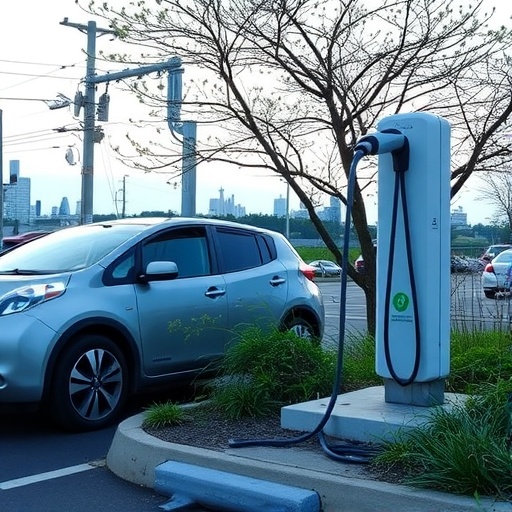
In a rapidly evolving energy landscape shaped by ambitious climate targets, the integration of electric vehicles (EVs) into the power grid presents a complex challenge that extends beyond mere technological adaptation. Recent research spearheaded by Zhang, Xin, Chen, and colleagues, published in Nature Communications, sheds light on a critical, yet often overlooked, factor influencing grid stability: behavioral uncertainty in EV charging patterns. Their groundbreaking study meticulously dissects how the unpredictability in individual EV owners’ charging decisions generates significant variability in grid load, a phenomenon that could impede the attainment of stringent climate goals.
The transition from fossil-fuel-powered cars to electric alternatives is widely considered a cornerstone of global efforts to curb greenhouse gas emissions. However, the deployment of EVs en masse introduces new dynamics into electricity consumption, notably a highly variable and time-sensitive demand linked to human behavior. Unlike industrial or stationary consumers, EV owners exhibit diverse charging habits influenced by myriad factors ranging from daily routines to weather conditions and socio-economic variables. Zhang and colleagues argue that this behavioral heterogeneity critically affects the grid’s operational reliability and complicates demand forecasting models essential for renewable energy integration.
Drawing upon sophisticated modeling techniques that incorporate data-driven behavioral insights, the research team demonstrated that the temporal distribution of EV charging is far less predictable than traditionally assumed. Their approach leveraged large-scale simulations calibrated with empirical datasets capturing charging events across various demographics. These simulations revealed that peak load occurrences attributed to EV charging do not follow a uniform pattern, but instead display pronounced fluctuations contingent upon individual uncertainties, such as variations in departure times, trip distances, and personal preferences for charging locations.
This nuanced understanding challenges the prevailing paradigm in energy modeling, which often employs aggregate or average demand profiles that inadequately capture this variability. The authors contend such simplifications risk underestimating the operational stresses imposed on critical grid infrastructure. Importantly, they illustrate how these stochastic charging behaviors amplify demand spikes, leading to heterogeneous load patterns that complicate grid management and increase the reliance on backup power generation, potentially compromising the environmental benefits of EV adoption.
The implications of these findings are profound, especially in the context of accelerating renewable energy integration. Sustainable grids rely heavily on balancing supply and demand, a task made inherently difficult by the intermittent nature of solar and wind resources. The unpredictable, behavior-driven surge in EV charging demand could exacerbate these balancing challenges, necessitating more sophisticated demand response strategies and grid-enhancing technologies. Zhang et al. emphasize the need for policies and innovations that address not just the physical infrastructure but also the human element driving demand uncertainty.
One promising avenue highlighted in the study is the deployment of smart charging technologies paired with real-time user feedback and incentives. By dynamically modulating charging rates based on grid conditions and user preferences, these systems can mitigate peak loads and smooth consumption profiles. However, execution remains complex, as the efficacy of such solutions hinges on accurate behavioral models that can predict and influence EV owner responses without imposing excessive restrictions or inconveniences.
Moreover, the research underscores the importance of integrating behavioral science with energy systems engineering. Traditional engineering approaches, focused primarily on hardware and network optimization, may fall short without incorporating behavioral dynamics that inherently drive usage patterns. The collaboration between social scientists, data analysts, and electrical engineers posited by Zhang’s team represents a paradigm shift crucial for creating resilient, climate-friendly power systems.
The study also touches upon the socio-economic dimensions of behavioral uncertainty in EV charging. Variability in charging habits can be linked to disparities in access to charging infrastructure, income levels, and urban versus rural residency. Recognizing these factors is vital for equitable grid planning and ensuring that decarbonization efforts do not inadvertently reinforce existing social inequalities. Tailored interventions might be necessary to accommodate diverse user profiles and foster inclusive participation in demand management programs.
In terms of policy implications, the research advocates for enhanced data collection and transparency around EV charging behaviors. Governments and utilities should invest in comprehensive monitoring systems that respect user privacy while enabling a granular understanding of consumption patterns. Such data infrastructure would empower stakeholders to design adaptive, behaviorally-informed strategies that enhance grid stability and support decarbonization objectives.
Furthermore, the paper outlines the potential consequences of neglecting behavioral uncertainty in grid modernization plans. Without accounting for these variations, infrastructure investments risk being misaligned with actual demand trajectories, leading to either overbuilt networks with wasted resources or underprepared grids vulnerable to outages. Strategic planning must therefore integrate behavioral unpredictability as a core consideration in capacity expansion and operational protocols.
This research marks a pivotal step towards reconciling human factors with technical demands in the energy transition. By illuminating the complex feedback loops between EV charging behavior and grid performance, Zhang and colleagues provide a critical framework for anticipating and managing load variability. Their insights call for a holistic approach combining technical innovation, behavioral interventions, and policy reforms to ensure a sustainable and reliable energy future.
Overall, as EV adoption scales exponentially to meet climate imperatives, embracing the inherent uncertainties of human behavior emerges as indispensable. The findings from this study not only refine our comprehension of grid dynamics but also inspire innovative pathways to harmonize environmental goals with consumer realities. The future of clean mobility, intertwined with smart electrification, depends on integrating behavioral nuances into our energy systems—and the work by Zhang and team sets the stage for this transformative endeavor.
Subject of Research: Behavioral uncertainty in electric vehicle charging and its impact on grid load variability under climate goals.
Article Title: Behavioral uncertainty in EV charging drives heterogeneous grid load variability under climate goals.
Article References:
Zhang, B., Xin, Q., Chen, S. et al. Behavioral uncertainty in EV charging drives heterogeneous grid load variability under climate goals. Nat Commun 17, 43 (2026). https://doi.org/10.1038/s41467-025-66796-4
DOI: https://doi.org/10.1038/s41467-025-66796-4
Tags: behavioral uncertainty in EV chargingclimate targets and electric vehiclesdemand forecasting for renewable energyelectric vehicle charging habitselectric vehicle grid stabilityhuman behavior and energy consumptionimpact of weather on EV chargingindividual EV charging patternsintegration of electric vehicles into power gridresearch on energy consumption variabilitysocio-economic factors in EV adoptionvariability in grid load