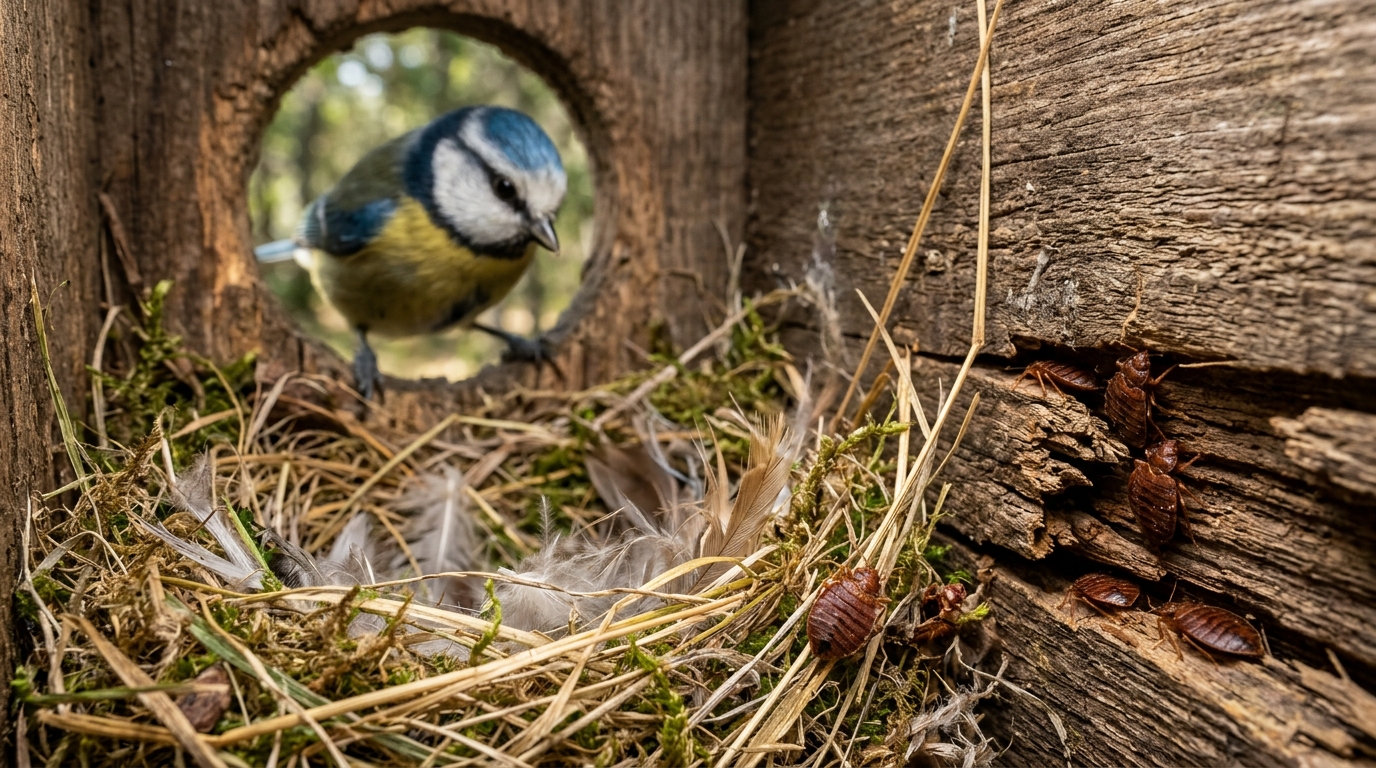
Researchers have documented a novel host-parasite interaction involving bed bugs infesting Eurasian Blue Tit nests in central Spain, marking the first time members of the insect family Cimicidae have been recorded parasitizing this avian host. The investigation identified the newly detected population by combining diagnostic morphological approaches with molecular genetic sequencing. The collected specimens exhibited external physical characteristics consistent with Cimex columbarius, yet molecular analysis revealed mitochondrial DNA belonging entirely to Cimex lectularius.
Nests of the Eurasian Blue Tit, Cyanistes caeruleus, are commonly infested by various ectoparasites, including blowfly larvae, mites, and fleas. Until this investigation, however, bed bugs had not been previously reported within the nesting sites of this host species. The unexpected discovery prompted researchers to analyze the morphology, genetic lineage, and feeding behavior of the insect population, while also describing the reproductive parameters of the infested nests relative to wider population values.
Field sampling took place across three breeding seasons between 2022 and 2024 within a Pyrenean oak forest located in Valsaín, central Spain. Over the course of the three-year study, bed bug specimens were gathered from four individual Blue Tit nests. The field collection yielded a total of 78 specimens, comprising 34 adults and 44 nymphs, which provided the material for morphometric analysis, mitochondrial gene sequencing, and host bloodmeal screening.
To evaluate physical characteristics, researchers measured diagnostic morphometric ratios across the 78 collected specimens. The observed measurements proved consistent with diagnostic morphometric ratios established for Cimex columbarius. However, morphological separation between the two closely related species faced structural limitations in the sample, as the specific diagnostic morphometric ratio that enables the distinction between the two species could be successfully measured in only nine of the 34 examined adults.
Molecular investigation involved sequencing fragments of the mitochondrial cytochrome c oxidase subunit I and 16S ribosomal RNA genes from ten bed bug specimens. This genetic sequencing identified three cytochrome c oxidase subunit I haplotypes and two 16S ribosomal RNA haplotypes. Crucially, seven of the ten sequenced specimens displayed double peaks exclusively at haplotype-diagnostic positions, an observation consistent with mitochondrial heteroplasmy. In phylogenetic assessments, all sequenced specimens fell within a clade composed exclusively of Cimex lectularius.
To establish whether the bed bugs were actively feeding on their avian hosts, researchers performed polymerase chain reaction amplification and sequencing of a Cyanistes-specific cytochrome b fragment. Blue Tit cytochrome b sequences were successfully recovered from engorged specimens, providing direct molecular evidence of feeding on this host. When evaluating reproductive outcomes, the infested nests showed no consistent pattern across reproductive parameters compared with population values, although fledging success in two of the four infested nests was lower than the population mean.
These findings demonstrate that bed bugs with Cimex columbarius-like morphology and Cimex lectularius mitochondrial lineages parasitize Eurasian Blue Tits in central Spain. The absence of mitochondrial differentiation between the two taxa aligns with the possibility that Cimex columbarius represents an avian-associated form of Cimex lectularius. Nonetheless, the researchers conclude that additional evidence remains necessary to fully resolve the taxonomic status and evolutionary relationship between these two bed bug populations.
Subject of Research: Bed bug infestation and genetic traits in Eurasian Blue Tit nests
Article Title: A novel host-parasite interaction in Blue Tit (Cyanistes caeruleus) nests: bed bugs (Hemiptera: Cimicidae) with Cimex columbarius-like morphology but Cimex lectularius mitochondrial DNA
Article References: García-Velasco, J., García-del Río, M., Martínez, J., & Merino, S. (2026). A novel host-parasite interaction in Blue Tit (Cyanistes caeruleus) nests: bed bugs (Hemiptera: Cimicidae) with Cimex columbarius-like morphology but Cimex lectularius mitochondrial DNA. Parasites & Vectors. https://doi.org/10.1186/s13071-026-07794-3
Image Credits: AI Generated
DOI: 10.1186/s13071-026-07794-3
Keywords: Cyanistes caeruleus, Blue Tit, Cimex lectularius, Cimex columbarius, Cimicidae, Hemiptera, host-parasite interaction, mitochondrial DNA, cytochrome c oxidase subunit I, 16S rRNA, mitochondrial heteroplasmy, cytochrome b, fledging success, Pyrenean oak forest, Valsaín, ectoparasites
News Source: Drew Townsend. (November 27, 2026). Bed Bugs Found Infesting Eurasian Blue Tit Nests in Spain. Scienmag.