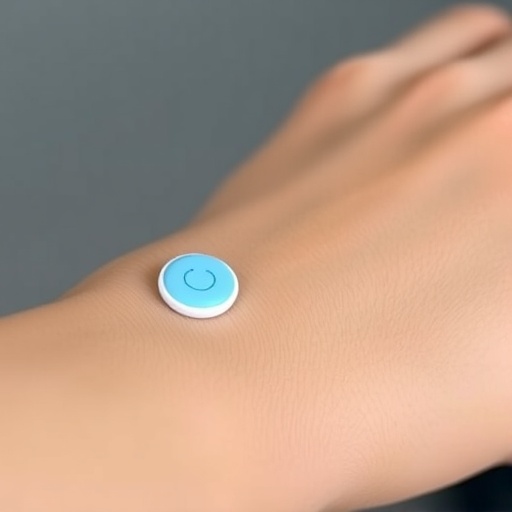
In a groundbreaking advancement destined to reshape personalized healthcare, researchers have unveiled a battery-free, wirelessly interconnected epidermal sensor network capable of continuous, high-fidelity physiological monitoring. The innovation addresses two critical bottlenecks in wearable technology: the cumbersome reliance on bulky batteries and the persistent challenge of efficient data transfer. By ingeniously coupling wearable metamaterials with smart textiles, the system achieves unprecedented synergy between power delivery and data communication, leveraging distinct frequency channels for optimized functionality.
Central to this pioneering system is the concept of a dual-mode metamaterial textile, seamlessly integrated into everyday clothing. This textile functions as an invisible, wireless conduit, separating the energy transfer from data signaling. At a low-frequency band of 13.56 MHz, the metamaterial facilitates efficient wireless power transfer, effectively energizing multiple epidermal sensors dispersed on the skin surface without the need for embedded batteries. Simultaneously, at 2.4 GHz—the globally accepted frequency for Bluetooth communications—the fabric handles low-latency data transmission, enabling real-time biosignal extraction with exceptional fidelity.
The architectural brilliance of this epidermal network lies not only in its wireless capabilities but also in its modular, scalable design. Each sensor node, imperceptible and conformal to the skin, is powered on-demand by the metamaterial integrated textile, which acts as a smart waveguide. This obviates the need for heavy, rigid batteries, thus enhancing wearability, comfort, and sensor lifespan. Moreover, the dual-frequency carrier approach mitigates signal interference and cross-talk often encountered in single-band systems, thereby preserving data integrity across multiple monitoring points.
Harnessing commonly available consumer electronics, the system enlists a smartphone as both a power transmitter and a data collection hub. Using near-field communication (NFC) technology at the power channel frequency, the phone wirelessly irradiates energy to the metamaterial textile embedded in the wearer’s clothing. This power then cascades through the dual-mode fabric to energize the epidermal sensor nodes. Concurrently, the same smartphone leverages the 2.4 GHz channel to communicate directly with the sensor nodes, aggregating biosignals such as continuous systolic blood pressure readings. This two-pronged wireless architecture smartly integrates with modern digital lifestyles, enabling seamless health monitoring without additional hardware.
The sensor network’s ability to continuously monitor systolic blood pressure marks a significant leap forward in cardiovascular diagnostics. Traditional blood pressure measurements rely on cuff-based, intermittent assessments that fail to capture dynamic physiological fluctuations. In contrast, this epidermal system achieves real-time, continuous tracking, even under motion-intensive conditions like exercise. This opens fresh avenues for early detection of hypertension episodes, personalized medication titration, and longitudinal study of cardiovascular health across a range of real-world environments.
From a materials engineering perspective, the metamaterial textile represents an elegant application of electromagnetic wave manipulation. Specifically designed to resonate and enhance electromagnetic field confinement at the designated frequencies, the textile maximizes power transfer efficiency while minimizing energy dissipation. The metamaterial’s geometry and composition are meticulously engineered to facilitate deep skin interfacing and robust signal coupling, overcoming the challenges posed by human body absorption and movement artifacts.
The sensor nodes themselves integrate cutting-edge bioelectronic interfaces capable of transducing minute physiological signals into electrical readouts. These biointerfaces are ultrathin, stretchable, and conformal, enabling intimate skin contact that enhances signal quality by reducing motion-induced noise and improving electrode-skin adhesion. The absence of onboard power sources significantly reduces sensor mass and complexity, which contributes to reduced skin irritation and long-term wearability.
Security and data privacy, paramount in any wireless health monitoring system, receive due consideration in this innovative platform. The separation of power and data channels inherently reduces channel congestion and interference, enhancing communication reliability. Furthermore, the communication protocols over the data channel incorporate encryption and secure authentication layers, preventing unauthorized access or tampering with sensitive physiological information.
By decentralizing sensing nodes and centralizing power and data flow through the metamaterial textile, the system introduces a new paradigm for wearable healthcare technologies. This multilayered connectivity framework enables a networked approach rather than isolated sensors, making it feasible to harness multimodal biosignals across different body regions. The distributed sensing strategy enhances diagnostic capabilities, offering a holistic view of an individual’s physiological state, a key asset for precision medicine.
The integration of such smart textiles into everyday apparel paves the way for transformative lifestyle applications beyond clinical settings. Whether embedded into workout wear, formal clothing, or casual attire, the system’s unobtrusiveness facilitates longitudinal health data acquisition, empowering users with real-time feedback on cardiovascular status. This continuity is anticipated to revolutionize preventive health strategies by fostering user engagement and proactive management of chronic conditions like hypertension.
Commercially, this technology holds compelling promise to disrupt established wearable device markets dominated by bulky wristbands or patch-based systems requiring frequent recharging or replacement. By circumventing battery constraints, the epidermal network dramatically extends device lifespan and sustainability, appealing to environmentally conscious consumers. The scalable manufacturing of metamaterial textiles integrates into conventional garment production lines, easing the path toward mainstream adoption.
The research team behind this innovation has diligently validated the system through rigorous in vivo and dynamic testing scenarios. Continuous blood pressure monitoring was demonstrated effectively during exercise sessions, capturing systolic variations with a high degree of accuracy and temporal resolution. These empirical validations underscore the robustness and user-friendliness of the epidermal sensor network, highlighting its readiness for translational research and eventual clinical trials.
Future developments aim to expand the sensing modalities beyond blood pressure, incorporating parameters such as heart rate variability, hydration, and biochemical markers. The modular nature of the sensor nodes allows for rapid adaptation and customization to a broad spectrum of physiological signals, thereby fostering a versatile platform for comprehensive health management. Moreover, advances in energy harvesting and metamaterial design are poised to further enhance power transfer efficiency and communication bandwidth.
Integrating with existing digital health ecosystems, the sensor network could synergize with cloud-analytics and artificial intelligence algorithms to provide predictive insights and personalized health recommendations. The fusion of continuous monitoring with machine learning may enable early warning systems for cardiovascular events, supporting timely clinical interventions and improving patient outcomes on a population scale.
This breakthrough exemplifies the transformative potential of interdisciplinary convergence, uniting materials science, bioelectronics, electromagnetic engineering, and data science to create a new class of wearable health devices. As this technology matures and scales, it will likely redefine the landscape of continuous vital sign monitoring, democratizing access to personalized cardiovascular healthcare with minimal burden on users.
In sum, this battery-free wireless epidermal sensor network represents a paradigm shift in wearable technology, marrying the sophistication of metamaterials with the practicality of smart textiles and ubiquitous smartphones. By delivering continuous, accurate physiological monitoring without the encumbrance of batteries, it sets a new benchmark for wearable healthcare innovation, with profound implications for patient empowerment, chronic disease management, and the future of digital medicine.
Subject of Research:
Wireless epidermal sensor networks for continuous physiological monitoring, focusing on battery-free power transfer and real-time systolic blood pressure tracking using metamaterial textiles.
Article Title:
A battery-free wireless epidermal sensor network for continuous systolic blood pressure monitoring.
Article References:
Kurt, S.A., Kasper, K.A., Xu, Q. et al. A battery-free wireless epidermal sensor network for continuous systolic blood pressure monitoring. Nat Electron (2026). https://doi.org/10.1038/s41928-026-01597-1
Image Credits:
AI Generated
DOI:
https://doi.org/10.1038/s41928-026-01597-1
Tags: battery-free wireless skin sensorsBluetooth data transmission at 2.4 GHzcontinuous physiological monitoringdual-mode metamaterial textilehigh-fidelity biosignal extractionmodular scalable wearable sensorspersonalized healthcare technologyreal-time blood pressure monitoringsmart textile biosignal communicationwearable metamaterials for power transferwireless epidermal sensor networkwireless power transfer at 13.56 MHz