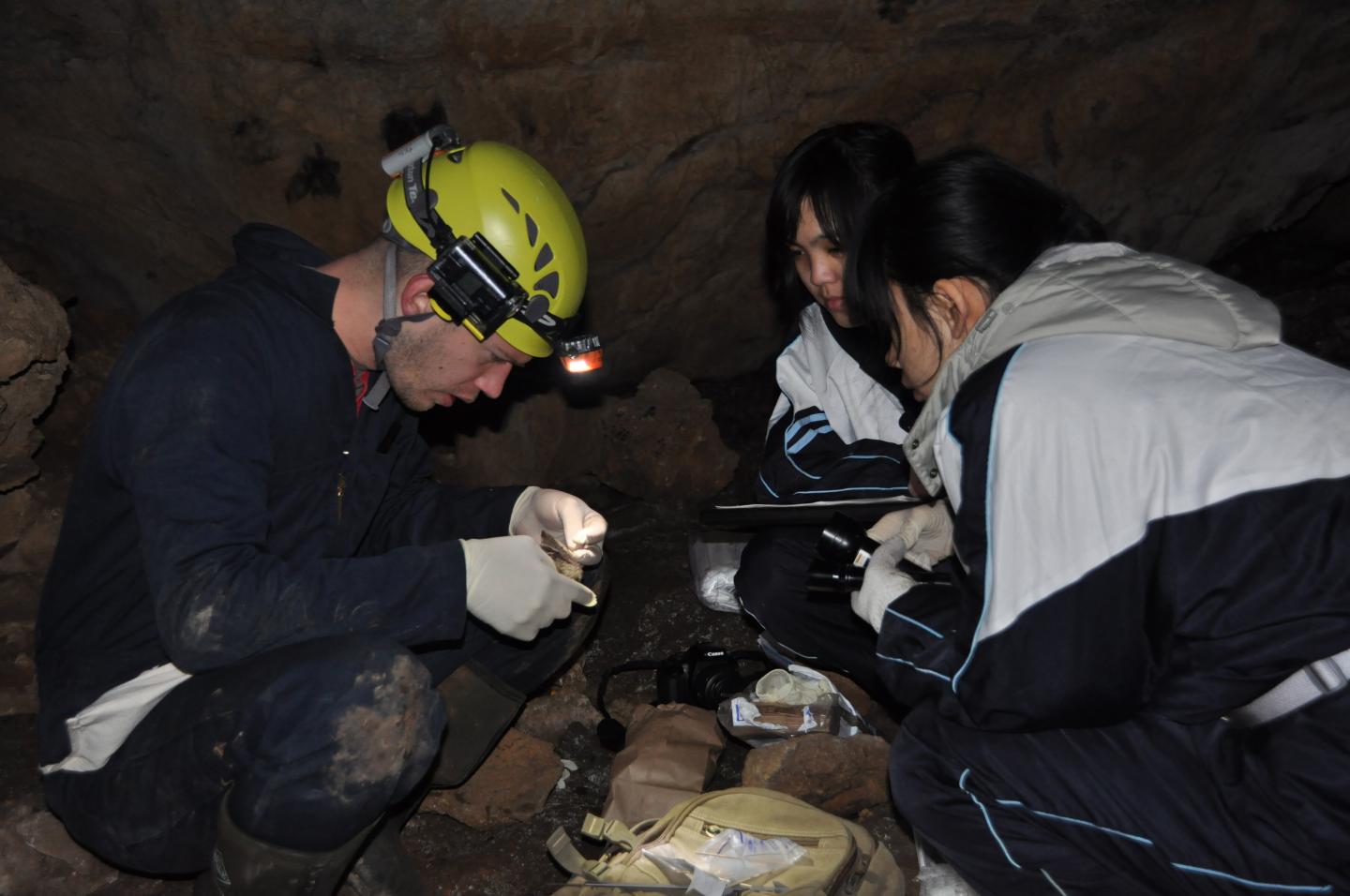
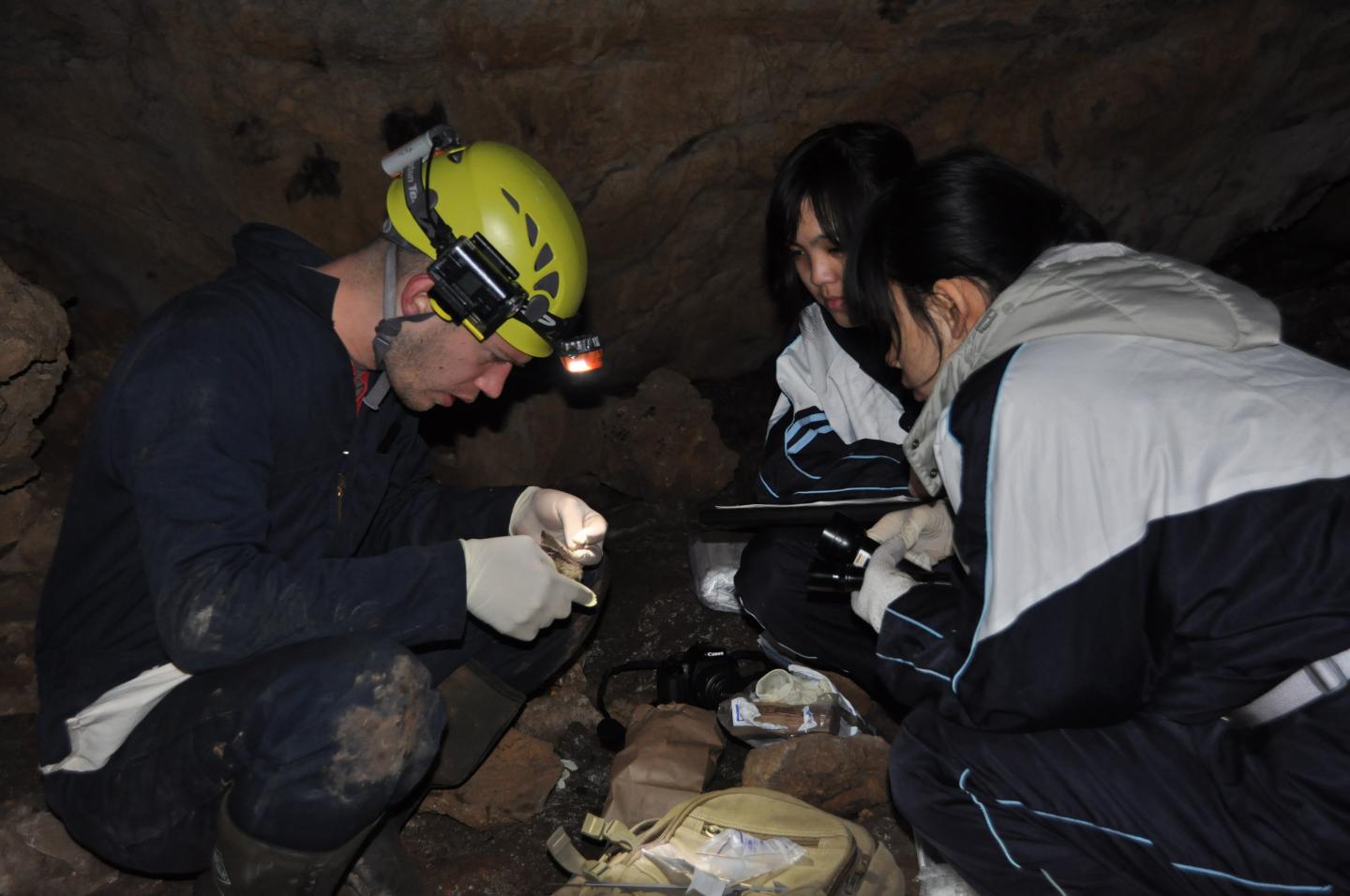
Bats in northeast China are infected with the fungus that causes white-nose syndrome, a deadly disease that has decimated bat populations in North America since it first appeared in upstate New York in 2006. A team of American and Chinese researchers found the fungus in caves where bats hibernate and found bats infected with the fungus.
Although infected bats had lesions characteristic of the disease and similar to lesions seen in North American bats, the researchers do not know the extent to which Chinese bat species are affected by the disease.
"We don't have historic population counts for bats in China, but there is no obvious evidence of the kind of population collapses that we've seen in North America," said Joseph Hoyt, a graduate student at the University of California, Santa Cruz, who led the study. Hoyt is first author of a paper on the new findings published November 2 in Emerging Infectious Diseases.
Scientists have known since 2010 that the fungus that causes white-nose syndrome is present in Europe. As in China, there is no evidence of the fungus causing mass mortality in European bat populations. Bat species in areas where the fungus has existed for a long time may have evolved resistance to or tolerance of the disease, but may still suffer appreciable mortality, according to coauthor Marm Kilpatrick, associate professor of ecology and evolutionary biology at UC Santa Cruz.
The new study expands the distribution of the fungus enormously and raises many interesting questions, Kilpatrick said. The overlapping ranges of the affected bat species in Europe and Asia suggest that the fungus may be widely distributed across all of northern Europe and Asia.
"There are several European species that come into northern Asia, and some Asian species that cross over into Europe," Hoyt said.
As a result of the new findings, Kilpatrick and Winifred Frick, who lead several research projects on white-nose syndrome at UC Santa Cruz, have received funding from the U.S. Fish and Wildlife Service to study the dynamics of the disease in China. "We've been studying disease dynamics in North America, and this gives us an opportunity to replicate that work in an endemic region where the pathogen has been for a long time," Frick said.
The new findings have important implications for efforts to prevent further global spread of the disease, Hoyt noted. "People need to start thinking about decontamination after visiting caves in China," he said.
Hoyt conducted the first sampling for the fungus in China in the summer of 2014, after receiving a National Science Foundation fellowship intended to promote research collaborations between U.S. graduate students and Chinese research institutions. He teamed up with researchers at Northeast Normal University in Changchun, China. After detecting the fungus at nine out of 12 sites, the researchers returned in winter of 2015 for additional sampling of cave environments and hibernating bats. The winter testing yielded positive results for the fungus in 75 percent of samples from three bat species.
###
In addition to Hoyt, Kilpatrick, and Frick, the coauthors of the paper include Jiang Feng, Keping Sun, Guanjun Lu, and Tinglei Jiang of Northeast Normal University, China; Katy Parise and Jeffrey Foster of Northern Arizona University; and Kate Langwig of UC Santa Cruz. This research was supported by the National Science Foundation, National Speleological Society Rapid Response Fund, U.S. Fish and Wildlife Service, National Science and Technology Foundation, and the Switzer Foundation.