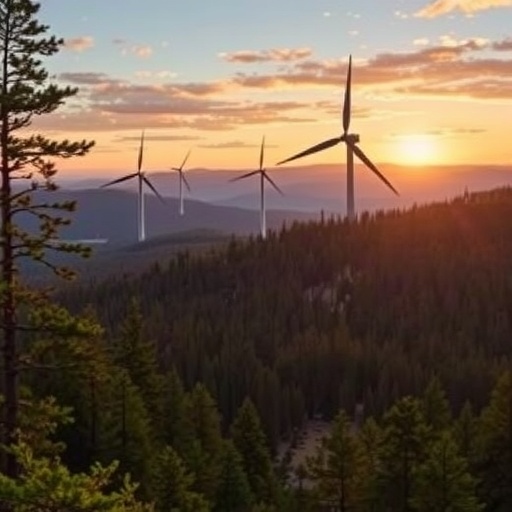
In the global pursuit of effective climate solutions, striking a delicate balance between environmental priorities has become paramount. A groundbreaking study by Zhang, P., Gou, F., Zhu, Z., and colleagues, soon to be featured in Nature Communications, untangles the complex trade-offs between two frontline strategies: forestation and wind energy implementation. This research delves deep into regional priorities, offering a nuanced roadmap for optimizing these climate interventions while acknowledging their intertwined challenges.
Forestation has long been heralded as a natural ally against climate change due to its effective carbon sequestration capabilities. By planting trees and restoring degraded lands, forest ecosystems absorb vast amounts of atmospheric carbon dioxide, a leading driver of global warming. However, the spatial requirements and ecological impacts of large-scale afforestation projects cannot be overlooked. This study investigates how forestation efforts must be strategically placed to minimize conflict with other land uses, biodiversity, and local socio-economic factors.
Conversely, wind energy stands as a pillar of renewable technology, providing clean electricity without the carbon footprint associated with fossil fuels. The expansion of wind farms contributes substantially to decarbonizing the energy sector, but comes with intrinsic ecological and societal challenges. For example, wind turbines often require vast tracts of land or offshore areas and can disrupt wildlife habitats, notably avian and bat populations. The study meticulously considers these impacts in regional contexts to guide more sustainable deployment practices.
What sets this research apart is its synthesis of spatial analysis, climate modeling, and ecological assessment. Using advanced geospatial tools alongside climate projections, the authors identify regions where forestation and wind energy can be prioritized without exacerbating environmental trade-offs. This approach allows for tailoring climate strategies that maximize carbon mitigation while preserving biodiversity and ecosystem services.
A key revelation from the study is that a one-size-fits-all approach to climate solutions is insufficient. Regional heterogeneity in climate conditions, land availability, biodiversity hotspots, and socio-economic structures necessitates context-specific strategies. For instance, in some temperate zones, forestation not only enhances carbon sinks but also supports local livelihoods through sustainable timber production. Meanwhile, arid or semi-arid regions may favor wind energy installations where vegetation growth is limited.
The intricacies of land use competition emerge prominently in the research. Forestation, while beneficial for carbon capture, may compete with agricultural land needed for food security or with areas earmarked for renewable energy infrastructure. The authors emphasize the need to incorporate land-use planning policies that integrate climate mitigation goals with existing regional development plans, avoiding unintended consequences such as food scarcity or habitat loss.
Beyond merely identifying priority areas, the study discusses technological innovations and management practices that can reduce trade-offs. For example, integrating agroforestry systems can harmonize forestation with agricultural productivity, creating multifunctional landscapes. Similarly, deploying bird-friendly turbine designs and careful siting can reduce wildlife mortality related to wind energy infrastructure.
The research also highlights the socio-political dimensions influencing the implementation of these climate solutions. Successful forestation and wind energy projects require stakeholder engagement, including local communities, government agencies, and private sectors. Transparent decision-making processes that address land rights, cultural values, and economic incentives are critical for long-term sustainability and social acceptance.
Climate feedback mechanisms further complicate the scenario. Forestation can alter local microclimates by modifying albedo, evapotranspiration, and soil moisture regimes, potentially affecting regional weather patterns. Wind farms can also influence atmospheric flow and temperature profiles. Understanding these interactions is vital for forecasting the net climate benefits and ensuring adaptive management in dynamic environmental conditions.
The temporal dimension of these solutions is another focal point. Forestation effects typically manifest over decades as trees mature and ecosystems stabilize, while wind energy can deliver immediate carbon reductions by replacing fossil fuels. The authors argue for integrative planning that leverages short-term energy transitions alongside long-term ecological restoration efforts to maximize cumulative climate impact.
Importantly, the study draws attention to the risk of unintended ecological consequences from large-scale interventions. Monoculture plantations, for example, may undermine biodiversity and soil health, compromising the resilience of forest carbon sinks. Similarly, poorly sited wind farms can fragment habitats. The authors advocate for biodiversity-inclusive metrics as integral to climate solution assessments.
By providing a sophisticated analytical framework, this research acts as a decision-support tool for policymakers. Mapping regional hotspots where forestation and wind energy are most synergistic guides resource allocation to achieve the highest climate mitigation efficiency with minimal trade-offs. This evidence-based approach enhances strategic planning at national and subnational levels.
Forward-looking, the authors propose further research into integrating other renewable sources and climate mitigation techniques, such as solar energy, bioenergy, and carbon capture technologies, with forestation and wind energy. Such multipronged strategies could synergize to overcome limitations inherent in individual solutions and drive more comprehensive climate action.
In conclusion, the work of Zhang et al. underscores the critical need for regional prioritization and integrative approaches to climate mitigation. Implementing forestation and wind energy in a coordinated, context-aware manner can reconcile environmental, economic, and social objectives, propelling global efforts toward a sustainable, low-carbon future. This study not only advances scientific understanding but also charts a clear path forward amid the climate crisis complexities.
As the world races to meet ambitious carbon neutrality targets, embracing nuanced, multi-dimensional climate solutions is indispensable. The insights presented here empower governments and stakeholders to optimize investments and policies, ensuring climate strategies that are robust, equitable, and ecologically sound. The era of strategic, evidence-driven climate interventions has arrived, promising transformative impacts when science meets practical implementation.
Subject of Research: Regional prioritization in climate solutions focusing on the trade-offs between forestation and wind energy implementation.
Article Title: Regional priorities in implementing forestation and wind energy as climate solutions in facing their trade-offs.
Article References:
Zhang, P., Gou, F., Zhu, Z. et al. Regional priorities in implementing forestation and wind energy as climate solutions in facing their trade-offs. Nat Commun (2026). https://doi.org/10.1038/s41467-026-71674-8
Image Credits: AI Generated
Tags: balancing forestation and wind energydecarbonizing energy with wind powerecological impacts of afforestationforestation carbon sequestration benefitsintegrated climate solution roadmapsland use conflicts in climate solutionslarge-scale afforestation challengesoptimizing wind energy deploymentregional climate intervention strategiesrenewable energy and biodiversity trade-offssocio-economic factors in climate policyspatial planning for climate mitigation