As conceived by Charles Darwin in the 1800s, evolution is a slow, gradual process during which species adaptations are inherited incrementally over generations. However, today biologists can see how evolutionary changes unfold on much more accelerated timescales.
Credit: Josh Borin, UC San Diego
As conceived by Charles Darwin in the 1800s, evolution is a slow, gradual process during which species adaptations are inherited incrementally over generations. However, today biologists can see how evolutionary changes unfold on much more accelerated timescales.
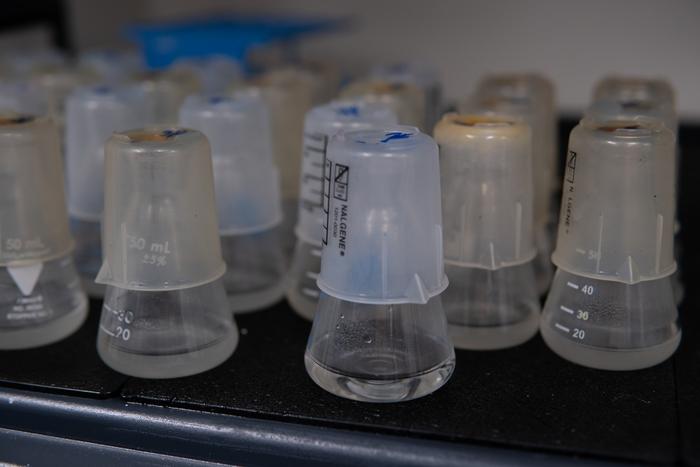
Rather than the evocative plants and animals of the Galapagos Islands that Darwin studied in forming his theory of evolution, Postdoctoral Scholar Joshua Borin and Associate Professor Justin Meyer of UC San Diego’s School of Biological Sciences are documenting rapid evolutionary processes in simple laboratory flasks.
Borin and Meyer set bacteria and viruses together in a closed laboratory flask — just two teaspoons large — to study coevolution in action. As viruses infect their bacterial neighbors, the bacteria evolve new defensive measures to repel the attacks. The viruses then counter these adaptations with their own evolutionary changes that work around the new defensive measures.
In only three weeks, this accelerated arms race between bacteria (Escherichia coli) and viruses (bacteriophage, or “phage”) results in several generations of evolutionary adaptations. The new findings, published in the journal Science, reveal the emergence of distinct evolutionary patterns.
“In this study we show the power of evolution,” said Meyer, an associate professor in the Department of Ecology, Behavior and Evolution. “We see how coevolution between bacteria and phage drive the emergence of a highly complicated ecological network. Evolution doesn’t have to be slow and gradual as Darwin thought.”
Meyer says the new study offers fresh perspectives on how intricate ecological networks develop across disparate ecosystems, whether they are food webs across the savanna, pollinator networks in the rainforest or microbes interacting in the ocean.
As bacteria and viruses adapted to each other’s presence over time, two prominent repeating patterns emerged. These included nestedness, a development in which narrow interactions between bacteria and virus specialists are “nested” within a broader range of generalist interactions; and modularity, in which interactions between species form modules within specialized groups, but not between groups.
“We were amazed to discover that our evolution experiment in tiny flasks had recapitulated the complex patterns that had been previously observed between bacteria and viruses collected at regional and transoceanic scales,” said Borin.
“When our research team first quantified this multiscale pattern in environmental bacteria and phage interaction data, we thought the emergence of such complexity required long periods of evolution,” added study coauthor Professor Joshua Weitz from the Department of Biology at the University of Maryland.
Meyer says capturing these evolutionary developments “in action” reinforces the power of evolution, which is often underestimated. Rapid pathogenic evolution continues to shape our world in new ways. Through COVID-19 and new mutations of SARS-CoV-2, viruses have demonstrated the potent capability for evolutionary adaptations that result in new strains when they encounter antibodies, vaccines and other roadblocks that keep them from effectively infecting and spreading. Such new concepts in microbial evolution are reframing the way patients are treated.
“We show that evolution can produce complex ecological networks quickly from very little external help,” said Meyer, who indicated that examples of such external evolutionary forces include isolation via geographical distance, environmental drivers and interactions with other species. “So we can use phage and bacteria as a model system to understand general evolutionary principles and help show how life on Earth has evolved into such diverse and complex ecosystems from simple beginnings.”
In related work, Meyer and Weitz are using artificial intelligence to study how phage could be used in the growing antibiotic resistance crisis. The research includes analysis of evolutionary data to determine which mutations in phage and bacteria can lead to infection and resistance. The research also highlights a new effort supported by the Howard Hughes Medical Institute to study how “jumbo” phages could be used as new therapeutic agents.
Coauthors of the Science paper include Joshua Borin, Justin Lee, Adriana Lucia-Sanz, Krista Gerbino, Joshua Weitz and Justin Meyer.
Journal
Science
DOI
10.1126/science.adi5536
Method of Research
Experimental study
Subject of Research
Not applicable
Article Title
Rapid bacteria-phage coevolution drives the emergence of multi-scale networks
Article Publication Date
10-Nov-2023