In a groundbreaking advancement poised to reshape the sustainable bioprocessing landscape, researchers have successfully engineered Corynebacterium glutamicum to heterologously express two novel alginate lyases, AlyB and AlyD, originally derived from the marine bacterium Vibrio algivorus. This pioneering work elucidates the complex enzymatic mechanisms underlying complete alginate depolymerization and opens promising avenues for the valorization of brown seaweed polysaccharides as renewable feedstocks for biomanufacturing.
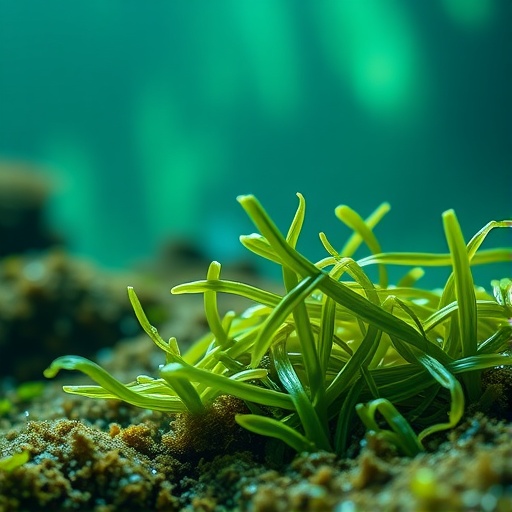
Alginate, a predominant polysaccharide making up 30% to 60% of brown seaweed biomass, possesses immense potential for industrial applications. Yet, its intrinsic high molecular weight coupled with a heterogeneous block structure has historically hindered its efficient utilization. The polysaccharide’s complex linear copolymer of β-D-mannuronic acid and α-L-guluronic acid residues presents structural challenges that demand precise enzymatic cleavage for productive downstream bioconversion. Overcoming these obstacles would unlock a vast marine resource for sustainable biochemical production.
In this context, the identification and functional characterization of AlyB and AlyD represent a significant stride forward. These two alginate lyases exhibit distinct but synergistic catalytic modalities. AlyB operates as an endo-enzyme, targeting internal glycosidic bonds in the alginate polymer chains, thereby generating oligomeric fragments. Conversely, AlyD enzymatically processes these oligomers exolytically, cleaving terminal monosaccharide units. The complementary activities of AlyB and AlyD combine to achieve comprehensive depolymerization, converting complex alginate polysaccharides into bioavailable sugar monomers.
Remarkably, AlyB demonstrates C-5 epimerization activity—a biochemical transformation rarely associated with polysaccharide lyases and unprecedented within the PL7 family of alginate enzymes. This dual functionality not only refines substrate specificity but could also modulate polymer block composition, influencing the physicochemical properties of degradation products. The discovery evidences sophisticated evolutionary adaptations that marine bacteria employ to exploit alginate as a carbon source and enhances our enzymology understanding in this family.
Capitalizing on these enzymatic capabilities, the research team implemented a bioprocess strategy wherein alginate subjected to AlyB and AlyD degradation served as the sole carbon source supporting the growth of genetically modified Escherichia coli strains engineered for riboflavin (vitamin B2) biosynthesis. Overcoming a critical bottleneck, the bioavailable monosaccharides produced from alginate depolymerization sustained cellular growth and metabolite production, ultimately achieving riboflavin expression at concentrations reaching 2.1 micrograms per milliliter.
This demonstration marks a milestone in integrating seaweed-derived polymers into microbial cell factories traditionally reliant on sugar-based feedstocks. It underscores the feasibility of leveraging heterogeneous carbohydrate substrates for value-added biochemical production, potentially reducing dependence on terrestrial crops and fossil-derived inputs. The deployment of C. glutamicum, a robust industrial microorganism renowned for amino acid manufacturing, as a heterologous host further accentuates the practical translational prospects of this research.
The broader implications extend beyond vitamin biosynthesis. The enzymatic toolkit characterized here lays the foundation for biomanufacturing pipelines capable of transforming seaweed biomass into diverse products such as food additives, specialty biochemicals, and biofuels. Given the rapid growth rates and carbon sequestration capabilities of seaweed, alginate valorization could emerge as a cornerstone technology in blue biotechnology and the circular bioeconomy.
Beyond the immediate applied outcomes, the study enriches fundamental insights into polysaccharide lyase biochemistry and microbial metabolic engineering. Functional expression of marine bacterial enzymes in C. glutamicum illustrates the versatility of this chassis for heterologous protein production and polymer degradation. It prompts future exploration of enzyme engineering to optimize activity, stability, and substrate range for customizable depolymerization strategies.
Moreover, the revelation of dual enzymatic and epimerization activity opens intriguing questions regarding enzyme structure-function relationships and evolutionary divergence within the PL7 alginate lyase family. Follow-up structural biology investigations may unravel mechanistic underpinnings and facilitate rational engineering of superior biocatalysts tailored for industrial alginate processing.
The study, published in the journal Systems Microbiology and Biomanufacturing and led by researchers from Higher Education Press, marks a decisive step in bridging marine polysaccharide chemistry with synthetic biology and microbial fermentation. It demonstrates an elegant convergence of enzymology, metabolic engineering, and bioprocess design to harness nature’s underutilized polysaccharides for sustainable bioproduction.
Moving forward, scaling this approach and integrating it with seaweed cultivation and biomass pretreatment processes will be critical to developing economically viable and environmentally friendly biorefineries. Addressing downstream challenges, including product recovery and process optimization, could accelerate commercial adoption and contribute to circular bioeconomy initiatives.
This innovative research underscores the untapped potential of marine bioresources and the transformative power of synthetic biology to convert complex biopolymers into high-value products. By unraveling and harnessing the enzymatic intricacies of AlyB and AlyD, scientists have unveiled a new paradigm for alginate degradation that may catalyze a wave of sustainable biotechnological applications grounded in ocean-derived feedstocks.
As global efforts to achieve carbon-neutral manufacturing intensify, the integration of alginate lyase-mediated bioconversion with microbial production platforms exemplifies how interdisciplinary approaches can generate novel solutions to resource challenges. This work not only expands the biocatalytic repertoire available to industrial microbiologists but also charts a promising course toward greener, seaweed-based bioprocessing futures.
Subject of Research: Not applicable
Article Title: Heterologous expression and functional characterization of two alginate lyases in Corynebacterium glutamicum
News Publication Date: 7-Jan-2026
Web References: http://dx.doi.org/10.1007/s43393-025-00432-6
Image Credits: HIGHER EDUCATION PRESS
Keywords: Alginate lyase, alginate depolymerization, AlyB, AlyD, Corynebacterium glutamicum, Vibrio algivorus, riboflavin production, marine polysaccharides, synthetic biology, microbial fermentation, bioprocessing, PL7 polysaccharide lyases
Tags: alginate breakdown mechanismsAlyB and AlyD characterizationbiomanufacturing with seaweed biomassbrown seaweed polysaccharide valorizationcomplete alginate depolymerizationdual enzyme alginate lyase systemengineered Corynebacterium glutamicumenzymatic cleavage of alginateindustrial applications of alginate polymersmarine bacterium Vibrio algivorus enzymesrenewable feedstocks from seaweedsustainable bioprocessing of seaweed