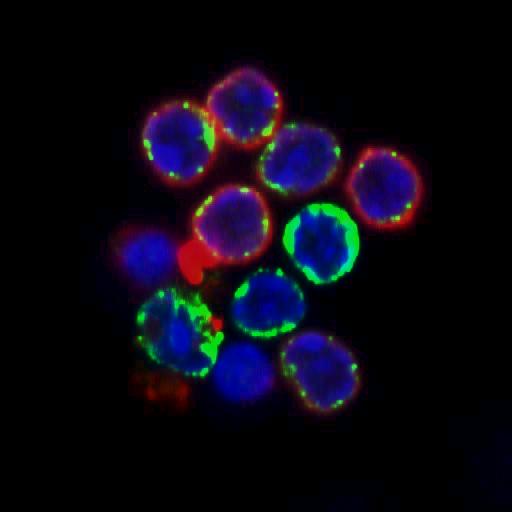
Credit: Di Virgilio, MDC
Whenever a germ gets into the human body, the immune system usually responds immediately to fight off the enemy attacker. One of our defense system’s most important strategies involves B lymphocytes, also known as B cells, which produce antibodies that target and neutralize pathogens. B cells play a central role in adaptive immunity and, together with T cells and components of the innate system, they protect the body against foreign pathogens, allergens and toxins.
Many Berlin researchers involved in the study
A team led by Dr. Michela Di Virgilio, head of the Genome Diversification & Integrity Lab at the Max Delbrück Center for Molecular Medicine in the Helmholtz Association (MDC), has now identified a protein called Pdap1 that supports B cells in this important task while simultaneously protecting them from stress-induced cell death.
The lead authors of the study, which was published in the Journal of Experimental Medicine, are the two doctoral students Verónica Delgado-Benito and Maria Berruezo-Llacuna – both members of Di Virgilio’s lab. Researchers from the MDC’s Berlin Institute of Medical Systems Biology (BIMSB) and the Experimental and Clinical Research Center (ECRC) were also involved. The ECRC is a joint institution of the MDC and Charité – Universitätsmedizin Berlin.
B cells must continuously adapt
“A successful humoral immune response, which is mediated by antibodies, is dependent on several factors,” explains Di Virgilio. Mature B cells have to modify their genes (i.e., building instructions) in order to create antibodies that better match the distinguishing features on the surface of the invading pathogen. This is known as the lock-and-key principle and is achieved by somatic hypermutation, which mutates the pathogen-recognizing portion of the antibody molecule after the encounter and B cell activation.
Over the course of the humoral immune response, another part of the antibodies is transformed in a process known as class-switch recombination (CSR). Here, B cells change the isotype of the antibodies they produce. Instead of immunoglobulins of the isotype IgM, which are predominantly produced at the start of an infection, they may produce, for example, IgG antibodies, which have a different effector function. This process potentiates the ability of antibodies to effectively dispose of the pathogen.
The protein was found with the help of “gene scissors”
“In the beginning, we primarily wanted to understand how class switching works,” says Delgado-Benito. “So we genetically modified a mouse B cell line using the CRISPR-Cas9 gene scissors to prevent them from producing certain proteins.” In this way, she and the team discovered that without PDGFA associated protein 1 (Pdap1), less class switching occurs.
“In the next step, we generated mice where the gene for Pdap1 was switched off specifically in B cells,” reports Berruezo-Llacuna. “This showed us that the protein is also crucial for somatic hypermutation.” Without the protein, fewer such mutations occurred in the pathogen-recognizing part of the antibody, thus reducing the possibility to generate highly-specific variants.
B cells die more easily without Pdap1
“A particularly surprising finding to come out of our in vivo experiments, however, was that mouse B cells that are unable to produce Pdap1 die far more easily than is normally the case,” adds Di Virgilio. Her team discovered that the protein protects B lymphocytes from stress-induced cell death. “Mature B cells experience cellular stressors particularly when they begin to grow and proliferate rapidly after contact with the pathogen,” explains the researcher.
It seems that in unmodified animals, Pdap1 helps B cells to cope with this stress. Without the protein, however, a program is started that ultimately leads to cell death. “So Pdap1 not only helps the B lymphocytes to consistently produce the effective antibodies,” says Di Virgilio. “It can also be seen as their protector.”
###
Publication
Verónica Delgado-Benito et al. (2020): “PDGFA-associated protein 1 protects mature B lymphocytes from stress-induced cell death and promotes antibody gene diversification,” Journal of Experimental Medicine, DOI: 10.1084/jem.20200137
Media Contact
Dr. Michela Di Virgilio
[email protected]
Related Journal Article
http://dx.