Credit: Toshiro Ito
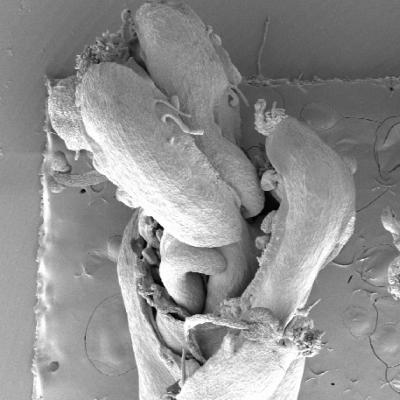
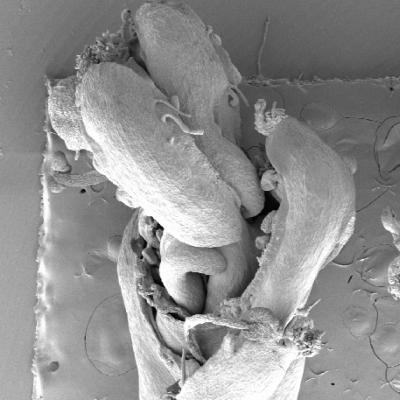
(Nara, Japan) Many human and animal foodstuffs, such as grains and fruits, derive from flowering plants. Flowers are formed from groups of dividing stem cells at the ends of shoots, and the division of these cells is stopped at a particular stage of development once floral components have formed. A new study by scientists at Nara Institute of Science and Technology (NAIST) provides new molecular insight into the coordination of this termination and development by showing the interplay between two molecules, CRABS CLAW and TORNADO2. The findings, published in Nature Communications, describes key molecular events that must occur for stem cells to stop growing and begin transitioning into the development of reproductive organs. They showed that the plant hormone auxin controls the change from cell division to female reproductive development.
"Termination of floral stem cell growth and the beginning of gynoecium development is tightly regulated spatially and temporally. Our interest is the coordination of these two events," explains NAIST Professor Toshiro Ito. Floral stem cell termination depends on the activation of two genes, one being CRABS CLAW and the other being KNUCKLES. The lab had already reported the influence of KNUCKLES on stem cell termination, so in the present work the focus was on CRABS CLAW. Therefore, Prof. Ito had his Assistant Professor, Nobutoshi Yamaguchi, prepare seeds of the plant Arabidopsis thaliana with mutants in CRABS CLAW and KNUCKLES.
The double mutant led the scientists to conclude that CRABS CLAW regulation of growth termination depends on its transcriptional regulation of the protein TORNADO2. "TORNADO2 regulates the auxin homeostasis. Auxin is a plant hormone that promotes growth of the stem tip," says Assist. Prof. Yamaguchi.
Indeed, they found that CRABS CLAW represses TORNADO2 expression by binding to an evolutionary conserved region in the TORNADO2 gene, suggesting this interaction is common in different plant species beyond Arabidopsis thaliana. This repressive binding was further shown to affect the TORNADO2 expression and thus auxin distribution in the floral buds. The study gives a roadmap for how CRABS CLAW coordinates the growth termination of the floral stem cells and the development of the gynoecium.
"We found that CRABS CLAW modulates auxin homeostasis through its interaction with the TORNADO2 gene. This result describes an elegant mechanistic link between floral stem cell growth termination and gynoecium development," says Assist. Prof. Yamaguchi.
"Because flowering plants are so important to our food supply, a fundamental understanding of flower development will help to improve it," Prof. Ito says. "Such understanding has an important impact for basic biology, and could help create biotechnological improvements for the production of high-value crops."
###
Title: Fine-tuning of auxin homeostasis governs the transition from floral stem cell maintenance to gynoecium formation"
Authors: Nobutoshi Yamaguchi#, Huang Jiangbo#, Yifeng Xu, Keitaro Tanoi, and Toshiro Ito*
Publication: Nature Communications
DOI: 10.1038/s41467-017-01252-6
# Authors contributed equally to the work.
* Author for correspondence
Information about Prof. Ito's lab. can be found at the website; http://bsw3.naist.jp/eng/courses/courses112.html
About NAIST
NAIST was founded in 1991 as a Japanese national university consisting solely of graduate schools in three integrated areas: information science, biological sciences, and materials science. In the early 2018, NAIST will transform its current structure into the one graduate school system to further promote the mission of cultivating global leaders in science and technology who will actively respond to social demands. At present, about 1,000 students -22% from overseas- are supervised by roughly 200 NAIST faculty. With its cutting-edge facilities and a 5 to 1 student-to-faculty ratio, NAIST's world-leading research and education are a direct result of its rich, global environment and supportive infrastructure. NAIST has quickly established itself as a world-class research and education center where young scientists and technologists become tomorrow's global leaders. For more detail please visit: http://www.naist.jp/en/
Media Contact
Michiko Muraki
[email protected]
81-743-725-641
@NAIST_MAIN_EN
http://www.naist.jp/index_en.html
Original Source
http://www.naist.jp/en/research_achievements/2017/10/004048.html http://dx.doi.org/10.1038/s41467-017-01252-6