Researchers at Örebro University have developed an autonomous robot navigation system designed to navigate through dense pedestrian crowds by learning and adopting human movement patterns. Moving through crowded environments such as railway terminals or airports presents severe logistical difficulties for conventional navigation systems and individuals with visual impairments. Traditional navigation robots treat human pedestrians strictly as static or dynamic obstacles that must be avoided at all costs. When pedestrian density increases significantly, these systems frequently encounter the freezing robot problem, halting entirely because their trajectory planners cannot identify a path cleared of perceived obstacles.
To overcome this limitation, the newly designed methodology shifts the underlying navigation paradigm from basic obstacle avoidance to active behavioral adaptation. In typical human crowd dynamics, people do not stop abruptly when encountering surrounding pedestrians; rather, they adjust their pace, keep to one side, and move along with the general flow. Doctoral researcher Yufei Zhu, who completed his thesis in computer science at Örebro University under the supervision of Professor Martin Magnusson, emphasized that assistive guide robots intended to help individuals with visual impairments cannot come to a complete stop whenever another person approaches, but must instead blend into ambient foot traffic.
The technical foundation of the research relies on spatio-temporal representations designated as Maps of Dynamics, integrated with the HiCrowd software system. Unlike conventional mapping frameworks that record only fixed architectural boundaries such as walls and doorways, Maps of Dynamics capture how pedestrians typically move through specific locations at various intervals throughout the day. By continuously observing dynamic foot traffic, the system models local behavioral habits and infers probable destination paths, enabling the robotic platform to anticipate pedestrian trajectories rather than responding solely to instantaneous spatial proximity.
Through the HiCrowd framework, surrounding crowds are interpreted as movement guidance rather than immediate navigational hazards. By tracking spatial flow patterns, the robotic agent follows emerging human corridors. Yufei Zhu compared this computational process to a newcomer who arrives in an unfamiliar town, systematically observes how local residents navigate the streets, and copies their movement patterns to travel efficiently through public infrastructure.
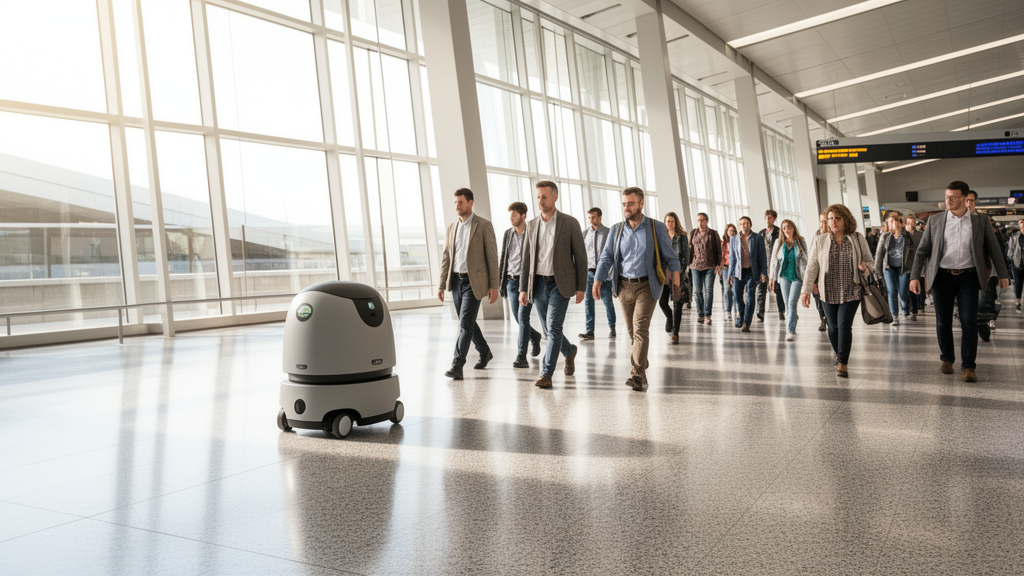
The navigation framework underwent real-world experimental evaluation at the Science Museum Miraikan in Tokyo and at Expo 2025 in Osaka. For these trials, the navigation system was deployed on a robotic unit resembling a compact suitcase, which was tasked with moving through dense streams of museum and exhibition visitors. During testing, the autonomous unit successfully negotiated high-density pedestrian corridors by following the movements of groups travelling ahead of it.
In one recorded trial, the robotic platform traversed a crowded hall directly behind a cluster of visitors. When the group executed a right turn, the robot followed their trajectory before its forward-facing sensors could directly detect the underlying cause, which turned out to be an oncoming wave of pedestrians. By aligning its path with the moving group ahead, the platform bypassed the counterflow without halting or disrupting its forward progress.
Experimental observations also evaluated pedestrian responses to the autonomous machine operating within crowded public spaces. Nearby visitors did not show signs of alarm, nor did they alter their pace to maintain wide clearances around the device. Because the platform adjusted its movement to match ambient human speed and directional flows, surrounding pedestrians treated the automated suitcase-sized unit similarly to any other walking pedestrian.
The doctoral research project was conducted at Örebro University in international collaboration with researchers at the Miraikan Accessibility Lab in Japan and Bosch in Germany. Beyond potential applications as a digital assistive guide for visually impaired travelers in bustling transportation hubs, the underlying dynamic mapping methods have also been deployed across broader domains, including industrial warehouse robotics and service robots operating among visitor groups in cultural institutions.
In real-world public deployments, navigating busy transport hubs presents distinct challenges that require continuous, real-time adaptation. The software combination of Maps of Dynamics and the HiCrowd framework allows autonomous units to learn location-specific movement patterns dynamically. Rather than treating dense crowds as safety hazards or persistent threats, the system utilizes emerging pedestrian trajectories to guide navigation in real time, demonstrating that mobile devices can circulate smoothly through large crowds without constant interruptions.
Doctoral researcher Yufei Zhu pointed out that railway stations exhibit clear, established human habits and regular movement flows throughout different periods of the day. By modeling these temporal dynamics, an automated guide robot could lead an individual with visual impairment along natural pathways, allowing travelers to move harmoniously with surrounding foot traffic rather than struggling against dense counterflows. Such autonomous guidance systems are envisioned over the long term as digital complements to traditional guide dogs, facilitating independent travel across bustling transportation corridors.
The published research thesis, titled “Spatio-Temporal Representations of Human Dynamics for Motion Prediction and Robot Navigation,” was presented under computational simulation and modeling research classifications. The development of the underlying navigation software involved cross-institutional contributions from Örebro University, the Miraikan Accessibility Lab, and corporate engineering researchers at Bosch. By validating the algorithms through live trials in high-density museum halls and exhibition spaces, the research demonstrated that service robots can seamlessly share pathways with walking pedestrians while executing continuous transit tasks.
Subject of Research: Autonomous robot navigation and human crowd motion prediction
Article Title: Robots learn to follow the crowd – could become digital guide dogs
Article References: Robots learn to follow the crowd – could become digital guide dogs. Original publication (Bibliographic details unavailable.)
Image Credits: AI Generated
DOI: Not provided
Keywords: Örebro University, robot navigation, crowd dynamics, Maps of Dynamics, HiCrowd, Yufei Zhu, Martin Magnusson, assistive robotics, freezing robot problem, pedestrian tracking, Miraikan Accessibility Lab, Expo 2025 Osaka, autonomous systems, motion prediction, computer science
News Source: Denise Maddox. (November 20, 2026). Autonomous Navigation System Enables Mobile Robots to Move With Human Crowd Flows. Scienmag.