In a groundbreaking development poised to transform diagnostic cytopathology, researchers have unveiled a sophisticated AI-powered framework that enables precise and autonomous classification of cellular populations from cytological samples. This revolutionary approach, detailed in a recent study published in Nature, harnesses a novel class probability vector system to dissect and visualize the complex cellular landscape, offering a predictive tool with remarkable accuracy for identifying disease states, including critical precancerous lesions.
At the core of this innovation lies the Cell Morphology Descriptor (CMD) framework, a paradigm shift in cellular analysis that abstracts each cell into a ten-dimensional vector derived from AI models trained on extensive cytological data. These vectors serve as multidimensional fingerprints, capturing subtle morphological nuances that conventional methods often overlook. By plotting these vectors in scatter plots, the researchers have introduced a statistically robust and interpretable visualization method that bridges the gap between raw computational outputs and clinically actionable insights.
The study applied this framework to a comprehensive set of cervical cytology samples, spanning diagnoses from negative for intraepithelial lesion or malignancy (NILM) to low-grade (LSIL) and high-grade squamous intraepithelial lesions (HSIL). Each sample underwent a detailed analytical pipeline: first, a scatter plot was employed to differentiate epithelial cells from contaminating leukocytes and debris, effectively gating out irrelevant populations. Then, histograms quantified the distribution of LSIL and HSIL probabilities within the gated epithelial compartment, enabling the calculation of absolute counts and proportions of potentially malignant cells.
Adding a richly informative dimension, the team employed Uniform Manifold Approximation and Projection (UMAP) techniques to visualize the spatial distribution of these epithelial populations in a two-dimensional representation. The UMAP plots vividly illustrated the intrinsic histological architecture, recapitulating the in situ organization of squamous and glandular cells as transitions rather than discrete categories. This pseudo-histological mapping was further corroborated by longitudinal markings of representative points corresponding to morphological transitions, from parabasal to intermediate and superficial squamous cells, as well as glandular to metaplastic phenotypes.
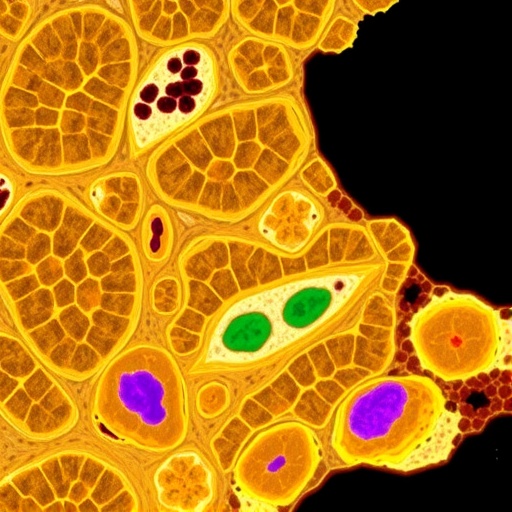
This high-resolution mapping was not merely academic; it offered vital clinical intelligence by precisely identifying cells exhibiting cytological atypia that corresponded with LSIL and HSIL diagnoses. The study included detailed single-cell image panels extracted from these mapped regions, showcasing distinct morphological features that pathologists traditionally associate with precancerous changes. The capability to automate and visualize these critical transitions holds profound implications for enhancing both the accuracy and efficiency of routine cytopathology workflows.
The strength of this approach is its dual function as both a diagnostic classifier and a morphometric explorer. By leveraging AI-derived probabilities rather than hard labels, the CMD framework provides a continuous, nuanced spectrum of cellular phenotypes, facilitating the detection of subtle early-stage disease signals. This is a stark departure from existing cytopathology methods that often rely on subjective assessments and categorical thresholds, which may compromise sensitivity or specificity.
The researchers demonstrated this framework’s robustness by analyzing samples from individuals of varied demographic backgrounds, underscoring its generalizability. The NILM datasets revealed the expected distribution of normal epithelial subtypes, while the LSIL and HSIL samples distinctly clustered in regions characteristic of their atypical morphology. This stratification is critical for clinical decision-making, as it guides intervention strategies and patient management with unprecedented precision.
Beyond diagnostic capabilities, the integration of CMD markers with UMAP visualization provides a versatile tool for cytological research. Investigators can explore underlying biological processes such as differentiation pathways, metaplastic transformation, and atypia progression in high-dimensional space, all rendered interpretable by intuitive visual outputs. This bridges the often-disparate realms of computational pathology and traditional histopathological interpretation.
Moreover, the CMD framework proposes a pathway towards fully autonomous cytopathology systems capable of whole-slide edge tomography. Such systems could dramatically reduce diagnostic turnaround times, minimize human error, and democratize access to expert-level screening in under-resourced settings. The implications for public health are significant, especially in regions burdened by high cervical cancer incidence but limited cytological expertise.
Importantly, the researchers have validated their model against established diagnostic categories, confirming concordance between AI-derived classifications and expert pathologist annotations. This rigor ensures that the tool does not replace but rather augments conventional practice, offering a decision-support system that enhances confidence in challenging cases. The transparent visualization facilitates user trust and fosters interpretability—key factors in clinical adoption.
The implications of this study extend beyond cervical cytology. The underlying principles of the CMD framework and AI-integrated visualization hold promise for a broad spectrum of tissues and pathologies where morphological heterogeneity complicates diagnosis. Whether in hematopathology, respiratory, or gastrointestinal cytology, such approaches can provide versatile platforms for multiplexed cellular phenotyping and disease stratification.
As AI technologies continue to permeate medical diagnostics, this work exemplifies a model where deep learning complements rather than supplants expert interpretation. By offering statistically robust markers derivable directly from imaging data, combining probability metrics with advanced dimensionality reduction, this framework sets a new standard for precision, scalability, and clarity in cytopathology. The future of autonomous pathology diagnosis is clearly on the horizon, heralded by innovations such as the CMD framework.
This pioneering research opens avenues for integrating molecular and genetic data with morphological descriptors, potentially creating multimodal diagnostic platforms that could achieve even higher fidelity in disease detection and prognostication. The synergy between AI-enhanced cytology and molecular oncology thus promises a new epoch of personalized medicine and preventive care.
In summary, the CMD-based AI framework for autonomous cytopathology represents a monumental leap toward transforming the analysis and interpretation of cytological samples. By implementing a multidimensional class probability vector representation paired with innovative visualization techniques, this approach transcends traditional limitations, providing a powerful, interpretable, and clinically applicable tool that confirms the evolving role of AI at the frontline of cancer diagnostics.
Subject of Research: Autonomous AI-based cytopathology utilizing multidimensional class probability vectors for enhanced cellular classification and visualization in cervical cancer screening.
Article Title: Clinical-grade autonomous cytopathology through whole-slide edge tomography.
Article References:
Nitta, N., Sugiyama, Y., Sugimura, T. et al. Clinical-grade autonomous cytopathology through whole-slide edge tomography. Nature (2026). https://doi.org/10.1038/s41586-025-10094-y
Image Credits: AI Generated
DOI: https://doi.org/10.1038/s41586-025-10094-y
Tags: AI-powered cellular classificationautonomous cytopathology diagnosticscell morphology descriptor frameworkcervical cytology AI analysisclass probability vector systemdetection of squamous intraepithelial lesionsedge tomography in cytologyhigh-grade lesion identification AIleukocyte differentiation in cytology samplesmultidimensional cellular fingerprintingpredictive tools for precancerous lesionsscatter plot visualization in cytology