• HOME
  • NEWS
  • EXPLORE
    • CAREER
      • Companies
      • Jobs
    • EVENTS
    • iGEM
      • News
      • Team
    • PHOTOS
    • VIDEO
    • WIKI
  • BLOG
  • COMMUNITY
    • FACEBOOK
    • INSTAGRAM
    • TWITTER
Sunday, November 22, 2026
BIOENGINEER.ORG
No Result
View All Result
  • Login
  • HOME
  • NEWS
  • EXPLORE
    • CAREER
      • Companies
      • Jobs
        • Lecturer
        • PhD Studentship
        • Postdoc
        • Research Assistant
    • EVENTS
    • iGEM
      • News
      • Team
    • PHOTOS
    • VIDEO
    • WIKI
  • BLOG
  • COMMUNITY
    • FACEBOOK
    • INSTAGRAM
    • TWITTER
No Result
View All Result
Bioengineer.org
No Result
View All Result
Home NEWS Science News Technology

Automated Slitter Machine Docking Reduces Defect Alignment Time by 73 Percent

by
November 20, 2026
in Technology
Reading Time: 2 mins read
0
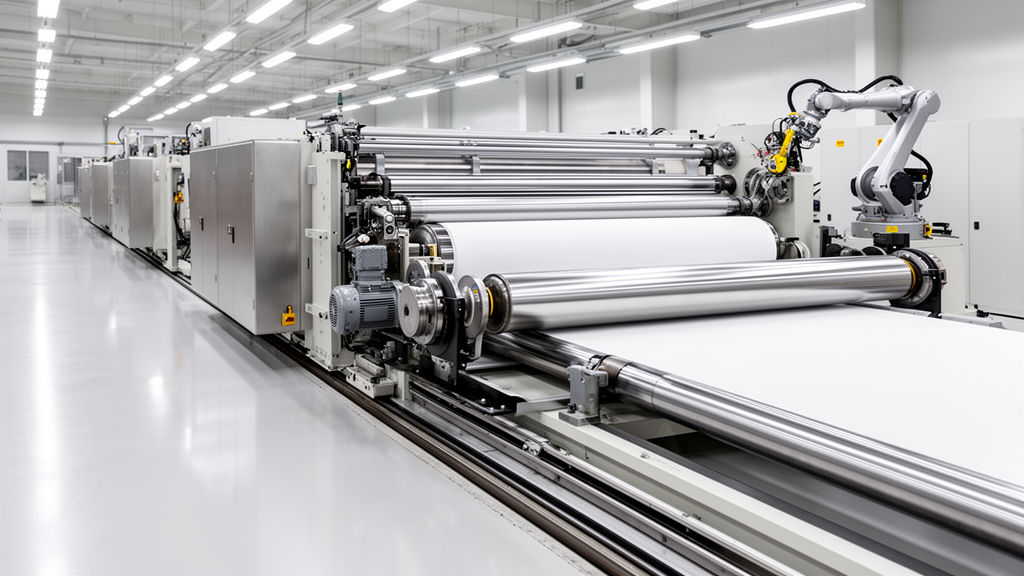
Automated Slitter Machine Docking Reduces Defect Alignment Time by 73 Percent

Automated Slitter Machine Docking Reduces Defect Alignment Time by 73 Percent

Share on FacebookShare on TwitterShare on LinkedinShare on RedditShare on Telegram

An automated docking system designed for industrial slitter machines reduced average docking duration to 12.3 seconds, representing a 73.1 percent decrease compared to manual procedures while achieving a mean docking error of 12.7 millimeters, according to findings from physical industrial experiments. The evaluation confirmed that the engineered platform successfully satisfied every hard real-time operational constraint across varying defect quantities and differing film thicknesses during continuous manufacturing trials.

The investigation addressed the operational demands of processing aluminum-plastic film, a material experiencing heightened industrial utilization alongside the rapid expansion of new energy electric vehicles. In commercial production environments, slitter machines perform critical cutting and treatment functions on rolls of aluminum-plastic film that contain localized defect spots. Automating the mechanical docking sequence targets the elimination of intensive manual labor previously required to align and treat these defective sections.

Constructed within the formal framework of Cyber-Physical Systems, the automation architecture specifically manages defect spot treatment across complex fabrication lines. To resolve defect omission failures that frequently arise when standard first-in-first-out scheduling operates across multiple observation areas, the researchers formulated a novel first-in-last-out task stack algorithm.

To maintain rigorous structural modularity and strict separation of concerns throughout the cyber-physical control architecture, the complete mechanism was systematically decomposed into ten loosely coupled timed automata templates.

The design team conducted formal verification of the control architecture using the UPPAAL verification tool suite to guarantee operational safety prior to deployment. The automated model checking verified critical system properties, encompassing complete freedom from deadlocks, mutual exclusion across active servo modes, and the deterministic ordering correctness of the task stack. All formal verification procedures for these core system properties were completed comprehensively within 33 seconds.

To bridge the theoretical formalisms with working shop-floor machinery, the authors established an exact one-to-one correspondence between the verified timed automata models and their operational Python software implementation. The developers made the complete software source code publicly accessible to enable direct reproducibility and practical deployment. In physical shop trials, the resulting 12.7-millimeter mean positioning error corresponded to 33 percent of typical manual operational error, delivering a validated model-driven framework connecting formal verification directly to physical manufacturing execution.

Subject of Research: Automated slitter machine docking for industrial defect spot management

Article Title: Systematic design of automatic docking function for a slitter machine using timed automata

Article References: Ouyang, Z., & Wang, H. (2027). Systematic design of automatic docking function for a slitter machine using timed automata. Cluster Computing, 30(1), Article 55. https://doi.org/10.1007/s10586-026-06817-z

Image Credits: AI Generated

DOI: 10.1007/s10586-026-06817-z

Keywords: slitter machines, automatic docking, timed automata, cyber-physical systems, aluminum-plastic film, defect spot management, first-in-last-out algorithm, task stack scheduling, UPPAAL verification, deadlock freedom, servo mode mutual exclusion, stack ordering correctness, model-driven engineering, hard real-time systems, industrial automation, electric vehicle materials, Python implementation

News Source: Denise Maddox. (November 20, 2026). Automated Slitter Machine Docking Reduces Defect Alignment Time by 73 Percent. Scienmag.
Tags: aluminum-plastic filmautomatic dockingcyber-physical systemsdeadlock freedomdefect spot managementelectric vehicle materialsfirst-in-last-out algorithmhard real-time systemsIndustrial automationmodel-driven engineeringPython implementationservo mode mutual exclusionslitter machinesstack ordering correctnesstask stack schedulingTimed automataUPPAAL verification
Share12Tweet7Share2ShareShareShare1

Related Posts

Strut-and-Tie Model Accurately Predicts Flexural Capacity of Prefabricated Bridge Wet Joints

Strut-and-Tie Model Accurately Predicts Flexural Capacity of Prefabricated Bridge Wet Joints

November 22, 2026
Precast Concrete Shear Walls with UHPC Boundary Connections Improve Seismic Performance

Precast Concrete Shear Walls with UHPC Boundary Connections Improve Seismic Performance

November 21, 2026

Portable Raman Spectroscopy Screens Microbial Carotenoids for Solar Cell Fabrication

November 21, 2026

New Unified Contraction Framework Establishes Fixed Point Results in Metric Spaces

November 21, 2026

POPULAR NEWS

  • Exfoliated Dual-Ligand Cobalt and Nickel Nanosheets Boost Photoelectrocatalytic Water Oxidation

    Exfoliated Dual-Ligand Cobalt and Nickel Nanosheets Boost Photoelectrocatalytic Water Oxidation

    29 shares
    Share 12 Tweet 7
  • Strut-and-Tie Model Accurately Predicts Flexural Capacity of Prefabricated Bridge Wet Joints

    29 shares
    Share 12 Tweet 7
  • Helicobacter pylori Drives Gastric Tissue Remodeling Through Stromal Immune Signaling Cascade

    29 shares
    Share 12 Tweet 7
  • Illness Perceptions Drive Student Self-Medication in Semi-Rural Nigerian University Study

    29 shares
    Share 12 Tweet 7

About

We bring you the latest biotechnology news from best research centers and universities around the world. Check our website.

Follow us

Recent News

Depression and Parkinson’s Associated With Greatest Quality of Life Reductions in Finland

Ugandan Parasite Surveillance Shows Complex Expansion of Pyrimethamine Resistance Mutation

Dual Immunotherapy Before Surgery Boosts T Cells in Recurrent Glioblastoma

Subscribe to Blog via Email

Enter your email address to subscribe to this blog and receive notifications of new posts by email.

Join 89 other subscribers
  • Contact Us

Bioengineer.org © Copyright 2023 All Rights Reserved.

Welcome Back!

Login to your account below

Forgotten Password?

Retrieve your password

Please enter your username or email address to reset your password.

Log In
No Result
View All Result
  • Homepages
    • Home Page 1
    • Home Page 2
  • News
  • National
  • Business
  • Health
  • Lifestyle
  • Science

Bioengineer.org © Copyright 2023 All Rights Reserved.