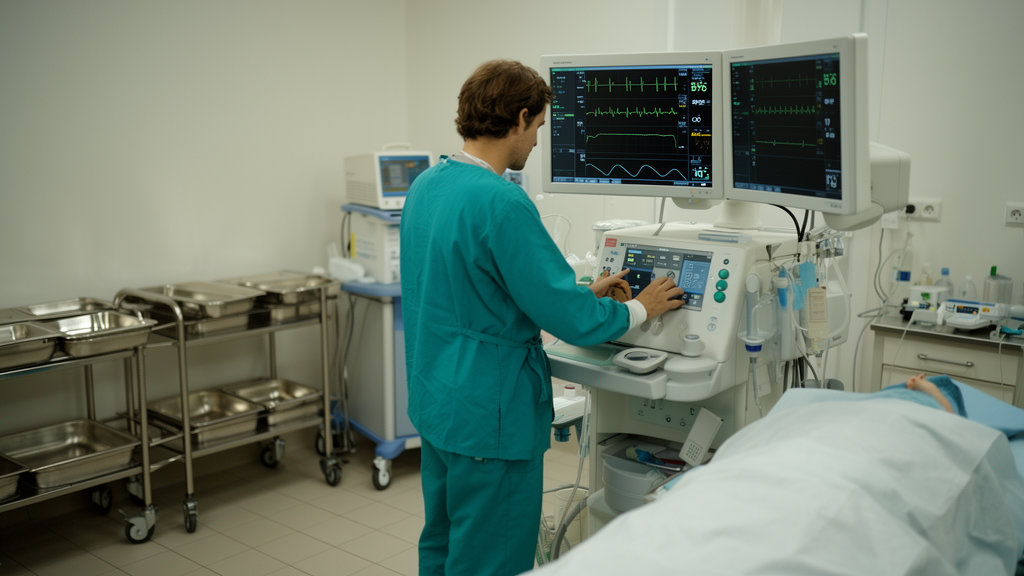
In a correspondence published in Anesthesiology and Perioperative Science, researchers Fredericus H. J. van Loon, Menno A. de Wilde, and Angelique T. M. Dierick-van Daele evaluated the future of automated anesthesia, responding to a comprehensive review by Xiuding Cai and colleagues. The authors observed that while intelligent closed-loop platforms powered by artificial intelligence and advanced physiological modeling hold considerable promise for personalizing and improving perioperative care, widespread clinical deployment cannot succeed without resolving critical technical, regulatory, and ethical challenges.
Data collection plays a central role in contemporary anesthesiological care, combining real-time surgical monitoring of physiological signals with preoperative diagnostic findings and imaging. The authors noted that processing these large data streams through algorithmic tools provides meaningful clinical decision support, particularly by identifying early warning signs of patient deterioration or acute adverse events during procedures.
Despite these analytical capabilities, the researchers argued that professional anesthesiological practice encompasses far more than simply inducing and sustaining controlled states of hypnosis, analgesia, and muscle relaxation. Beyond drug delivery, care provided by physician anesthesiologists and nurse anesthetists represents a dynamic, patient-centered discipline that unites pharmacology, physiology, and clinical judgment to orchestrate complex operating room systems and protect patient safety.
Technological innovations in artificial intelligence-driven closed-loop systems can enhance drug responsiveness while reducing the cognitive workload of clinical teams. Such platforms readily automate repetitive tasks, administrative requirements, and drug titration; however, the authors noted that automated system overviews often overlook the indispensable contributions made by healthcare professionals during clinical delivery.
According to the authors, anesthesiologists and nurse anesthetists deliver a concerned presence by continually responding to the holistic physical and psychological needs of patients. Although automated systems provide operational stability, algorithms and automated devices cannot replace human dimensions such as situational awareness, ethical responsibility, accountability, and clinical intuition.
The correspondence highlighted clinical intuition—frequently manifesting as an experienced sense of worry—as a vital competency enabling practitioners to make rapid assessments based on clinical experience, knowledge, and direct observation. Drawing on findings by Robben and colleagues, the authors emphasized that intuition serves as an essential catalyst for critical thinking, complex problem-solving, and patient advocacy.
Furthermore, recognizing clinical deterioration within the perioperative context cannot rely exclusively on objective measurements such as vital signs. Environmental dynamics, including the immediate physiological repercussions of surgical interventions, are frequently detected and contextualized much earlier by experienced clinicians than by contemporary automated algorithms.
Data-driven anesthesia models also operate under persistent technical limitations that create inherent uncertainty, including incomplete training datasets, measurement noise, dynamic biological complexity, and inter-patient physiological variability. Because real-time clinical constraints make it impossible to eliminate uncertainty completely, the researchers emphasized that models must incorporate transparency, explainability, rigorous validation, and continuous evaluation to prevent the safety risks posed by opaque black-box systems.
As smart operating environments advance, the role of anesthesia practitioners is expected to evolve into a hybrid function that bridges technological mechanisms and bedside care delivery. Clinicians will increasingly integrate clinical acumen with systems thinking, interdisciplinary problem-solving, and close collaboration with engineers, data scientists, ethicists, and policymakers to oversee and validate automated workflows.
The authors concluded that the digital transformation of anesthesia requires an enduring balance between artificial intelligence precision and human clinical expertise. While automated closed-loop systems offer valuable real-time adjustments that reduce complications and clinician strain, safe perioperative outcomes ultimately depend on experienced anesthesia caregivers acting as technology integrators within multidisciplinary patient care.
Examining the foundation of modern anesthesiological monitoring, the correspondence emphasizes that contemporary clinical workflows rely heavily on extensive multi-source data collection. This ongoing data gathering operates across two primary domains: the real-time recording and tracking of patient physiological parameters during surgical procedures, and the comprehensive baseline information compiled preoperatively through diagnostic evaluations and imaging studies. Both the authors of the correspondence and the original review by Xiuding Cai and colleagues agree that routing this substantial stream of clinical information through computational algorithms holds substantial clinical value. When structured effectively, algorithmic data processing provides clinicians with timely decision support, offering particular utility in identifying adverse events or subtle signs of clinical deterioration at an early stage before such complications escalate into acute surgical crises.
Beyond data processing, the correspondence addresses the definition and conceptual scope of anesthesiological practice, disputing narrow depictions of the discipline that reduce it to pharmacological sedation. Fredericus H. J. van Loon, Menno A. de Wilde, and Angelique T. M. Dierick-van Daele observe that professional practice extends significantly further than merely inducing and sustaining controlled physiological states such as unconsciousness or hypnosis, analgesia for pain relief, and neuromuscular blockade or muscle relaxation. Instead of functioning solely as administrators of anesthetic agents, physician anesthesiologists and nurse anesthetists engage in the medical specialty dedicated to the systematic study and practice of anesthesia and perioperative medicine. The authors define this care as a dynamic, patient-centered enterprise that synthesizes pharmacology, physiological science, and clinical judgment to protect patient comfort and physiological stability during operative and invasive interventions.
While acknowledging the technological utility of artificial intelligence, the authors examine the distinct division of labor between algorithmic closed-loop platforms and human clinicians. Automated systems excel at handling predictable operational functions, including the continuous titration of anesthetic drugs, the execution of repetitive clinical actions, and the completion of necessary administrative tasks. By managing these demanding routine duties, automated platforms directly lower the cognitive workload carried by anesthesia teams while enhancing the speed and consistency of drug responsiveness. Nevertheless, the authors emphasize that technological overviews frequently fail to articulate the unique contributions of clinical practitioners, who provide an ongoing concerned presence that addresses the combined physical and psychological needs of patients throughout the perioperative experience. Although closed-loop devices ensure consistent mechanical stability, they remain incapable of replacing essential human attributes, including ethical responsibility, situational awareness, accountability, and clinical intuition.
The correspondence places particular emphasis on clinical intuition, characterizing it alongside a professional sense of worry as an indispensable competency developed through clinical practice. The authors describe intuition as the learned capacity of experienced clinicians to formulate rapid clinical judgments and assessments by synthesizing experiential memory, medical knowledge, and real-time bedside observations. Citing prior work by Robben and colleagues, the commentary highlights how this intuitive worry functions as a primary catalyst for rigorous critical thinking, structured clinical problem-solving, and decisive patient advocacy. Within acute perioperative environments, recognizing patient instability cannot depend exclusively on objective digital metrics and physiological parameters. Instead, complex environmental circumstances, including the immediate physiological consequences of active surgical manipulation, exert a critical influence on patient status. Experienced clinicians consistently detect and interpret these subtle environmental shifts far earlier than current algorithms can, leading Robben and colleagues to argue that healthcare professional intuition must operate directly alongside technological platforms to guide clinical choices.
The technical constraints that govern data-driven modeling in anesthesia receive detailed examination in the letter, which identifies persistent vulnerabilities that generate unavoidable clinical uncertainty. Algorithmic predictions remain vulnerable to incomplete datasets, unaddressed training biases, measurement errors from monitoring equipment, significant variability in individual patient responses, and the profound complexity inherent to living physiological systems. Because biological variability and real-time operational constraints prevent the complete elimination of uncertainty, the authors argue that mathematical models must adhere strictly to established design principles. These mandatory safeguards require developers to ensure transparent system architecture, explainable algorithmic reasoning, rigorous validation across diverse settings, and continuous post-implementation performance evaluation. Clinicians must possess clear insight into how algorithmic predictions are computed and why particular therapeutic recommendations are generated. Without these transparent safeguards, opaque black-box models present grave safety risks in high-stakes perioperative environments.
Looking toward future smart operating environments, the authors consider how technological transformation will alter the professional responsibilities of anesthesiology personnel. As automated tools assume responsibility for routine manual and computational tasks, the healthcare professional serves as the definitive bridge connecting technological capability to actual patient care. This evolution establishes a hybrid clinical role where healthcare professionals merge advanced bedside acumen with technical insight, operating not merely as direct caregivers but as sophisticated systems coordinators. Operating room teams must combine technical proficiency with clinical mastery, utilizing interdisciplinary collaboration, adaptive problem-solving, and systems thinking. By cultivating proactive partnerships with technologists, software engineers, professional ethicists, and healthcare policymakers, anesthesia providers help guide the engineering of resilient clinical architectures. This shared developmental process ensures that practitioners understand and trust the decision-making logic of closed-loop systems, ultimately accelerating their safe acceptance and adoption across institutional practice.
In their assessment of perioperative management, the authors frame technological innovation in anesthesiological care as effectively limitless, anticipating that near-future closed-loop architectures will continuously modulate medication delivery in direct response to real-time physiological and physical feedback. When deployed effectively, these responsive systems have the potential to suppress anesthesia-related complications while substantially elevating operative safety and patient outcomes. However, the commentary insists that comprehensive anesthesiological care requires holistic, multidisciplinary patient management extending across the entire surgical continuum. Safe and patient-centered recovery relies on the careful coordination of anesthesia, nursing, and surgical interventions through every phase of treatment. Because algorithms and robotic machinery cannot reproduce this broad collaborative coordination, clinical progress within the specialty demands the active participation of knowledgeable and experienced clinicians who comprehend the future of the discipline.
Synthesizing their perspective in the summary illustration generated with Google NotebookLM, the authors reaffirm that the development of automated anesthesia requires an enduring balance between artificial intelligence precision and human clinical oversight. Intelligent closed-loop automation offers precise drug control and mitigates clinician exhaustion, yet it must remain anchored by the irreplaceable human capacities of clinical intuition, situational perception, and holistic patient care. The future of the discipline will not displace anesthesiologists and nurse anesthetists, but will instead position them as central technology integrators who bridge computational automation with individualized, compassionate medicine.
Subject of Research: The integration of artificial intelligence and human clinical expertise in automated anesthesia
Article Title: Comment on: “advances in automated anesthesia: a comprehensive review” by “Xiuding Cai”
Article References: van Loon, F. H. J., de Wilde, M. A., & Dierick-van Daele, A. T. M. (2026). Comment on: “advances in automated anesthesia: a comprehensive review” by “Xiuding Cai”. Anesthesiology and Perioperative Science, 4(1), Article 11. https://doi.org/10.1007/s44254-026-00162-5
Image Credits: AI Generated
DOI: 10.1007/s44254-026-00162-5
Keywords: automated anesthesia, closed-loop anesthesia systems, artificial intelligence, perioperative care, clinical intuition, anesthesiological care, physician anesthesiologists, nurse anesthetists, drug titration, physiological monitoring, algorithmic decision support, patient safety, situational awareness, clinical deterioration, black box models, biological variability, model explainability, interdisciplinary collaboration
News Source: Blake Davidson. (November 10, 2026). Automated Anesthesia Systems Require Human Clinical Intuition Alongside Artificial Intelligence. Scienmag.