• HOME
  • NEWS
  • EXPLORE
    • CAREER
      • Companies
      • Jobs
    • EVENTS
    • iGEM
      • News
      • Team
    • PHOTOS
    • VIDEO
    • WIKI
  • BLOG
  • COMMUNITY
    • FACEBOOK
    • INSTAGRAM
    • TWITTER
Thursday, December 25, 2025
BIOENGINEER.ORG
No Result
View All Result
  • Login
  • HOME
  • NEWS
  • EXPLORE
    • CAREER
      • Companies
      • Jobs
        • Lecturer
        • PhD Studentship
        • Postdoc
        • Research Assistant
    • EVENTS
    • iGEM
      • News
      • Team
    • PHOTOS
    • VIDEO
    • WIKI
  • BLOG
  • COMMUNITY
    • FACEBOOK
    • INSTAGRAM
    • TWITTER
  • HOME
  • NEWS
  • EXPLORE
    • CAREER
      • Companies
      • Jobs
        • Lecturer
        • PhD Studentship
        • Postdoc
        • Research Assistant
    • EVENTS
    • iGEM
      • News
      • Team
    • PHOTOS
    • VIDEO
    • WIKI
  • BLOG
  • COMMUNITY
    • FACEBOOK
    • INSTAGRAM
    • TWITTER
No Result
View All Result
Bioengineer.org
No Result
View All Result
Home NEWS Science News Chemistry

Attomolar sensing: Fabrication of surface-enhanced raman scattering substrate

Bioengineer by Bioengineer
September 6, 2025
in Chemistry
Reading Time: 2 mins read
0
IMAGE
Share on FacebookShare on TwitterShare on LinkedinShare on RedditShare on Telegram

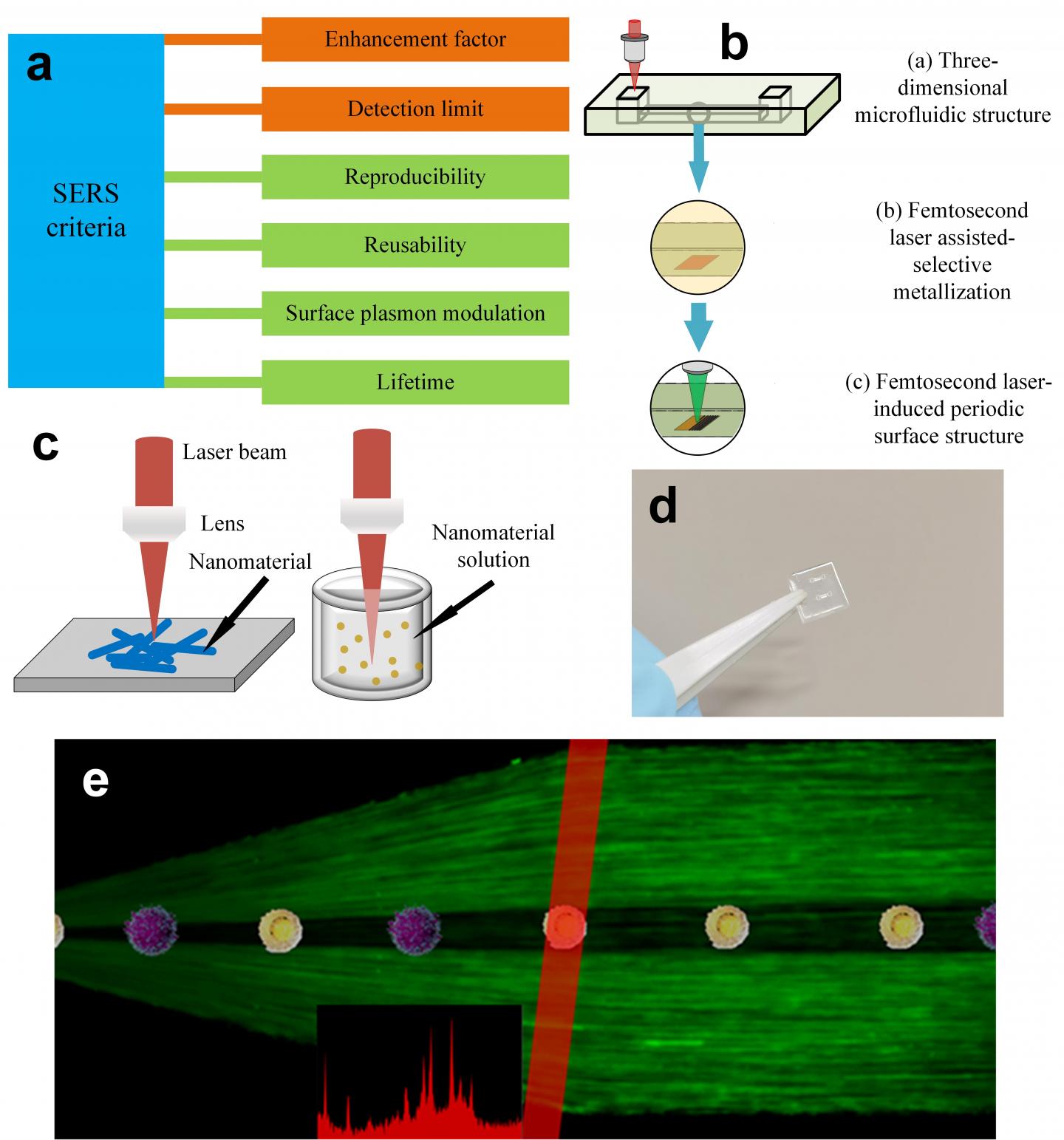
In the 1970s, Fleischmann, the scientist in British, discovered that on noble metallic nanostructure, the Raman scattering of pyridine was enhanced hundreds-hold. Then, the scientists attributed the enhancement to the localized electric field highly amplified near the surface of specific noble metallic nanostructures. Thus, this phenomenon was termed surface-enhanced Raman scattering (SERS). Currently, although the enhancement mechanism of SERS is still in the debate, the SERS exhibits incomparable abilities of monitoring and sensing with high sensitivity in diverse fields including environment, biomedicine, food security, archaeology, soil components. The femtosecond laser processing increasingly attracting attention to be used for fabrication of the SERS substrates due to its versatility, flexibility and high resolution.

In a new paper published in Light Advanced Manufacturing, a team of scientists, led by Prof. Koji Sugioka and Dr. Shi Bai from Advanced Laser Processing Research Team, RIKEN Center for Advanced Photonics, RIKEN, Japan reviewed the fabrication methods of highly sensitive SERS substrates by femtosecond laser processing and their applications. The paper firstly gave the commonly used criteria for evaluation of SERS substrates and summarized the calculation methods of enhancement factor. The typical technologies of femtosecond laser processing for the fabrication of SERS substrates were then introduced. To realize the attomolar sensing with the SERS substrates, the authors highlighted the several strategies employing synergistic enhancement effects. Additionally, the recent applications of SERS for real-time sensing based on microfluidic chips and biomedicine including cell recognition, deoxyribonucleic acid and protein identification were introduced. The authors have concluded that further efforts for not only developing the next generation of SERS substrates with higher enhancement and lower detection limits but also overcoming unresolved issues such as a universal method for calculating the enhancement factor and the stability and robustness of SERS substrates will continue.

###

Media Contact
Koji Sugioka
[email protected]

Related Journal Article

http://dx.doi.org/10.37188/lam.2021.013

Tags: Attomolar sensingChemistry/Physics/Materials SciencesEnhanced spectroscopy techniquesFemtosecond laser processingNanostructured substratesOpticsSurface-enhanced Raman scattering (SERS)
Share12Tweet8Share2ShareShareShare2

Related Posts

Cutting Electrolyte Reduction Boosts High-Energy Battery Performance

Cutting Electrolyte Reduction Boosts High-Energy Battery Performance

December 19, 2025
Microenvironment Shapes Gold-Catalysed CO2 Electroreduction

Microenvironment Shapes Gold-Catalysed CO2 Electroreduction

December 11, 2025

Photoswitchable Olefins Enable Controlled Polymerization

December 11, 2025

Cation Hydration Entropy Controls Chloride Ion Diffusion

December 10, 2025
Please login to join discussion

POPULAR NEWS

  • Nurses’ Views on Online Learning: Effects on Performance

    Nurses’ Views on Online Learning: Effects on Performance

    70 shares
    Share 28 Tweet 18
  • NSF funds machine-learning research at UNO and UNL to study energy requirements of walking in older adults

    71 shares
    Share 28 Tweet 18
  • Unraveling Levofloxacin’s Impact on Brain Function

    54 shares
    Share 22 Tweet 14
  • Exploring Audiology Accessibility in Johannesburg, South Africa

    51 shares
    Share 20 Tweet 13

About

We bring you the latest biotechnology news from best research centers and universities around the world. Check our website.

Follow us

Recent News

Genes, Environment Shape Weight Gain Across Lifespan

Engineered Vesicles Boost Oral Antibiotic Efficiency, Gut Health

MEI1 Variants Linked to Female Infertility and Embryo Issues

Subscribe to Blog via Email

Success! An email was just sent to confirm your subscription. Please find the email now and click 'Confirm' to start subscribing.

Join 70 other subscribers
  • Contact Us

Bioengineer.org © Copyright 2023 All Rights Reserved.

Welcome Back!

Login to your account below

Forgotten Password?

Retrieve your password

Please enter your username or email address to reset your password.

Log In
No Result
View All Result
  • Homepages
    • Home Page 1
    • Home Page 2
  • News
  • National
  • Business
  • Health
  • Lifestyle
  • Science

Bioengineer.org © Copyright 2023 All Rights Reserved.